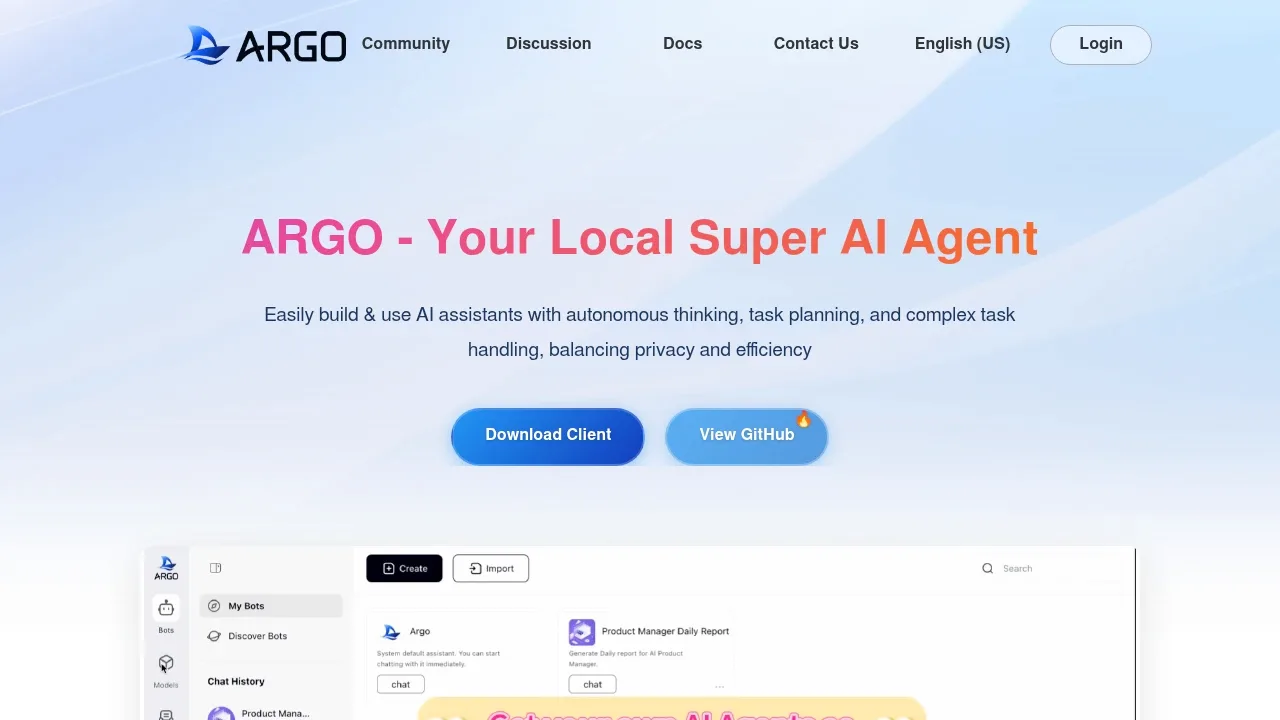
ARGO is a local AI agent platform for people who want assistants that can research a topic, work with their documents and carry out tasks with several steps. It runs on Windows, macOS and Linux, including Intel and Apple Silicon Macs, or through Docker. You can create specialized assistants by describing their role in plain language.
Its research engine uses multiple agents to break a request into steps, call tools and produce reports. You can revise a research plan in natural language before execution. Built-in tools cover web search, scraping, browser control and local file management; MCP support lets assistants use additional tools.
The local knowledge base accepts files, folders and websites. It reads PDFs, Office documents, Markdown and plain text, keeps linked folders synchronized, and traces answers to reference passages. For complex questions, it breaks the query into smaller parts and checks whether it has enough information to answer.
ARGO works with Ollama and GGUF models from Hugging Face. It also connects to OpenAI, Claude, DeepSeek and services with an OpenAI-compatible API, with model switching available during a conversation. Local operation supports offline use and keeps stored data on your machine. Choosing a cloud model sends requests to that provider, while web research needs internet access.
The stated minimum hardware is a four-core CPU and 8 GB of RAM. Docker deployments can use NVIDIA CUDA with the NVIDIA container toolkit.
Claim this page with an email at xark-argo.com. ARGO gets the verified badge, and you can upgrade the listing to be featured on localhosted. Proud to be listed? Put our badge on your site.
Want more people to find ARGO?Promote it
Something wrong or outdated on this page?
1.7KUpdated 3 days ago
macOS · Windows · Linux · iOS · Android · Web#Agent Skills#Code execution#Human approval
Halo puts Claude Code and Codex in a visual desktop app for people who want AI agents to work with files, write code and handle recurring tasks. It runs on macOS, including Intel and Apple Silicon, Windows and Linux. The desktop app doesn't require a separate backend server. Model access uses Anthropic, OpenAI, DeepSeek or compatible APIs, so running the app locally doesn't make those services offline.
4.1KUpdated 4 days agoAGPL-3.0
macOS · Windows · Linux · iOS · Android#Agent Skills#Code execution#Human approval
18.2KUpdated 5 months agoApache-2.0
macOS · Windows · Linux · Docker · Web#Guardrails#Human approval#Knowledge graphs
2Updated 6 days agoMIT
macOS · Windows · Linux · Docker · Web#Code execution#MCP#Multi-agent workflows
3.3KUpdated 1 day agoMIT
macOS#GGUF#llama.cpp backend#OpenAI-compatible API
66.6KUpdated 13 hours agoMIT
macOS · Windows · Linux · Android · Docker · Web#LM Studio integration#MCP#Multimodal input
Kelivo is a free, open-source LLM chat client for people who want to use local and cloud models in the same app while keeping their conversation history on their own device. It connects to Ollama, self-hosted OpenAI-compatible endpoints, and providers such as OpenAI, Gemini, Claude, DeepSeek and OpenRouter. The app runs on Android, iOS, HarmonyOS, Windows, macOS and Linux, including Apple Silicon and Intel Macs.
OpenFang runs scheduled AI agents on your own machine, with built-in task packages called Hands that report results to a dashboard. It's for people who want recurring research, monitoring or business tasks to continue without prompting an agent each time. The open source platform runs on macOS, Windows and Linux under the Apache 2.0 license.
RemiAI is a self-hosted AI assistant for people who want chat to work directly with their files and carry context between conversations. It can read and edit folders you permit, extract text from PDFs and office documents, and track file changes. Persistent memory stores facts and preferences across chats, with controls to review and delete them.
Sidekick is a native macOS app for people who want AI chat grounded in their own documents and research materials. Its built-in llama.cpp engine runs GGUF models such as Qwen3.5 without separate model software. Local conversations work offline. The app is open source under the MIT license and requires an Apple Silicon Mac with at least 8 GB of RAM.
AnythingLLM is an open source AI assistant for people who want to chat with their documents and use AI agents on their own hardware. The desktop app runs on Windows, macOS and Linux, while a Docker deployment supports multiple users on a self-hosted server. No account is required for the desktop app.