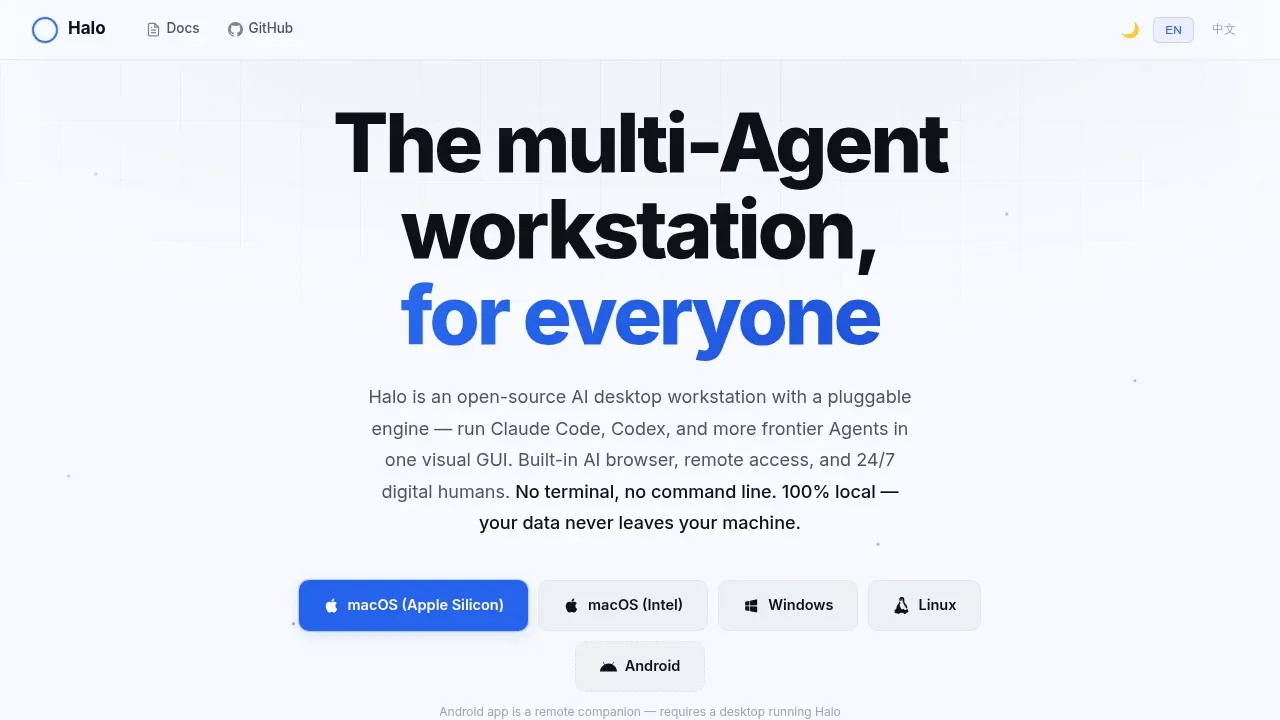
Halo puts Claude Code and Codex in a visual desktop app for people who want AI agents to work with files, write code and handle recurring tasks. It runs on macOS, including Intel and Apple Silicon, Windows and Linux. The desktop app doesn't require a separate backend server. Model access uses Anthropic, OpenAI, DeepSeek or compatible APIs, so running the app locally doesn't make those services offline.
Its pluggable engine lets you switch agents while keeping the same interface. Project spaces separate conversation context and settings, while file previews, image viewing and live output help you inspect the work. A built-in terminal lets agents use command-line tools and SSH, with visible sessions you can take over manually.
For recurring work, Halo has autonomous agents called Digital Humans. They run on schedules or respond to events, retain memory between runs, and handle jobs such as monitoring, report generation and web scraping. You can manage their MCP and Skill permissions visually.
The embedded browser can fill forms and automate web tasks. Reusable Browser Actions let the AI choose a task while a script handles the specific operation. A knowledge base lets agents reference PDFs, presentations, Markdown files and text extracted from images.
Remote access lets you review outputs and give instructions from another device through a browser. WeCom and WeChat also provide agent control. The mobile apps are remote companions and require a desktop running Halo. Android has an APK; iOS requires building from source.
Claim this page with an email at hello-halo.cc. Halo gets the verified badge, and you can upgrade the listing to be featured on localhosted. Proud to be listed? Put our badge on your site.
Want more people to find Halo?Promote it
Something wrong or outdated on this page?
827Updated 9 months ago
macOS · Windows · Linux · Docker#GGUF#Human approval#MCP
ARGO is a local AI agent platform for people who want assistants that can research a topic, work with their documents and carry out tasks with several steps. It runs on Windows, macOS and Linux, including Intel and Apple Silicon Macs, or through Docker. You can create specialized assistants by describing their role in plain language.
2.4KUpdated 18 hours agoMIT
macOS · Windows · Linux · Web#Agent Client Protocol#Agent Skills#Code execution
2Updated 6 days agoMIT
macOS · Windows · Linux · Docker · Web#Code execution#MCP#Multi-agent workflows
467Updated 9 hours agoMIT
macOS · Windows#Agent Skills#Code execution#Human approval
169Updated 3 months agoMIT
macOS · Windows#Agent Skills#Code execution#Git integration
66.6KUpdated 13 hours agoMIT
macOS · Windows · Linux · Android · Docker · Web#LM Studio integration#MCP#Multimodal input
OpenBitFun is an open-source AI agent workspace for coding and work that involves desktop apps, remote hosts or custom tools. Its desktop application runs on Windows, macOS, Linux and HarmonyOS under the MIT license. A Rust runtime supports persistent sessions, interruption recovery and long-term memory for tasks that continue across sessions.
RemiAI is a self-hosted AI assistant for people who want chat to work directly with their files and carry context between conversations. It can read and edit folders you permit, extract text from PDFs and office documents, and track file changes. Persistent memory stores facts and preferences across chats, with controls to review and delete them.
CoWork OS is a local-first AI agent desktop for developers and people who work with documents, research and email. It brings agent tasks, files, terminals and browser work into one workspace, with visible actions and approval controls. The app is open source under the MIT license, and runs on macOS and Windows.
Selene is an MIT-licensed desktop app for macOS and Windows that combines AI agents with coding, browser tasks and personal assistants. It supports fully offline use with local models, plus connections to WhatsApp, Telegram, Slack and Discord for interacting with agents through messaging apps.
AnythingLLM is an open source AI assistant for people who want to chat with their documents and use AI agents on their own hardware. The desktop app runs on Windows, macOS and Linux, while a Docker deployment supports multiple users on a self-hosted server. No account is required for the desktop app.