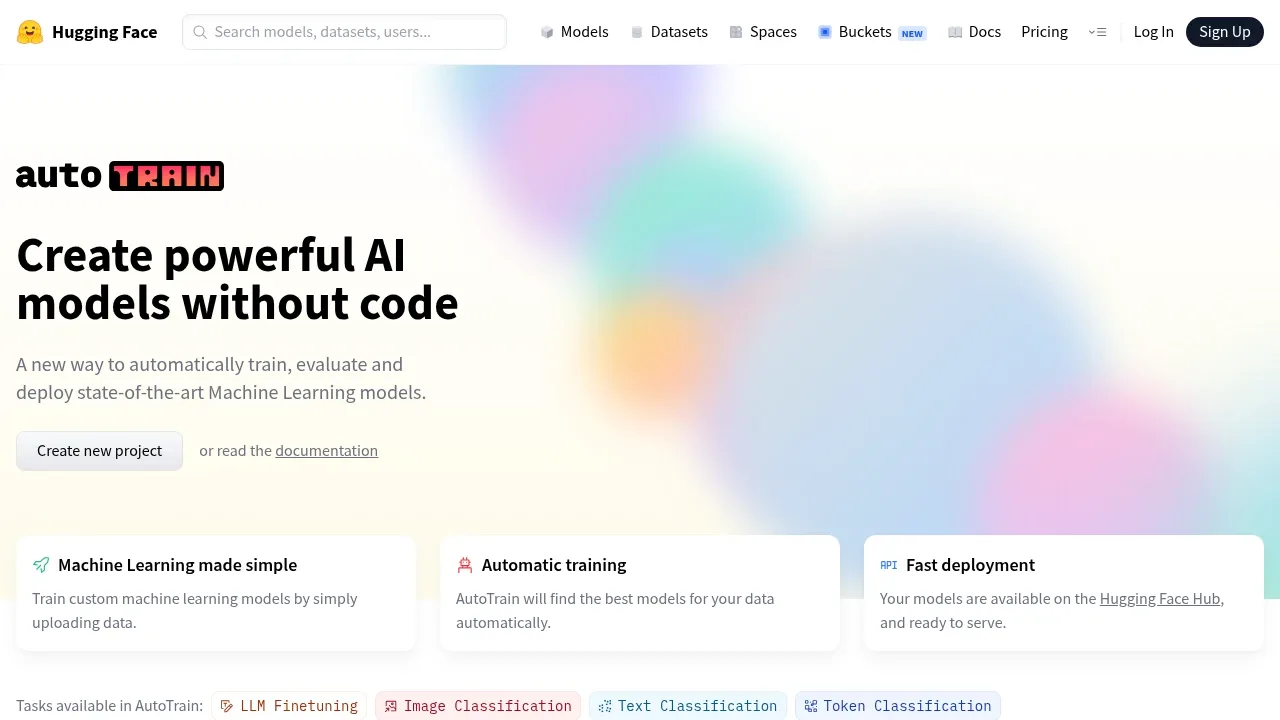
AutoTrain trains custom machine learning models from your own data through a no-code interface. It's for people who need to fine-tune an LLM or build a classifier without writing a training pipeline. The local AutoTrain Advanced project is no longer maintained, so it won't receive bug fixes or new features.
The software is open source under Apache-2.0. You can run training on your own hardware or infrastructure, or use Hugging Face Spaces. The interface also runs on Colab. With the hosted service, training data stays on Hugging Face's servers, private to your account, and transfers use encryption.
AutoTrain covers several kinds of model training:
Automatic model selection is part of the hosted offering: AutoTrain chooses models for the uploaded data, then trains and evaluates them. Its Hugging Face integration makes trained models available on the Hub for serving. Language support follows the models available there.
Training data needs to match the task's expected format. AutoTrain accepts CSV, TSV, JSON, or ZIP files, depending on what you're training.
Claim this page and we'll verify you by hand. AutoTrain gets the verified badge, and you can upgrade the listing to be featured on localhosted. Proud to be listed? Put our badge on your site.
Want more people to find AutoTrain?Promote it
Something wrong or outdated on this page?
12.2KUpdated 3 days agoMIT
macOS · Windows · Linux · Web#Hugging Face integration#Image-to-image#LoRA
AI Toolkit (ostris) is an MIT-licensed training suite for people who want to fine-tune image and video models on their own hardware or a self-hosted server. It targets consumer NVIDIA GPUs and runs on Linux and Windows, including ARM64 Linux systems such as DGX Spark. An experimental installer also supports Apple Silicon Macs. GPU memory needs depend on the model and training task.
15.8KUpdated 2 days agoApache-2.0
Web#Distributed execution#Hugging Face integration#LoRA
15.9KUpdated 1 month agoApache-2.0
Web#MLX#Multi-user access
Kubeflow is a self-hosted AI platform for teams that run machine learning workloads on Kubernetes. It brings model development, training and production workflows into a modular stack that can run on a local laptop, on-premises infrastructure or a cloud Kubernetes cluster. It's open source under Apache 2.0.
75.2KUpdated 2 days agoApache-2.0
Web#LoRA#Multimodal input#OpenAI-compatible API
12.5KUpdated 2 days agoApache-2.0
Docker#Distributed execution#Hugging Face integration#LoRA
1.1KUpdated 2 years agoMIT
#Hugging Face integration#LoRA#Quantization
ms-swift is a Python framework for developers and researchers who want to train and deploy language or multimodal models on their own hardware. It brings fine-tuning, evaluation and model serving into one project, with support for Qwen3, DeepSeek-R1, Llama4 and Mistral, plus multimodal models such as Qwen3-VL and InternVL3.5. It's open source under Apache 2.0.
LLaMA-Factory is an open-source framework for developers and researchers who want to adapt language and multimodal models on their own hardware. It brings training and inference into one toolkit, with support for LLaMA, Qwen3, Qwen3-VL, DeepSeek, Gemma, Mistral and LLaVA. Its license is Apache 2.0.
Axolotl is an open-source LLM fine-tuning framework for developers, researchers, and teams training models on their own data. It runs on local hardware or cloud infrastructure you control, including Docker and Kubernetes environments. The framework uses Apache 2.0, which permits commercial use.
DataDreamer connects LLM prompting, synthetic data generation, and model training in one Python library. It's for researchers and developers who want to build datasets and use them to fine-tune or align models in reproducible workflows. The library is open source under the MIT license.