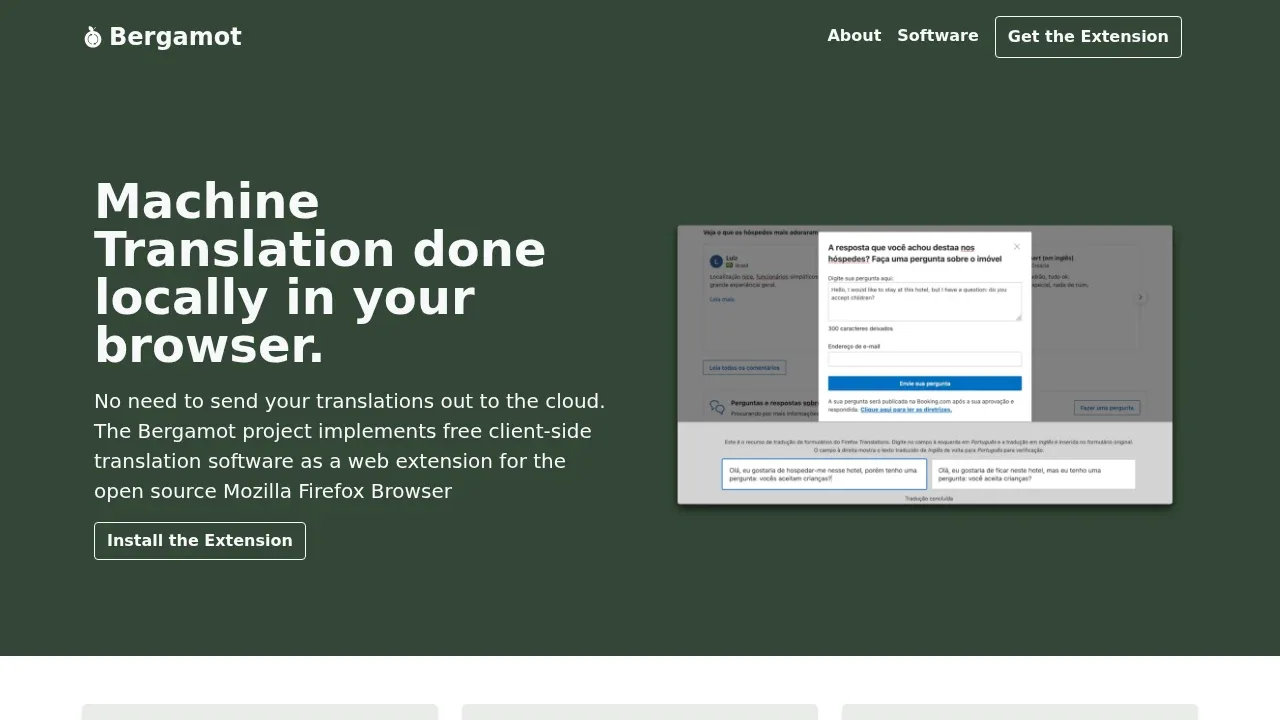
Bergamot Translator is a C++ library for running neural machine translation on your own device. Developers can integrate it into native applications or build it for WebAssembly. Separate browser integrations, such as the TranslateLocally extension, make the engine accessible to end users. The software is free and open source under the Mozilla Public License 2.0.
Translation happens locally. The text you translate never goes to a third party, so a translation provider doesn't receive it or learn your viewing history from those requests. Bergamot optimizes its machine learning for consumer hardware, with local processing as part of its design.
The project supports Bulgarian, Czech, English, Estonian, French, Polish and Spanish. Support for translating Icelandic and Norwegian into English is limited. The Firefox extension is the browser-facing option for people who want to use translation without building an application around the library.
For developers, Bergamot provides a cross-platform C++ library based on the Marian NMT framework. Its unified API exposes neural translation functionality for integration into other projects. Native builds support applications outside the browser, while a WebAssembly build makes the translator available to JavaScript applications. The project also publishes translation models and open-source training utilities for developers and researchers.
Claim this page with an email at browser.mt. Bergamot Translator gets the verified badge, and you can upgrade the listing to be featured on localhosted. Proud to be listed? Put our badge on your site.
Want more people to find Bergamot Translator?Promote it
Something wrong or outdated on this page?
21.1KUpdated 2 days agoApache-2.0
macOS · Web#GGUF#Hugging Face integration#Multilingual
Candle is a Rust machine learning framework for developers who want to embed local AI in applications or deploy models on their own servers. It produces lightweight binaries that don't need Python in production, making it a candidate for serverless inference where a large runtime can slow startup. Its API uses tensor operations familiar to PyTorch developers.
1.1KUpdated 7 months agoAGPL-3.0
Web · Browser Extension#Multilingual#Multimodal input#Ollama integration
16.3KUpdated 1 week agoApache-2.0
Web#Hugging Face integration#Image-to-image#Multilingual
631Updated 2 years agoMIT
macOS · Windows · Linux · Web · Browser Extension#Batch processing#Multilingual#Quantization
5.1KUpdated 20 hours ago
macOS · Windows · Linux · iOS · Android · Web#MLX#Multimodal input#OpenAI-compatible API
ExecuTorch is PyTorch's runtime for developers building AI into mobile apps, desktop software and embedded devices. It runs models on the user's hardware, with support for Android, iOS, Linux, macOS and Windows, as well as microcontrollers. Developers can reuse a PyTorch model across targets, though hardware-specific deployments need their own exported model files.
3.5KUpdated 19 hours agoApache-2.0
macOS · Windows · Linux · iOS · Android · Web#Agent Skills#Hugging Face integration#Multimodal input
NativeMind brings a local AI assistant into Chrome for people who want help with webpages, documents, and writing without sending that content to a cloud model. The browser extension connects to Ollama on your machine, keeping prompts and AI processing on-device. It requires no account and uses the AGPL-3.0 open-source license.
Transformers.js is a JavaScript library for developers building web apps that run AI models on the user's device. Inference happens in the browser, so an app doesn't need a separate model server to process its inputs. The library is open source under Apache 2.0.
TranslateLocally is an open source machine translation app for Windows, macOS and Linux. It's for people who want to translate text on their own device, including those handling material they don't want to send to a remote translation service. The desktop app has an MIT license and uses Marian and Bergamot translation models.
LiteRT is Google's open-source framework for developers building AI into apps that run on users' own devices. It succeeds TensorFlow Lite and covers model conversion, optimization and local inference. It's licensed under Apache 2.0.