ClearML is an MLOps suite for recording experiments, managing datasets and running ML workloads. Its Apache 2.0 Python SDK connects to a ClearML Server, available as a hosted service or open-source software you deploy yourself. ClearML Agent handles job orchestration and reproducibility.
The experiment manager records source-control information, local code changes, package versions and parameters. It captures console output, resource use, model snapshots and artifacts, with support for TensorBoard, Matplotlib and Seaborn output.
Automation tools turn experiments into remote jobs and pipelines. Dataset tools version data in S3, Google Cloud Storage, Azure or NAS. Additional modules provide remote JupyterLab and VSCode-server sessions and model serving backed by NVIDIA Triton.
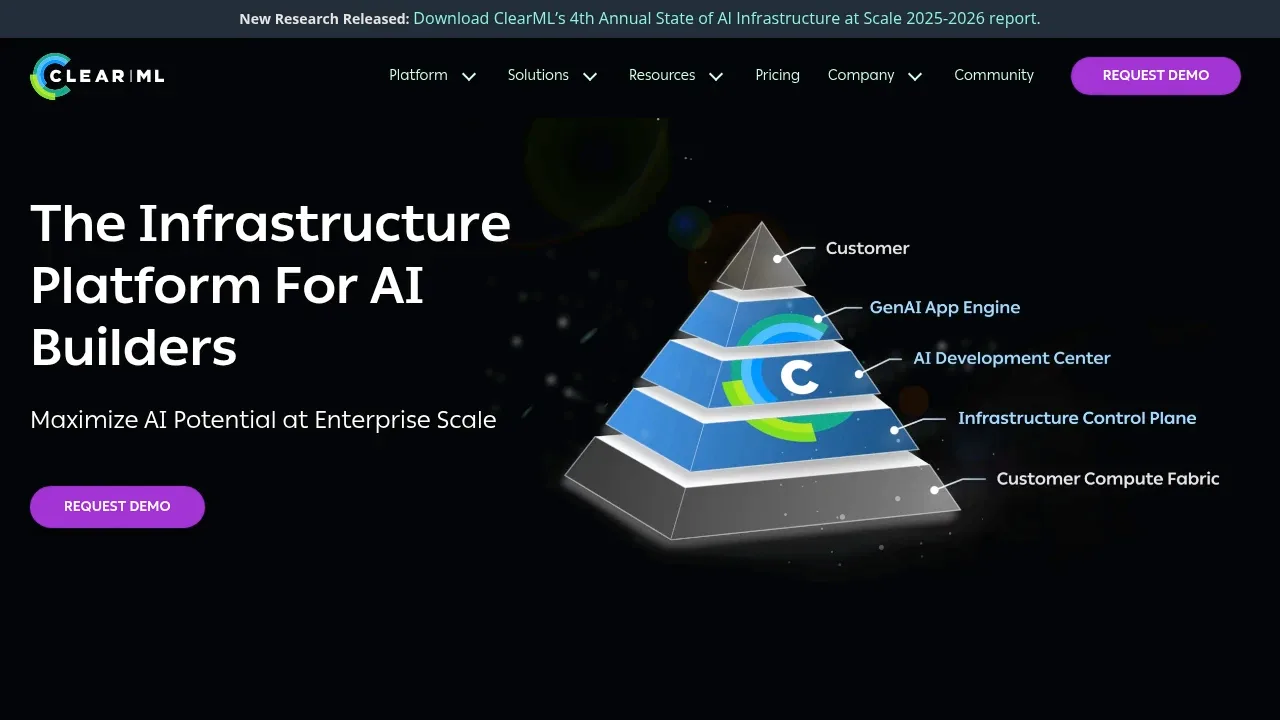
ClearML also markets an enterprise infrastructure platform for on-premises, cloud and hybrid clusters. Its advertised controls include tenant isolation, role-based access, GPU allocation and a GenAI App Engine for deploying LLM APIs. These commercial platform capabilities are separate from the Apache 2.0 SDK and open-source server; check the required edition when planning a deployment.
Claim this page with an email at clear.ml. ClearML gets the verified badge, and you can upgrade the listing to be featured on localhosted. Proud to be listed? Put our badge on your site.
Want more people to find ClearML?Promote it
Something wrong or outdated on this page?
1KUpdated 7 days ago
#Distributed execution#Hugging Face integration#LoRA
Kaito manages self-hosted LLM inference, fine-tuning, and document retrieval services in a Kubernetes cluster. It's for teams that want to run models on infrastructure they control while reducing the work of sizing GPU resources and managing model deployments. The project is open source under Apache 2.0.
2.3KUpdated 1 day agoMPL-2.0
macOS · Windows · Linux · Docker#Agent Skills#Batch processing#Multi-user access
15.9KUpdated 1 month agoApache-2.0
Web#MLX#Multi-user access
Kubeflow is a self-hosted AI platform for teams that run machine learning workloads on Kubernetes. It brings model development, training and production workflows into a modular stack that can run on a local laptop, on-premises infrastructure or a cloud Kubernetes cluster. It's open source under Apache 2.0.
223Updated 16 hours agoApache-2.0
macOS · Linux#GGUF#Git integration#Guardrails
5.1KUpdated 20 hours agoApache-2.0
#Batch processing#Distributed execution#LoRA
8.2KUpdated 20 hours ago
#Distributed execution#Multimodal input#OpenAI-compatible API
dstack is a self-hosted orchestration tool for AI teams managing compute across GPU clouds and their own servers. It puts cluster management, training jobs and model inference behind one interface, so teams can use different providers and accelerators without maintaining a separate workflow for each environment. It's open source under the Mozilla Public License 2.0.
LLMKube is a free, open-source Kubernetes operator for teams and homelab owners running local LLM inference across their own hardware. It manages Linux GPU servers and Apple Silicon Macs together, so a mixed fleet can serve models through the same platform. It uses the Apache 2.0 license.
AIBrix is open-source infrastructure for teams serving large language models on their own Kubernetes clusters. It focuses on the work around inference: directing requests, scaling capacity and managing models across servers. Enterprise infrastructure teams can use its components to build a self-hosted model service. It's licensed under Apache 2.0.
NVIDIA Dynamo is a self-hosted inference framework for teams serving models across multiple GPUs or server nodes. It coordinates SGLang, TensorRT-LLM and vLLM, adding cluster-level scheduling and request routing above those engines. Its focus is large deployments where GPU capacity, response latency and repeated computation affect serving costs.