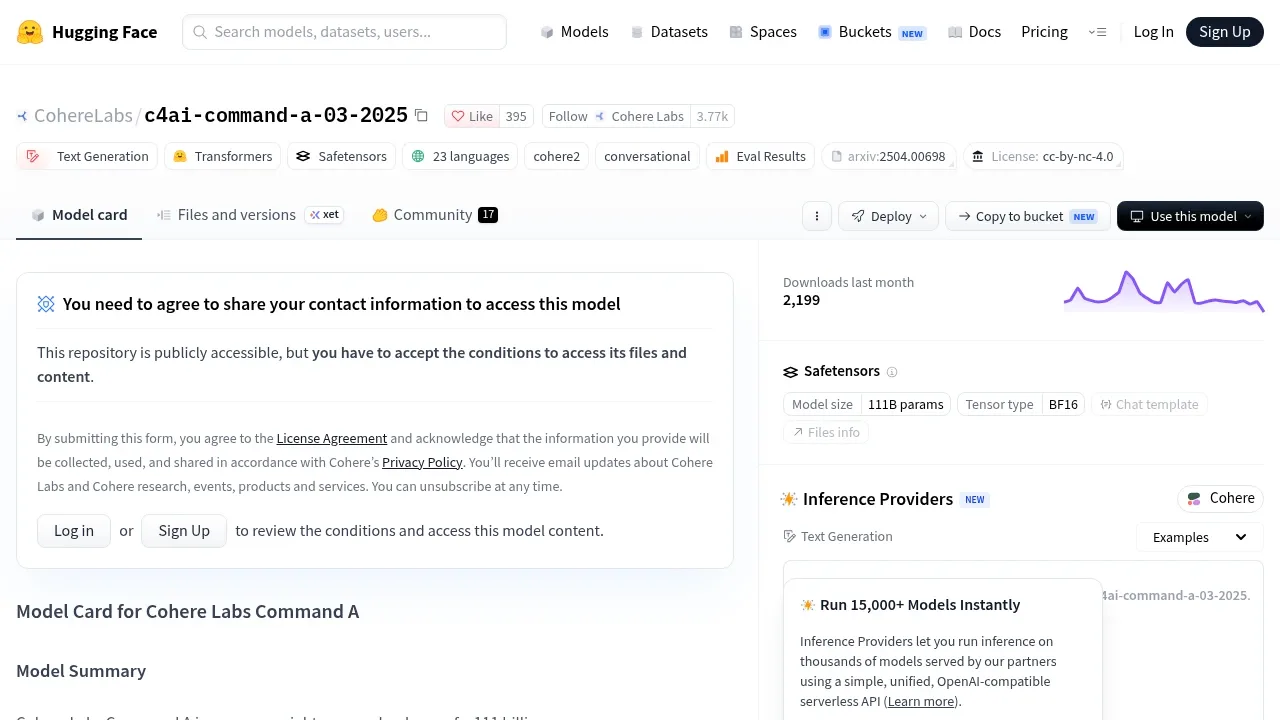
Command A is an open weights language model from Cohere and Cohere Labs for researchers and developers building self-hosted chatbots, document assistants and AI agents. Its focus is business tasks that combine multilingual text, supplied documents and external tools. You can run the model on your own hardware; Cohere also offers hosted chat through a playground and Hugging Face Space.
The model can answer questions using document snippets and cite the passages behind individual claims. It can also call APIs, query databases or use search engines through tools supplied by an application. Citations can point to tool results as well as documents, so readers can check where an answer's details came from.
Beyond conversational replies, Command A handles summarization, information extraction, translation and categorization. Its coding capabilities include SQL generation, code explanations and translation between programming languages. It accepts and produces text, with language coverage that includes English, Arabic, Chinese, Japanese, Ukrainian and Persian.
The weights use Safetensors and work with Hugging Face Transformers. Cohere describes deployment on two GPUs, making this a model for teams with access to substantial GPU hardware. Its long context supports document-heavy tasks. Contextual and strict safety modes provide different restrictions on sensitive content.
The research weights carry the CC-BY-NC-4.0 license and Cohere Labs' Acceptable Use Policy. Access requires a Hugging Face account, acceptance of the terms and sharing contact information with Cohere.
Claim this page and we'll verify you by hand. Command A gets the verified badge, and you can upgrade the listing to be featured on localhosted. Proud to be listed? Put our badge on your site.
Want more people to find Command A?Promote it
Something wrong or outdated on this page?
107Updated 1 year ago
#GGUF#Hugging Face integration#Multilingual
EXAONE 4.0 is a family of language models from LG AI Research that combines general language tasks and complex problem solving in the same model. It's aimed at developers building multilingual AI applications, including on-device apps and agents that use tools. It supports English, Korean and Spanish.
huggingface.coCoding Models
#Hugging Face integration#LoRA#Multilingual
273Updated 2 years agoApache-2.0
Linux#Guardrails#Hugging Face integration#LM Studio integration
3.2KUpdated 1 year agoApache-2.0
#Hugging Face integration#Multilingual#Tool calling
2.1KUpdated 3 weeks agoApache-2.0
Linux#GGUF#Guardrails#Hugging Face integration
3.9KUpdated 1 week agoApache-2.0
#Hugging Face integration#Multilingual#Tool calling
GLM-4.5 is an open-source language model for developers building AI agents and coding tools on their own servers. It combines reasoning with tool calling and offers a choice between thinking mode for complex tasks and non-thinking mode for direct responses. The MIT license permits commercial use and modification.
Granite is IBM's family of open-source AI models for developers and businesses that want to run and customize AI on their own hardware or servers. The language-model repository listed here is archived and no longer maintained. The broader family includes models for language, speech, document understanding and forecasting, released under Apache 2.0 for research and commercial use.
MiniMax-M1 is an open-source reasoning model for developers building agents or working on complex software and mathematical problems. Its million-token context window makes it a candidate for tasks with long inputs that also need extended reasoning. You can serve the model on your own infrastructure through vLLM or use it through Transformers.
Nemotron is NVIDIA's family of AI models for developers building agents that reason, write code and call tools. You can run models locally for private, offline work or deploy them on your own servers. NVIDIA publishes model weights, training data and recipes so teams can inspect and adapt the models for their applications.
SmolLM3 is a 3B parameter language model from Hugging Face for developers and researchers who want to run an LLM on their own hardware. It comes as a base model and an instruction-tuned model for chat, reasoning and tool calling. Both run locally.