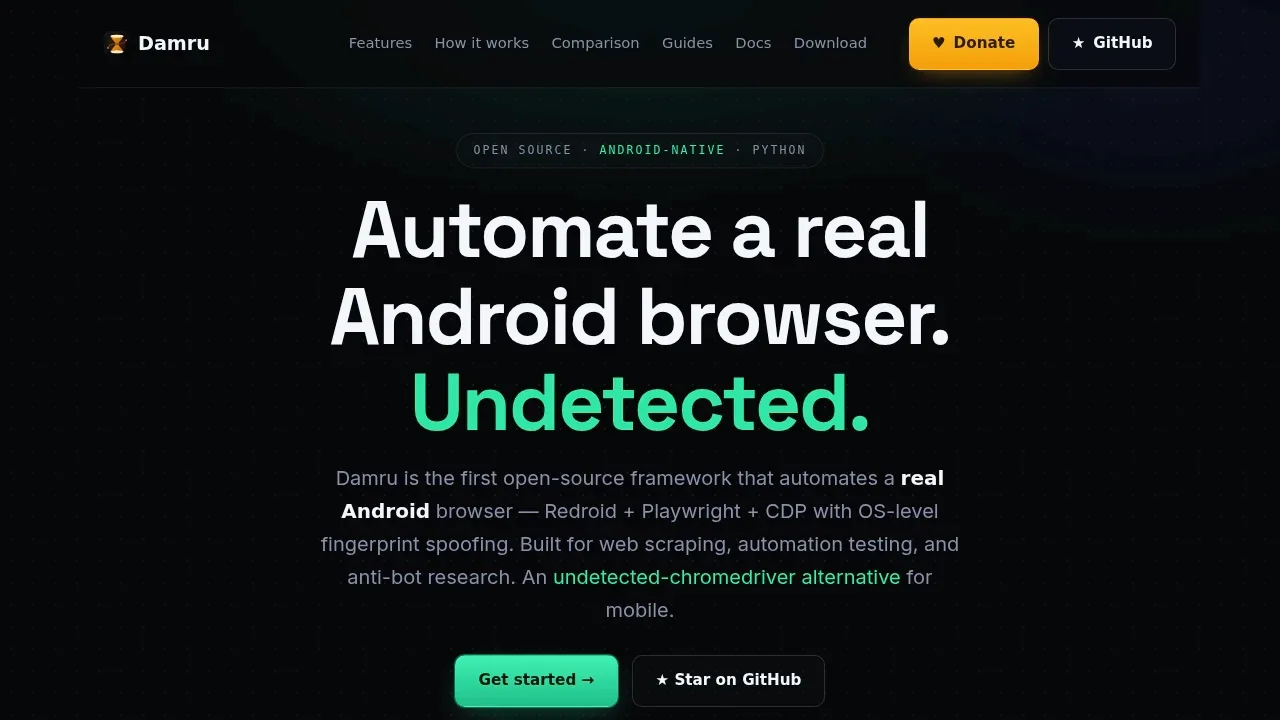
Damru is a Python browser automation framework for developers building web scrapers or AI agents, and researchers testing mobile browser fingerprinting. It runs Android through Redroid in Docker and controls Chrome with Playwright and the Chrome DevTools Protocol. The supported environment is containerized Android, not a physical phone. The project is beta and depends on host kernel, Docker, ADB and Redroid support.
Its main distinction is where it changes the browser's identity. Damru applies fingerprint spoofing at the operating system, binary and protocol layers without injecting JavaScript into pages. That makes it an Android-based alternative to desktop tools such as undetected-chromedriver and playwright-stealth, with control over signals beyond the browser viewport.
Device profiles cover Samsung, Pixel, Xiaomi, OPPO and Realme hardware. Damru can adjust screen dimensions and density, patch GPU fingerprints, and vary TLS and JA3 network fingerprints. It also pairs Chrome builds with matching browser identity signals. These capabilities support automation testing and anti-bot research, but don't establish that every detection system will accept an automated session.
The Android environment runs on your own hardware or server, and worker pools can run multiple Redroid containers in parallel. Its Python API follows Playwright conventions, which may suit teams already writing browser automation in Python. Damru uses the PolyForm Noncommercial license, which restricts commercial use.
Claim this page with an email at damru.dev. Damru gets the verified badge, and you can upgrade the listing to be featured on localhosted. Proud to be listed? Put our badge on your site.
Want more people to find Damru?Promote it
Something wrong or outdated on this page?
11.3KUpdated 1 day agoMIT
macOS · Windows · Linux · Docker#Browser automation#Multi-user access#PII redaction
CamoFox Browser is a self-hosted browser server for developers whose AI agents need to browse sites that block ordinary automation. It builds on Camoufox, a Firefox fork that changes browser fingerprints inside the engine rather than through JavaScript patches. This approach targets detection systems such as Cloudflare and Google's bot checks.
9.4KUpdated 20 hours agoMIT
macOS · Windows · Linux · Android · Docker · Web#Batch processing#LM Studio integration#MCP
2.7KUpdated 1 day agoApache-2.0
macOS · Windows · Linux#Agent Skills#Browser automation#Code execution
28.2KUpdated 1 day agoApache-2.0
Linux · Docker#Browser automation#Code execution#MCP
419Updated 6 months ago
macOS · Windows · Linux#Agent Skills#Browser automation#Guardrails
webctl is a local browser automation CLI for developers and AI agents that need to read websites and interact with pages. It runs Chromium through Playwright on macOS, Windows and Linux, and supports container deployment. Its main distinction is control over how much page information reaches an agent's context: you can filter results before the agent reads them.
6.2KUpdated 4 months agoMIT
macOS · Docker#Agent Skills#Browser automation#Code execution
xberg, formerly Kreuzberg, is a local document extraction engine for developers building AI search, document processing, and retrieval-augmented generation applications. It reads PDFs, Office files, scanned images, email, and nested archives, extracting text, tables, images, and metadata through one shared engine. It's open source under MIT.
Moli is a headless browser you run on your own machine or server for AI agents, web scraping and retrieval pipelines. It can read pages and execute JavaScript without spending resources on visual rendering for every request. Layout and rendering run only when a task needs them, such as capturing a screenshot or clicking at specific coordinates.
Obscura is a headless browser engine for developers building AI agents and web scraping systems that need many independent browser sessions. Each session starts with fresh state, so cookies, logins, and cached data don't carry between tasks. It's written in Rust and runs without Chromium, with a smaller memory footprint intended to support more concurrent sessions per machine.
bb-browser lets AI agents work through your local Chrome browser using the website accounts you're already signed into. It's for people building agents that need to research across websites or interact with authenticated pages without a separate API integration for each service. The project is open source under the MIT license.