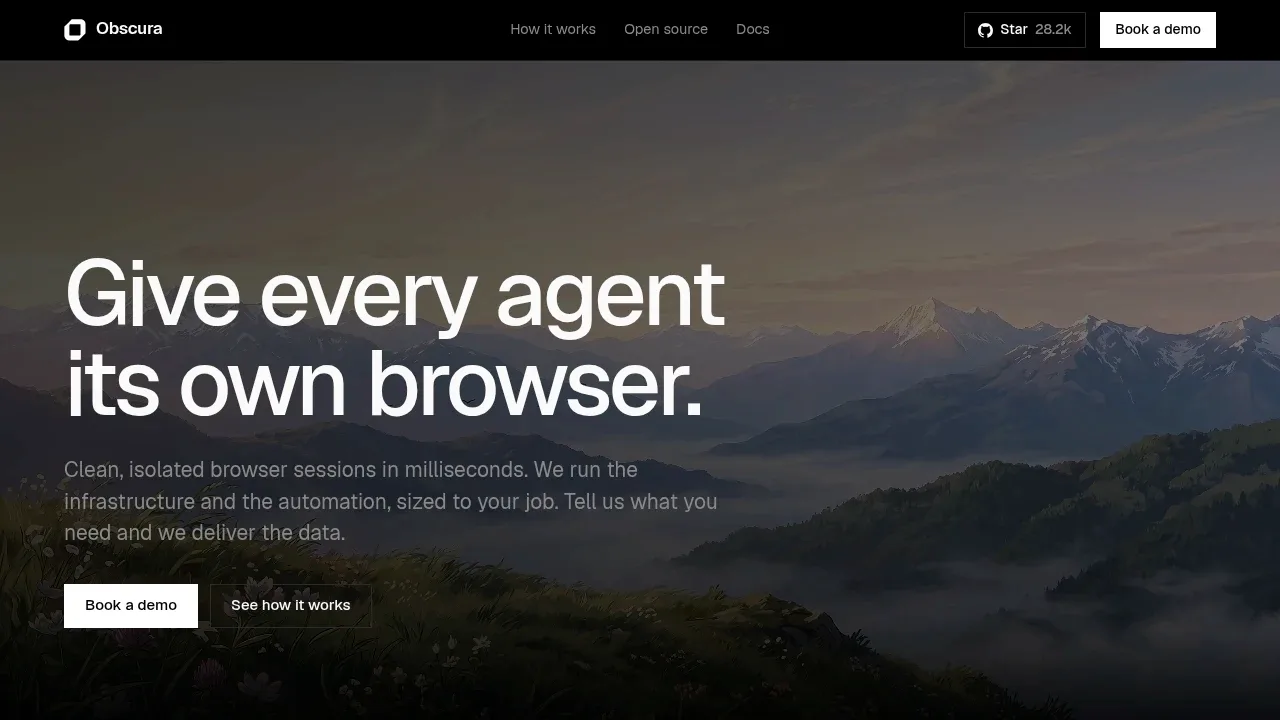
Obscura is a headless browser engine for developers building AI agents and web scraping systems that need many independent browser sessions. Each session starts with fresh state, so cookies, logins, and cached data don't carry between tasks. It's written in Rust and runs without Chromium, with a smaller memory footprint intended to support more concurrent sessions per machine.
The engine is open source under Apache 2.0 and can run on your own Linux server or in Docker. Self-hosting keeps the browser engine on infrastructure you control. The managed cloud service runs browsers on Obscura's infrastructure, and the company also offers to operate automation jobs and deliver the extracted data.
Obscura supports Playwright and Puppeteer through the Chrome DevTools Protocol, so teams can keep their existing automation code. It executes JavaScript with V8 and includes its own rendering engine for screenshots, live page screencasts, and PDF export. It can also turn page content into Markdown and intercept network requests.
An included MCP server gives agents in Claude Desktop and Cursor access to browser actions, readable page snapshots, screenshots, and PDFs. A Hermes agent plugin connects browser tasks to the engine. For scraping sites that detect automation, an optional stealth mode randomizes browser fingerprints and masks automation signals. That mode also blocks analytics, ads, telemetry, and fingerprinting scripts.
Claim this page with an email at obscura.sh. Obscura gets the verified badge, and you can upgrade the listing to be featured on localhosted. Proud to be listed? Put our badge on your site.
Want more people to find Obscura?Promote it
Something wrong or outdated on this page?
6.2KUpdated 4 months agoMIT
macOS · Docker#Agent Skills#Browser automation#Code execution
bb-browser lets AI agents work through your local Chrome browser using the website accounts you're already signed into. It's for people building agents that need to research across websites or interact with authenticated pages without a separate API integration for each service. The project is open source under the MIT license.
701Updated 2 days ago
#Browser automation#Human approval#MCP
Fortress is a Chromium fork for developers whose scrapers and AI agents encounter browser fingerprint checks. It runs as a local browser binary and changes the fingerprint inside Chromium's C++ code, rather than applying JavaScript overrides that pages can inspect.
456Updated 5 months agoMIT
#Agent Skills#Browser automation#Code execution
426Updated 3 weeks agoMIT
macOS · Windows · Linux · Docker · Web#Agent Skills#Code execution#Human approval
37.7KUpdated 3 days agoApache-2.0
macOS · Windows · Linux · Docker#Browser automation#Code execution#LM Studio integration
11.3KUpdated 1 day agoMIT
macOS · Windows · Linux · Docker#Browser automation#Multi-user access#PII redaction
ZeroToken is a local, open source MCP server that turns an AI agent's browser actions into reusable scripts. It's for people automating recurring web tasks, such as daily logins, report collection or browser tests, through OpenClaw, Cursor or another MCP client. The Python project uses Playwright and Chromium and carries the MIT license.
OwnPilot is a self-hosted personal AI assistant for people who want chat, personal records, and autonomous agents in one browser interface. It runs through Docker or on macOS, Windows, and Linux, and it's open source under the MIT license. Agents can work in separate workspaces, keep memory across tasks, and delegate work to other agents.
Playwright MCP lets AI agents control a browser by reading structured page information rather than interpreting screenshots. It's for developers building browser automation, exploratory tests or agent workflows that need to keep a browser session open across repeated actions. The server runs locally on macOS, Windows and Linux, or as a self-hosted service.
CamoFox Browser is a self-hosted browser server for developers whose AI agents need to browse sites that block ordinary automation. It builds on Camoufox, a Firefox fork that changes browser fingerprints inside the engine rather than through JavaScript patches. This approach targets detection systems such as Cloudflare and Google's bot checks.