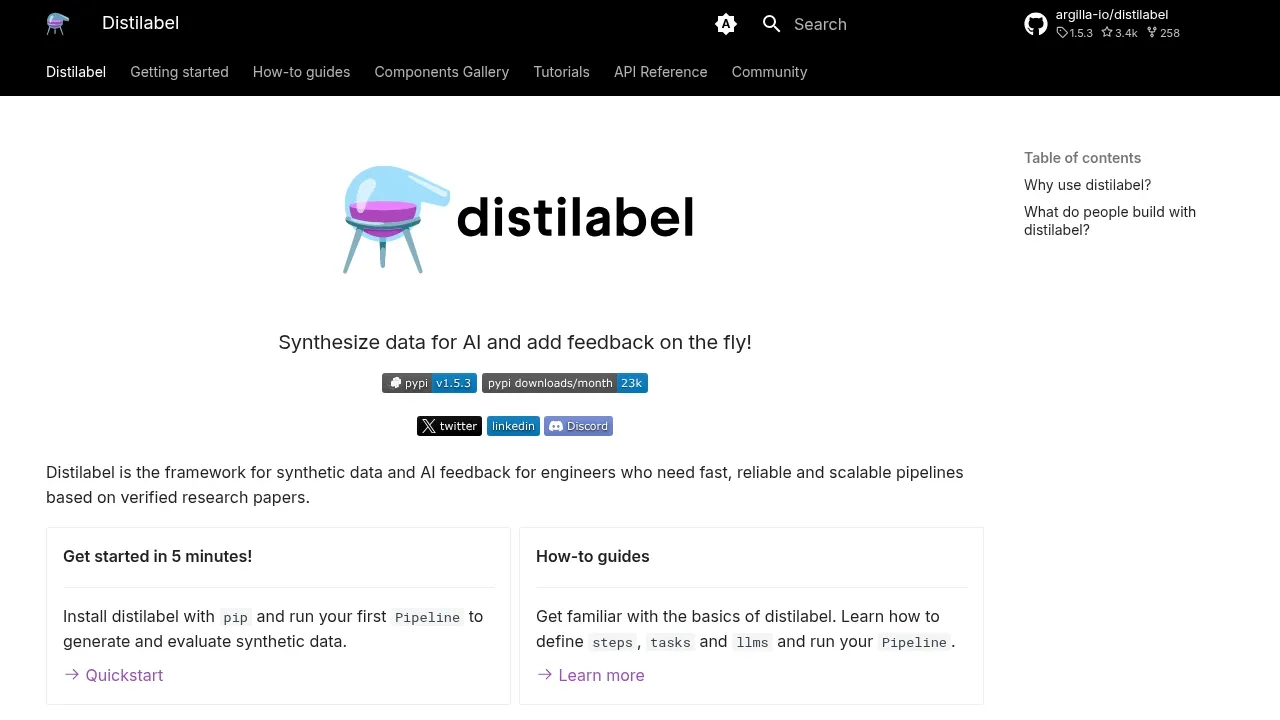
Distilabel is an open-source Python framework for engineers building datasets to train or evaluate AI models. It pairs synthetic data generation with LLM feedback, so a pipeline can create examples and judge their quality. It uses the Apache 2.0 license.
Its tasks cover classification and information extraction as well as instruction following, dialogue generation and judging model responses. For fine-tuning work, it can produce preference data and use AI judgments to filter examples. The generation and evaluation methods draw on published research, giving teams established approaches to work from when developing their own datasets.
Distilabel brings LLM providers behind a shared API, with integrations for Anthropic and Cohere's cloud services. Those integrations send model requests to the provider. It also supports exporting generated datasets to Argilla for further review, while Outlines and Instructor integrations support structured generation.
The framework suits teams that need repeatable data pipelines and control over how examples are produced and assessed. Ray support lets them distribute pipeline work, and fault tolerance supports larger jobs. Data processing capabilities include sentence embeddings with FAISS, text clustering with UMAP and Scikit-learn, and duplicate detection with MinHash. Community datasets built with Distilabel include OpenHermesPreference and Intel Orca DPO.
The original authors have moved on. Community collaborators maintain the project, with current fixes and improvements available on its development branch.
Claim this page with an email at distilabel.argilla.io. Distilabel gets the verified badge, and you can upgrade the listing to be featured on localhosted. Proud to be listed? Put our badge on your site.
Want more people to find Distilabel?Promote it
Something wrong or outdated on this page?
5.1KUpdated 1 year agoApache-2.0
Web#Multi-user access#Semantic search
Argilla is an open-source data annotation and feedback tool for AI engineers and domain experts who build training and evaluation datasets. You can run your own Argilla server or deploy it on Hugging Face Spaces. It's licensed under Apache 2.0.
15.9KUpdated 7 months agoApache-2.0
Ragas is an open-source Python library for developers who need repeatable evaluations of LLM applications and retrieval-augmented generation (RAG) systems. It combines model-based scoring with traditional metrics so teams can compare application changes using test results rather than manual judgments alone. Its license is Apache 2.0.
9.4KUpdated 1 day agoApache-2.0
macOS · Windows · Linux · iOS · Android · Web#Batch processing#LLM tracing#Structured output
1.7KUpdated 2 days agoApache-2.0
#Batch processing#Code execution#Multimodal input
5.1KUpdated 21 hours ago
macOS · Windows · Linux#Git integration#MCP#Multi-agent workflows
Kiln is a desktop workbench for teams building AI applications on macOS, Windows and Linux. It keeps a task and its dataset together across evaluation, prompt optimization, RAG and fine-tuning, so teams can compare changes against the same examples. Engineers, data scientists, QA staff and subject matter experts can contribute through the app.
1.9KUpdated 3 months agoMIT
macOS · Windows · Linux#Distributed execution#llama.cpp backend#Quantization
BAML is a programming language for developers building AI agents, with typed model calls and local tracing built into the language. It runs standalone on macOS, Linux and Windows, or alongside an existing application. The language is open source under Apache 2.0, and works offline.
Curator is a Python library for developers preparing LLM training datasets or extracting structured records from existing data. It supports local inference through Ollama and vLLM alongside cloud model APIs, so the same data pipeline can use models on your hardware or a hosted provider. It's open source under Apache 2.0.
Augmentoolkit turns your documents into training data for a custom LLM that learns a particular subject. It's for researchers, developers and hobbyists who want models trained on their own material, such as research papers or fictional lore. The Python toolkit is open source under the MIT license and runs on macOS and Linux, with WSL recommended for Windows.