ExtractThinker is a Python library for developers who need structured data from documents, such as invoice fields their application can use. It pairs document parsers with an LLM and returns results that follow a Pydantic schema. It's open source under Apache 2.0 and runs on macOS, Windows and Linux.
The schema defines both the fields to extract and the rules those values must satisfy. You can add application-specific validation, and extraction raises an error when validation fails rather than inventing defaults for required fields. A valid result can still contain factual mistakes, so schema checks don't replace evaluation on your own documents.
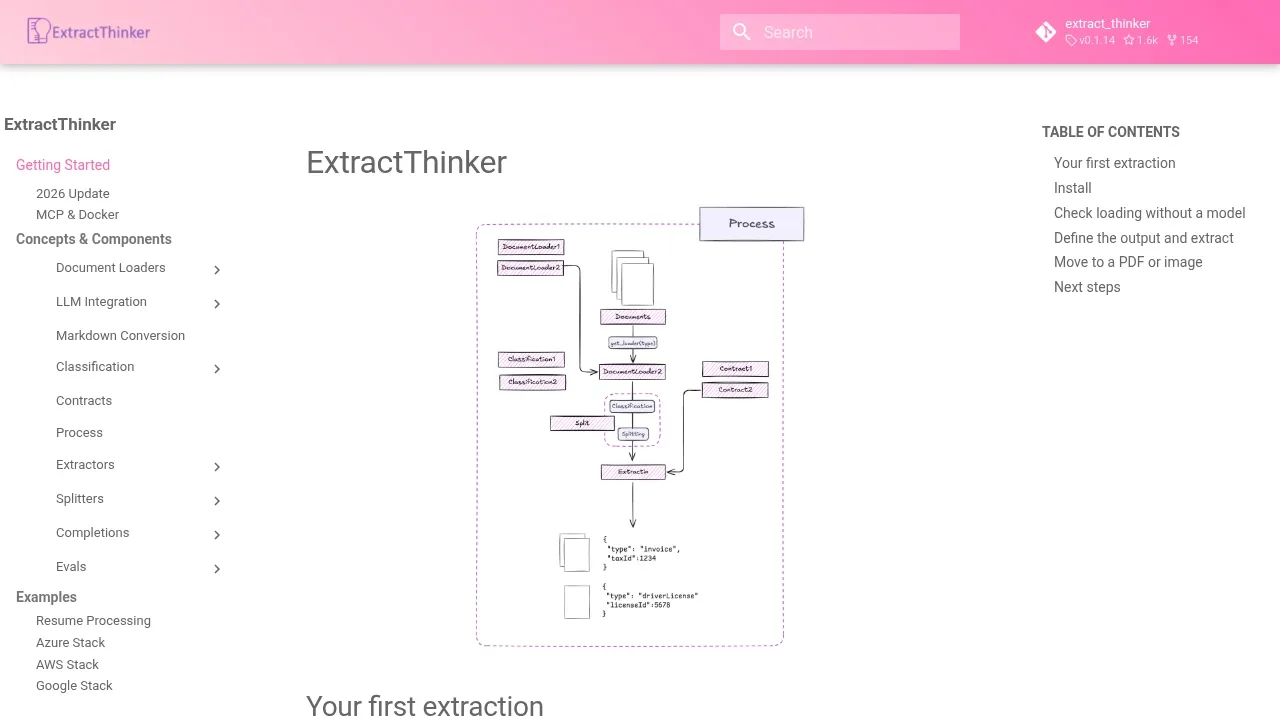
Document loaders cover PDFs, images, tables and spreadsheets. Classification and splitting help process bundles that contain different document types. Text PDFs can use pypdf; scans need OCR or a vision-capable model, while image extraction requires a loader that supplies page images.
The library supports Ollama for local LLM use as well as providers such as OpenAI, Anthropic and Groq. Document loading can run without provider credentials or a model call. Extraction sends document content to the configured model, so a cloud provider receives that content when you choose a hosted backend. Provider access requires the relevant credentials and may carry charges.
An optional MCP service exposes the library through Docker or a native Python process.
Claim this page and we'll verify you by hand. ExtractThinker gets the verified badge, and you can upgrade the listing to be featured on localhosted. Proud to be listed? Put our badge on your site.
Want more people to find ExtractThinker?Promote it
Something wrong or outdated on this page?
9.4KUpdated 1 day agoMIT
macOS · Windows · Linux · Android · Docker · Web#Batch processing#LM Studio integration#MCP
xberg, formerly Kreuzberg, is a local document extraction engine for developers building AI search, document processing, and retrieval-augmented generation applications. It reads PDFs, Office files, scanned images, email, and nested archives, extracting text, tables, images, and metadata through one shared engine. It's open source under MIT.
81KUpdated 3 days ago
macOS · Windows · Linux#llama.cpp backend#MCP#MLX
68.2KUpdated 22 hours agoMIT
macOS · Windows · Linux#MCP#Works offline
15.5KUpdated 3 hours agoApache-2.0
macOS · Windows · Linux · Docker#Multilingual
37.3KUpdated 5 hours agoAGPL-3.0
macOS · Windows · Docker · Web#Batch processing#Hugging Face integration#MCP
27.7KUpdated 5 hours agoMIT
macOS · Windows · Linux#Code execution#MCP#Tool calling
MinerU parses documents locally into structured text for AI agents, RAG systems and knowledge bases. It's for people working with scanned PDFs, academic papers and Office files whose tables, formulas or page layouts need more care than plain text extraction.
Docling is an MIT-licensed, open source document parser for developers turning files into structured content for search and AI applications. It runs locally on macOS, Linux, and Windows, including in air-gapped environments. Its PDF processing identifies page layout and reading order, extracts tables, code, and formulas, and classifies images.
Unstructured is a local document processing library for developers building LLM applications and document ingestion pipelines. It turns PDFs, Word documents, HTML, emails and images into document elements that applications can use. The Python library is open source under Apache 2.0 and runs on your own hardware, including through Docker images for x86_64 and Apple Silicon.
PDFMathTranslate translates scientific PDFs while keeping their page layout, formulas, charts, contents pages and annotations. It's for researchers, students and others who need to read papers in another language without losing the relationship between the text and its figures. It produces both translated PDFs and bilingual documents for comparison with the original.
Cua gives AI agents access to computers they can inspect and operate, with tools for desktop automation, local virtual machines, and hosted fleets. It's for developers building agents that work across native apps and browsers, or evaluating how well those agents complete computer tasks. You bring the agent and model.