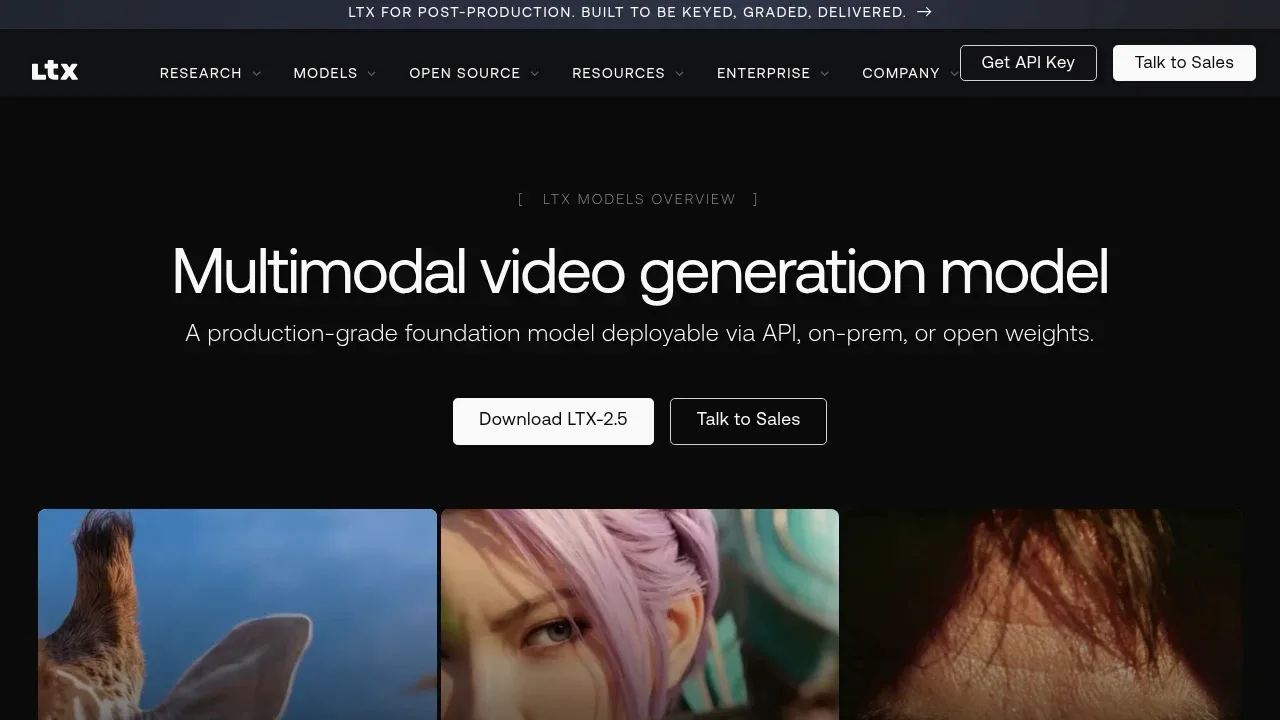
LTX-Video is an AI video generation model for creators building controlled animations and developers adding video tools to their own products. You can run it locally or on your own servers using publicly available weights. The LTX family also offers a managed cloud API; local deployments can run in isolated environments without a cloud dependency.
It generates video from text or images, accepts multiple keyframes, and can extend footage forward or backward. Video-to-video editing lets you work with existing clips. Pose, depth, and Canny edge controls give you ways to guide movement and composition beyond a written prompt. ComfyUI and Hugging Face Diffusers integrations make it usable within existing generation workflows.
Model variants trade output quality against speed and GPU memory use. Distilled models suit repeated drafts, while smaller and quantized variants reduce VRAM needs. LTX-Video-Trainer supports full fine-tuning and LoRA training for adapting the model to a particular style or domain.
The newer LTX-2 and LTX-2.5 models are separate successors. They add synchronized audio and video; LTX-2.5 also supports connected shots and HDR and EXR output. The LTX-Video repository code uses Apache 2.0. Model licensing is separate: each checkpoint has its own terms. LTX-2.5 has conditional permissions based on organization size and separate commercial licensing.
Claim this page with an email at lightricks.com. LTX-Video gets the verified badge, and you can upgrade the listing to be featured on localhosted. Proud to be listed? Put our badge on your site.
Want more people to find LTX-Video?Promote it
Something wrong or outdated on this page?
12.3KUpdated 2 years agoApache-2.0
Web#Hugging Face integration#LoRA#Multimodal input
AnimateDiff adds text-driven animation to personalized Stable Diffusion models without requiring separate training for each model. It's for artists and developers who want to generate motion while keeping the visual style of a chosen image model. The Python implementation runs locally and includes a Gradio browser interface.
13KUpdated 11 months agoApache-2.0
Windows · Web#Hugging Face integration#LoRA#Multimodal input
9.2KUpdated 2 weeks agoApache-2.0
#ControlNet#LoRA#Multimodal input
17.3KUpdated 11 months agoApache-2.0
Windows · Linux · Web#Hugging Face integration#Multimodal input
12.6KUpdated 3 months ago
Web#Multimodal input#Quantization
HunyuanVideo is an AI video generation model for creators and developers who want to generate footage on their own hardware. Tencent provides model weights and inference code for text-to-video and image-to-video generation, alongside a hosted web experience. Local inference runs on your GPUs; the web offering runs through Tencent's service.
3.7KUpdated 11 months agoApache-2.0
Web#Hugging Face integration#LoRA
Mochi 1 is a text-to-video model for creators and developers who want to generate videos on their own hardware or adapt a model to their own footage. Genmo releases it under Apache 2.0, with downloadable weights and code for local use. Genmo also offers a hosted playground for trying the model in a browser.
CogVideoX is a family of downloadable video generation models for developers, researchers and creators who want to generate clips on their own hardware. It turns English text prompts into video, animates a supplied image and can continue an existing video. A local Gradio web interface provides a browser front end for generation.
Sana is an open-source framework for running image and video generation on your own hardware, with image models small enough for laptop GPUs. It's aimed at creators who want local AI generation and developers who need training and inference pipelines for their own models. The code uses the Apache 2.0 license.
FramePack is an open source desktop app for making videos from a still image and a written motion prompt. It runs on Windows and Linux, with generation handled by your own NVIDIA GPU. It suits people who want to make AI video locally and see the clip develop as it renders.