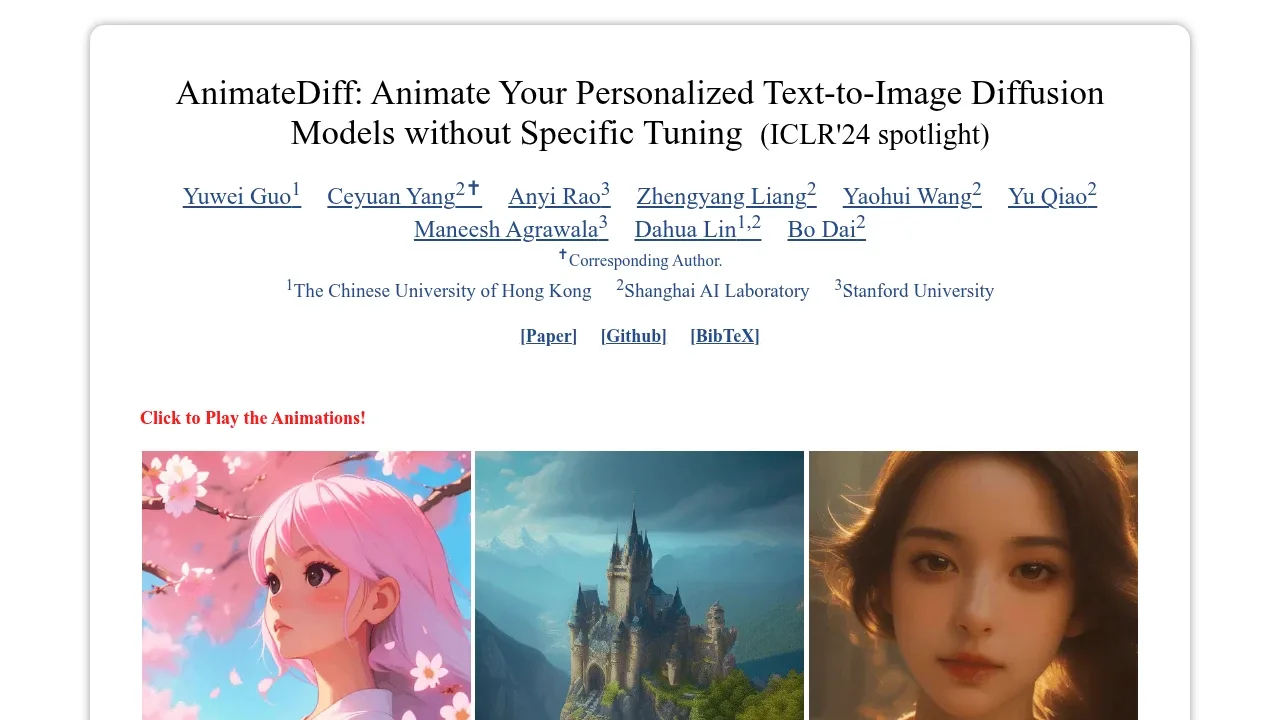
AnimateDiff adds text-driven animation to personalized Stable Diffusion models without requiring separate training for each model. It's for artists and developers who want to generate motion while keeping the visual style of a chosen image model. The Python implementation runs locally and includes a Gradio browser interface.
Its reusable motion module works with models based on Stable Diffusion 1.5, including customizations made with LoRA and DreamBooth. Examples include ToonYou, Realistic Vision and majicMIX Realistic. This lets you choose a model for its appearance and use the motion module to generate animated output. AnimateDiff also works through Hugging Face Diffusers.
For more control over the result, MotionLoRA supports camera movements such as zooms, pans, tilts and rotation. SparseCtrl accepts RGB images or sketches to guide animation content, so a text prompt isn't the only way to shape a scene. For image animation and interpolation, images generated by the same community model are recommended to keep the style consistent.
The project code and released motion modules use Apache 2.0. Base Stable Diffusion weights and personalized checkpoints have their own model terms, which also apply when generating animations. Its focus on compatibility with community image models comes with limits: output can show flicker, and general text-to-video quality is limited because the approach isn't specifically optimized for that use.
Claim this page and we'll verify you by hand. AnimateDiff gets the verified badge, and you can upgrade the listing to be featured on localhosted. Proud to be listed? Put our badge on your site.
Want more people to find AnimateDiff?Promote it
Something wrong or outdated on this page?
13KUpdated 11 months agoApache-2.0
Windows · Web#Hugging Face integration#LoRA#Multimodal input
CogVideoX is a family of downloadable video generation models for developers, researchers and creators who want to generate clips on their own hardware. It turns English text prompts into video, animates a supplied image and can continue an existing video. A local Gradio web interface provides a browser front end for generation.
17.3KUpdated 11 months agoApache-2.0
Windows · Linux · Web#Hugging Face integration#Multimodal input
3.7KUpdated 11 months agoApache-2.0
Web#Hugging Face integration#LoRA
Mochi 1 is a text-to-video model for creators and developers who want to generate videos on their own hardware or adapt a model to their own footage. Genmo releases it under Apache 2.0, with downloadable weights and code for local use. Genmo also offers a hosted playground for trying the model in a browser.
3.2KUpdated 2 years agoMIT
macOS · Web#Hugging Face integration#Multimodal input
7.6KUpdated 8 months ago
Web#Hugging Face integration#Multimodal input
12.6KUpdated 3 months ago
Web#Multimodal input#Quantization
HunyuanVideo is an AI video generation model for creators and developers who want to generate footage on their own hardware. Tencent provides model weights and inference code for text-to-video and image-to-video generation, alongside a hosted web experience. Local inference runs on your GPUs; the web offering runs through Tencent's service.
FramePack is an open source desktop app for making videos from a still image and a written motion prompt. It runs on Windows and Linux, with generation handled by your own NVIDIA GPU. It suits people who want to make AI video locally and see the clip develop as it renders.
Pyramid Flow is an open-source AI video generator for people who want to create clips on their own hardware, and for researchers working on video models. It turns text prompts into video or animates a supplied image with guidance from text. The Python code uses PyTorch and carries MIT. Model licenses are separate: the SD3-derived weights use the Stability AI Community License. Check the chosen checkpoint before deployment.
SkyReels-V2 is a family of downloadable video models for developers and researchers who want to run generation on their own GPUs. It supports text-to-video, image-to-video and extended video generation. Its autoregressive Diffusion Forcing architecture generates longer sequences by continuing video segments.