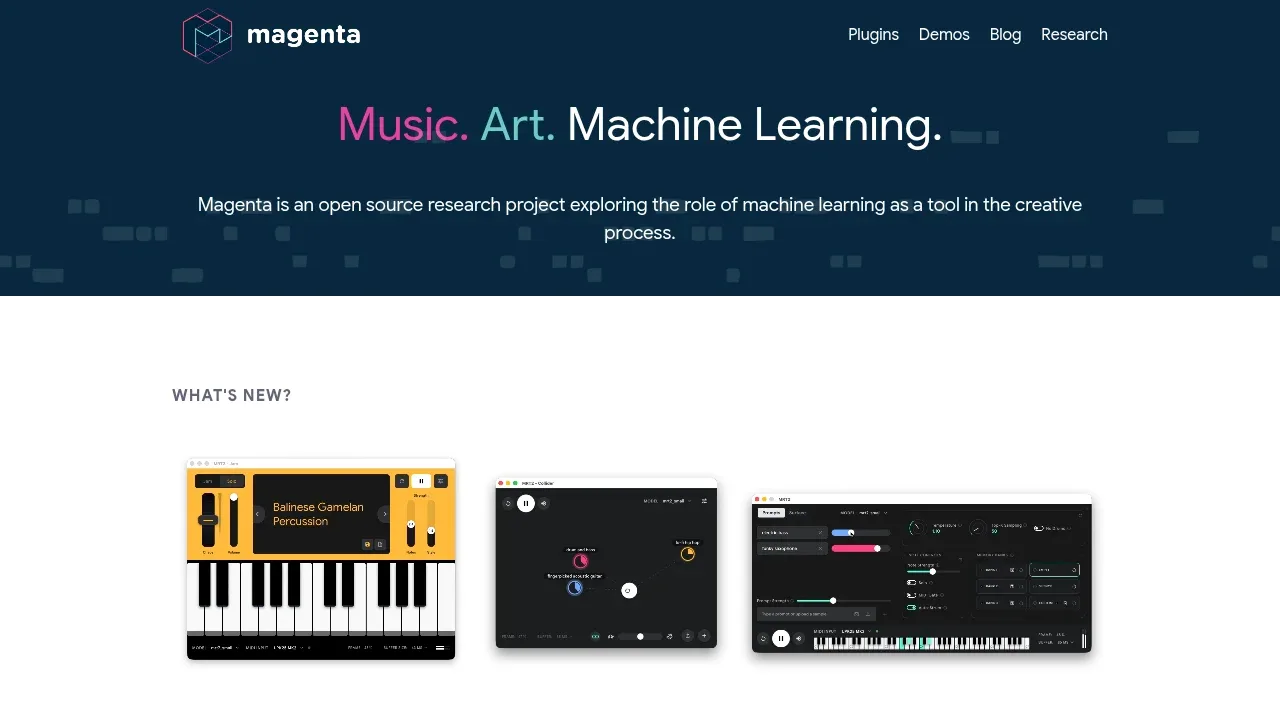
Magenta RealTime 2 is a local AI music model and synthesis engine for musicians and developers who want to play or build AI musical instruments on a laptop. It generates streaming audio in real time, with open weights and code under the Apache 2.0 license.
You can use it through a standalone macOS app or an AUv3 plugin for DAWs. Example apps explore note control and musical prompts, giving developers concrete starting points for instruments and interactive music software. The model runs on your own hardware.
Real-time playback requires Apple Silicon. The smaller model runs on any Apple Silicon Mac, including MacBook Air models. The larger model offers higher quality but needs more powerful supported Apple Silicon hardware to generate audio faster than playback. Both models also support generation without real-time playback on any Apple Silicon Mac or an NVIDIA GPU through the Python library.
For developers, the project includes a Python library with JAX and MLX backends and a C++ engine for streaming audio on Apple Silicon MacBooks. These support embedding music generation into custom applications or building a DAW plugin around the model. The repository includes standalone app and plugin examples alongside the inference libraries.
The original Magenta RealTime model and code remain on the v1_legacy branch.
Claim this page with an email at magenta.withgoogle.com. Magenta RealTime gets the verified badge, and you can upgrade the listing to be featured on localhosted. Proud to be listed? Put our badge on your site.
Want more people to find Magenta RealTime?Promote it
Something wrong or outdated on this page?
23.7KUpdated 2 years agoMIT
#Multimodal input
MusicGen is Meta AI's music generation model within AudioCraft, a PyTorch library for developers and audio researchers who want to generate music in their own computing environment. It creates music from text descriptions and can use a melody to guide the result. AudioCraft includes both inference and training code, so it's suited to people building audio tools or studying music generation.
4.9KUpdated 7 months agoApache-2.0
macOS#LoRA#Multilingual
2.6KUpdated 2 years ago
macOS · Linux · Web#Batch processing#Hugging Face integration
AudioLDM 2 generates sound effects, music and speech on your own hardware. It's a Python tool for people experimenting with synthetic audio, including sound designers and researchers who want to work with pretrained models. A Gradio browser interface and command-line tools provide access to local generation; a hosted Hugging Face demo is also available.
2.3KUpdated 10 months agoApache-2.0
macOS · Windows · Linux · Docker#Hugging Face integration#Multimodal input
3.9KUpdated 2 years agoMIT
macOS · Windows · Linux · Web#Hugging Face integration#Image-to-image#Multimodal input
13.2KUpdated 2 days agoApache-2.0
#ControlNet#Image-to-image#Inpainting
ACE-Step is an open-source music generation model for musicians, producers and developers who want to create and edit music on their own hardware. It generates songs with vocals or instrumental tracks from text descriptions and supplied lyrics. You can choose the duration and describe the sound with genre tags, longer prompts or a scene description.
DiffRhythm is a local AI music generation model for musicians, developers and researchers who want to create full-length songs on their own hardware. It uses latent diffusion to generate songs with vocals and accompaniment, and can also produce instrumental music. The full model supports songs up to 4 minutes and 45 seconds.
Riffusion is a Python library for generating music and audio on your own hardware using Stable Diffusion. It's for developers and musicians who want to experiment with text-driven sound generation or build it into an app. The hobby project is no longer actively maintained.
DiffSynth-Studio is a Python diffusion model engine for developers and researchers who want to generate media and train models on their own hardware. It supports large models on consumer GPUs through memory offloading and quantization, with inference and training in the same framework. It's open source under Apache 2.0.