
NeMo Automodel
An open-source LLM training library for GPU workstations and clusters, with Hugging Face compatibility, LoRA fine-tuning and multimodal training.
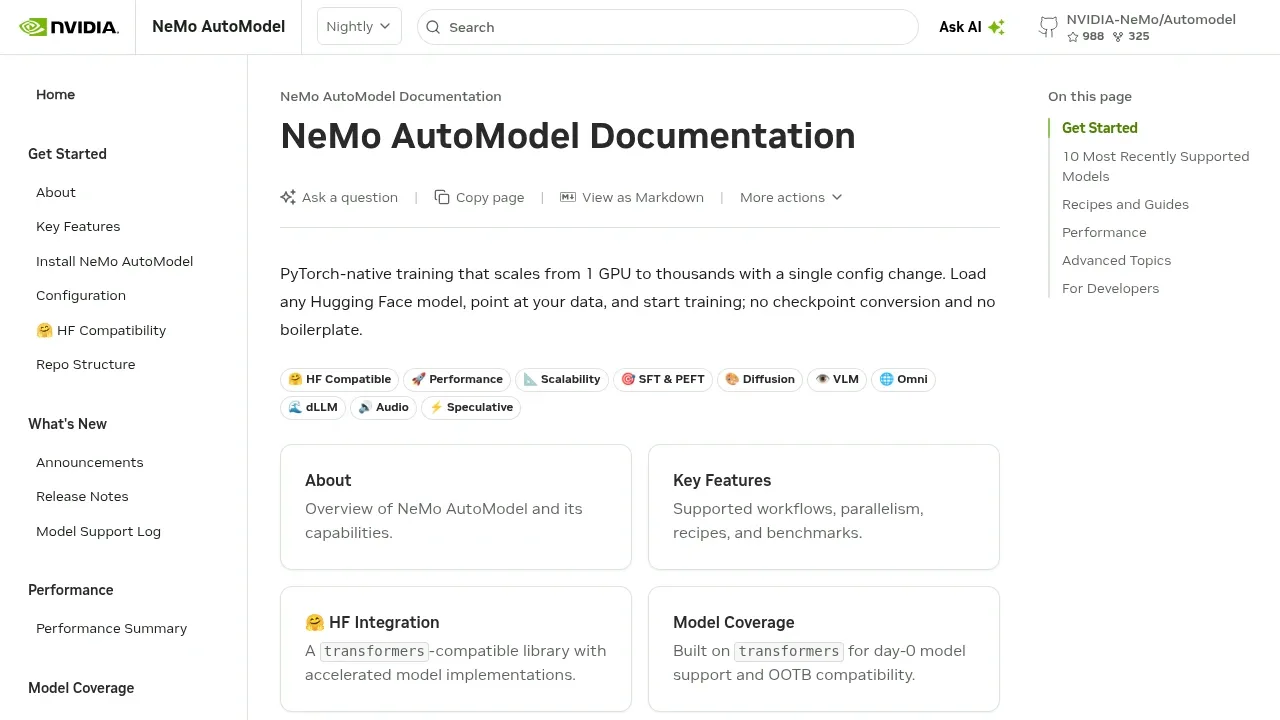
NeMo Automodel is a Python library for researchers and developers who want to train or adapt AI models on their own GPU workstations or clusters. Its PyTorch-based training works with Hugging Face models without converting checkpoints.
- LLM training and adaptation: Pretrain models on your own text corpus, fine-tune all weights, or use LoRA to adapt models with less GPU memory; supported families include Llama, GPT-OSS and DeepSeek.
- Task-specific training: Train models for tool calling and text classification, or fine-tune embedding and reranking models for search and retrieval.
- Multimodal models: Fine-tune vision-language models such as Qwen2.5-VL and Gemma 3 on image-text data, adapt Qwen3-Omni for speech recognition, and train diffusion models for image or video generation.
- Smaller deployment models: Use knowledge distillation to train a smaller model from a teacher, or quantization-aware training to prepare models for quantized deployment.
- Distributed training: Scale the same training program across multiple GPUs and machines, with mixed precision and gradient checkpointing to manage memory use.
The library is open source under Apache 2.0 and includes training optimizations for NVIDIA GPUs. Jobs can run on a local workstation, in Docker, or on SLURM and Kubernetes clusters. It's a training library rather than a desktop chat app.
For existing training workflows, it can act as an accelerated backend for TRL or OpenRLHF. Experiment tracking supports MLflow and Wandb, checkpoint output supports SafeTensors, and NeMo RL can use its checkpoints for further training.


