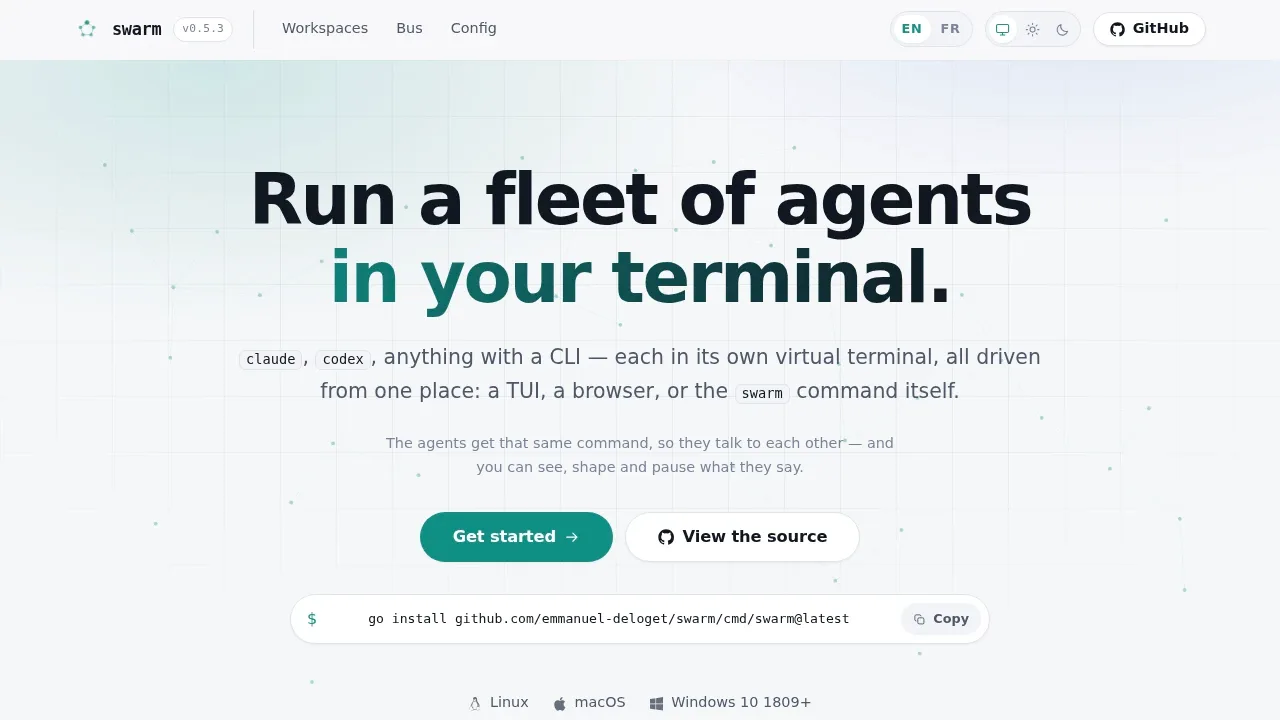
Swarm Fleet runs multiple terminal agents on your own machine and lets you supervise them together. It's for developers coordinating coding, review or ticket work across Claude, Codex and other command-line tools. Written in Go and licensed under MIT, it runs on Linux, macOS and Windows. Swarm serves its browser interface itself.
Each agent gets a separate terminal, so interactive tools retain their normal behavior. You can watch one agent closely or see the whole fleet in a grid, then send input through the terminal interface, browser or command line. Status indicators show which agents are working, idle or waiting for approval. Swarm also tracks unanswered requests and flags agents that have gone quiet while still owing a response.
Agents can exchange messages without you passing them along. Delivery can be immediate, wait for the recipient to check its inbox, or hold until it becomes quiet. You can inspect conversations, restrict who talks to whom, limit conversation turns and pause messaging when coordination starts taking over the work.
Workspace separation helps agents avoid interfering with the same checkout. They can share a directory, use separate durable clones or get a Git worktree and branch for a single task. Task-specific agents leave when their work is complete. Signature-checked incoming webhooks can route pull requests and tickets to agents, while outgoing webhooks can report completed work to another endpoint.
Claim this page with an email at emmanueldeloget.com. Swarm Fleet gets the verified badge, and you can upgrade the listing to be featured on localhosted. Proud to be listed? Put our badge on your site.
Want more people to find Swarm Fleet?Promote it
Something wrong or outdated on this page?
403Updated 12 hours agoApache-2.0
macOS · Windows · Linux#Agent Skills#Code execution#Git integration
Liza coordinates coding agents through a software delivery workflow with separate authors and reviewers. It's for developers who want to delegate work from specifications through tested, documented code while retaining control over product decisions. Its Go supervisor enforces role boundaries, validation gates and merge authority in code, rather than relying entirely on agents to follow prompts.
1.4KUpdated 2 months agoMIT
macOS · Windows · Linux · Android#Agent Skills#Code execution#Human approval
15.9KUpdated 4 months agoMIT
macOS · Windows · Linux#Agent Skills#Code execution#Git integration
294Updated 5 hours ago
macOS · Windows · Linux · Web#Agent Skills#Batch processing#Code execution
Ringer runs parallel AI coding agents on your machine and checks their output by executing tests or other validation commands. It's for developers who want to delegate implementation while keeping planning and review with a stronger model. The aim is to reduce model spending on routine coding work without relying on workers' claims that they're finished.
195Updated 7 months agoMIT
macOS · Windows · Linux · Web#Agent Skills#Code execution#Guardrails
3.2KUpdated 18 hours agoApache-2.0
macOS · Linux · Web#Agent Client Protocol#Agent Skills#MCP
Multi-Agent Shogun runs a team of AI coding assistants on your computer or server, with separate roles for delegation, task management, implementation and analysis. It's for developers who want parallel work across projects while keeping each agent's activity visible. The orchestration runs locally on Linux, macOS or Windows through WSL2; the connected coding services handle model access through their own authentication or provider API keys.
OpenHarness is an MIT-licensed Python framework for developers and researchers building AI agents on their own machines. It runs on macOS, Linux and native Windows, and includes ohmo, a personal assistant that can work on coding tasks through Feishu, Slack, Telegram or Discord.
VibeHQ Hub coordinates separate Claude Code, Codex and Gemini CLI agents on your own computer. It's for developers assigning parts of a project to multiple coding assistants who need agreement on interfaces, dependencies and deliverables. The hub runs locally. It's open source under the MIT license, with tested Windows and macOS support; some Linux components remain untested.
fx is an open source coding assistant that runs as a small native program in your terminal and connects to local or cloud models. It's aimed at developers who prefer a shell-style interface, and researchers building agents into larger systems. Written in Zig and licensed under Apache 2.0, it runs without a background service.