
Torrix
A self-hosted LLM monitoring tool that tracks costs, latency, and prompt traces on macOS, Windows, Linux, or Docker, with Ollama and cloud API support.
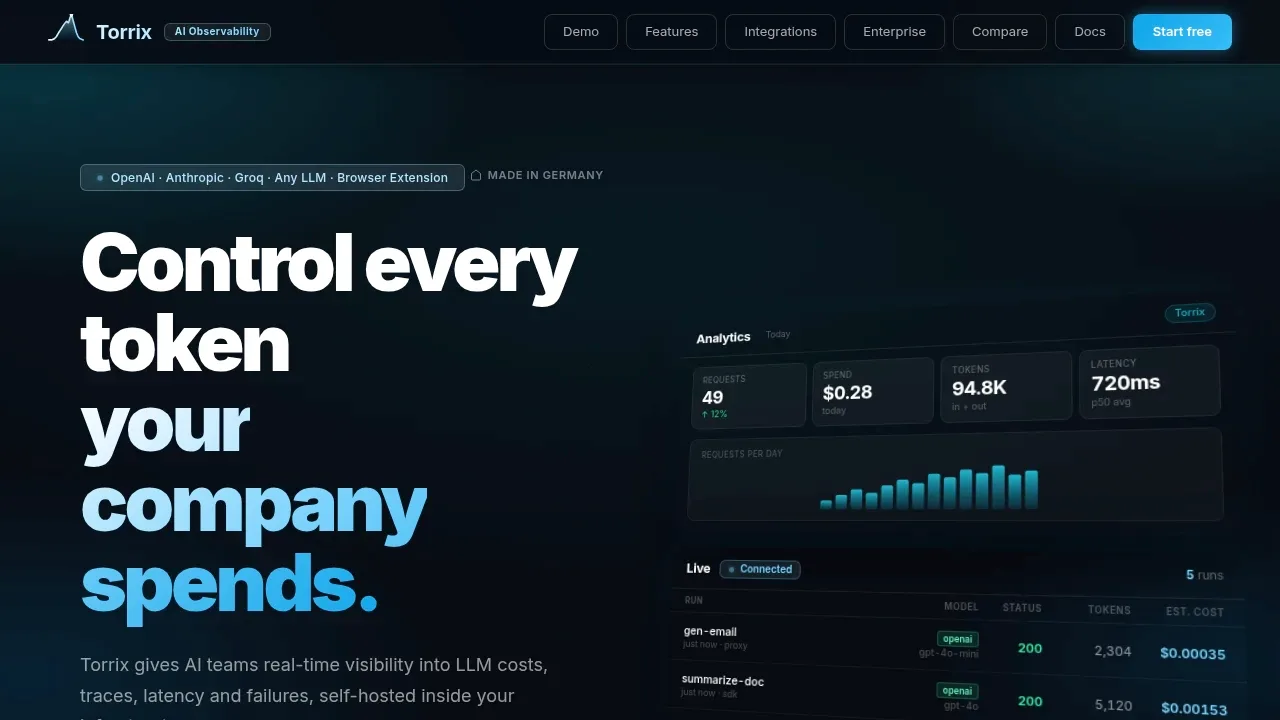
Torrix is a self-hosted LLM monitoring tool for teams investigating AI spending and failed requests. It keeps request records in your infrastructure and brings usage analytics and individual traces into one dashboard.
- Usage and cost analysis: Track tokens, estimated costs, latency, and failures, then compare spending by model, application, user, or agent.
- Request traces: Inspect full prompts, responses, finish reasons, and image inputs, with related calls grouped into agent traces or conversation sessions.
- Response evaluation: Replay saved reference runs, compare responses side by side, and batch-test datasets against models.
- PII masking and exports: Redact emails, phone numbers, credit card numbers, and IP addresses before storage, and export filtered records as CSV or JSON.
- Application and browser coverage: Monitor calls through language SDKs, HTTP and MCP proxies, LangChain, or OpenTelemetry; a Chrome extension captures conversations from ChatGPT, Claude, Gemini, and other supported chat services.
Torrix runs on macOS, Windows, and Linux, or in Docker on your own server. It works with Ollama, OpenAI-compatible APIs, and providers including OpenAI, Anthropic, Google Gemini, and Azure OpenAI, plus n8n and Make workflows. Account creation supplies a Torrix API key.
Monitoring records stay on your host, but cloud model requests still go to the selected provider. Anonymous telemetry is enabled by default and can be disabled; it sends an instance ID, operating system, and Node version.


