
UNO
Local AI image generation framework based on FLUX.1-dev, with single and multi-subject control, Apache 2.0 code, and noncommercial model licensing.
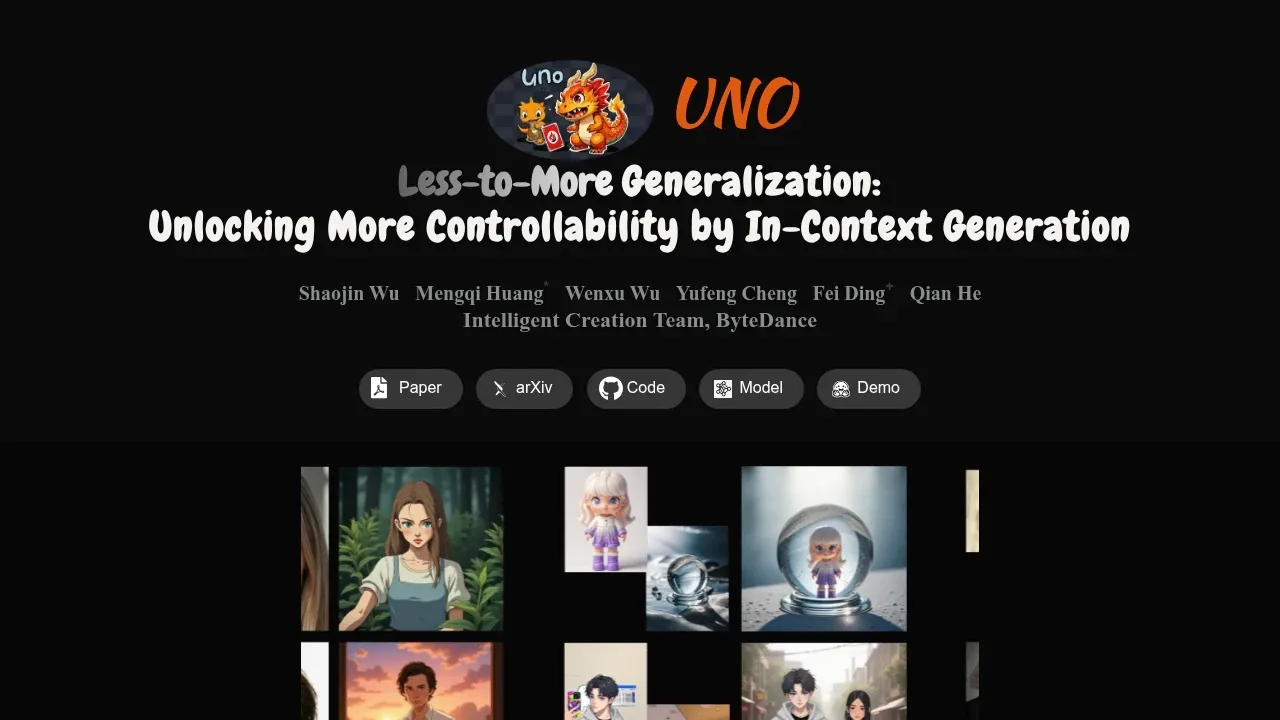
UNO generates images from reference images, with one model handling both a single subject and several subjects together. It's a local AI image generation framework from ByteDance for researchers and creators who want control over which subjects appear in a generated image and how consistently it preserves their appearance.
Its focus is subject consistency. Multiple reference images guide the output, so the model can place distinct subjects in the same image. UNO addresses attribute confusion, where a model mixes characteristics between subjects as more references enter the scene. Its universal rotary position embedding, called UnoPE, is designed to reduce that problem.
The framework builds on FLUX.1-dev and diffusion transformers. It trains progressively on single-subject data and then on multi-subject pairs, using synthesized images to support that progression. The repository includes inference and training code, plus a Gradio demo for running the model on your own hardware. Model checkpoints download from Hugging Face.
GPU memory is a practical consideration. The documented FP8 mode with offloading has a peak memory use of 16 GB; the project gives an RTX 3090 as its inference example.
The code is open source under Apache 2.0. The models use CC BY-NC 4.0, which restricts commercial use, and models based on FLUX.1-dev also remain subject to that base model's licensing terms.


