
wigolo
A local web server gives AI agents search, crawling and extraction through MCP or REST, with an offline cache and no API keys for core tools.
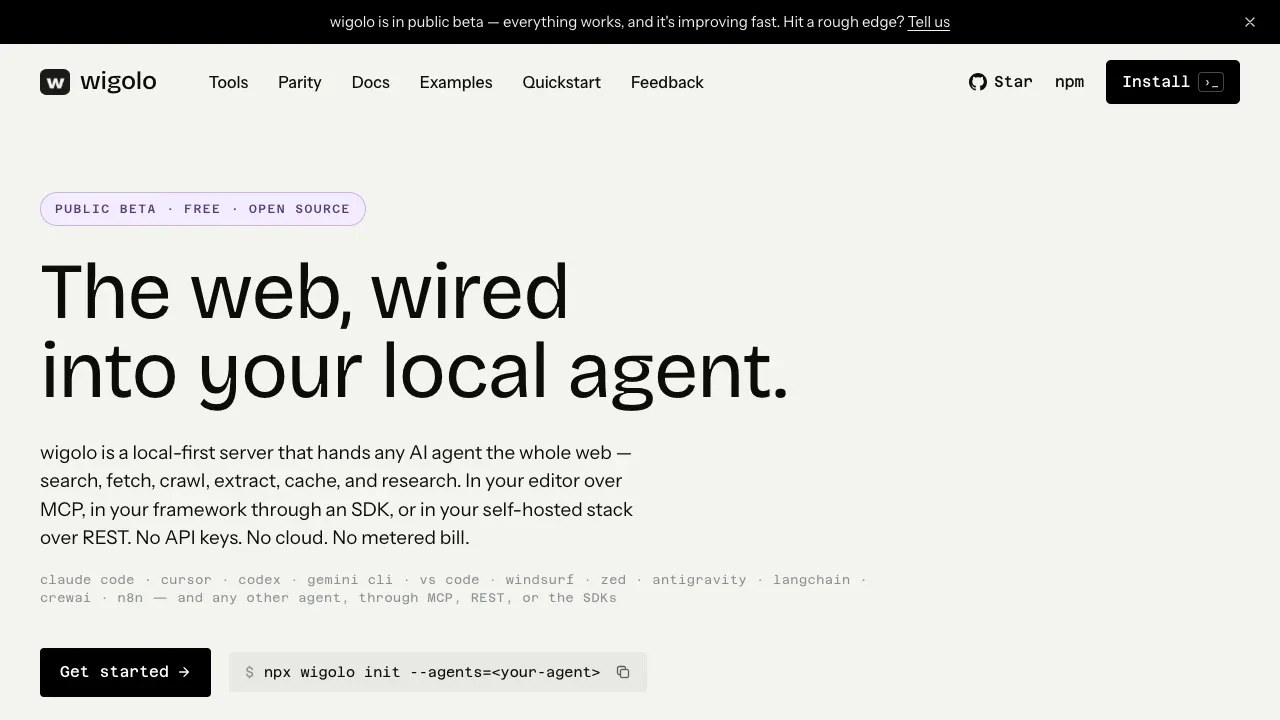
wigolo gives AI agents web access from a server on your own machine. It's for developers who want coding assistants or self-hosted agents to gather web evidence and reuse what they've already fetched.
- Search with citations: Search across multiple engines and get ranked results with quoted excerpts, citation IDs and explanations of each result's score.
- Page reading and extraction: Fetch pages, crawl sites and extract tables or structured data, with browser rendering for pages that need JavaScript.
- Offline cache: Search previously fetched content using keywords or semantic matching, find similar pages and detect changes. The cache and embedding models stay on your machine.
- Research and autonomous gathering: Turn a question into searches and a cited brief, or let an agent gather and synthesize sources with a step log. These capabilities require an LLM, either local through Ollama or through an external provider such as Gemini.
- Agent integrations: Connect through MCP, REST, or TypeScript and Python SDKs. Integrations include Claude Code, Cursor, Codex, LangChain, CrewAI, LlamaIndex and Vercel AI SDK.
wigolo is free and open source under AGPL-3.0, with a commercial license available for different terms. It runs on macOS, Linux and Windows, and supports Docker deployment. Core search, fetching, crawling, extraction and caching need no account or API key. Search ranking and embeddings run locally; live searches and page retrieval contact external websites, while cached content remains searchable offline. Choosing a cloud LLM sends synthesis work to that provider. Some strict anti-bot barriers require an optional proxy, solver or reader.
 Logotyper


