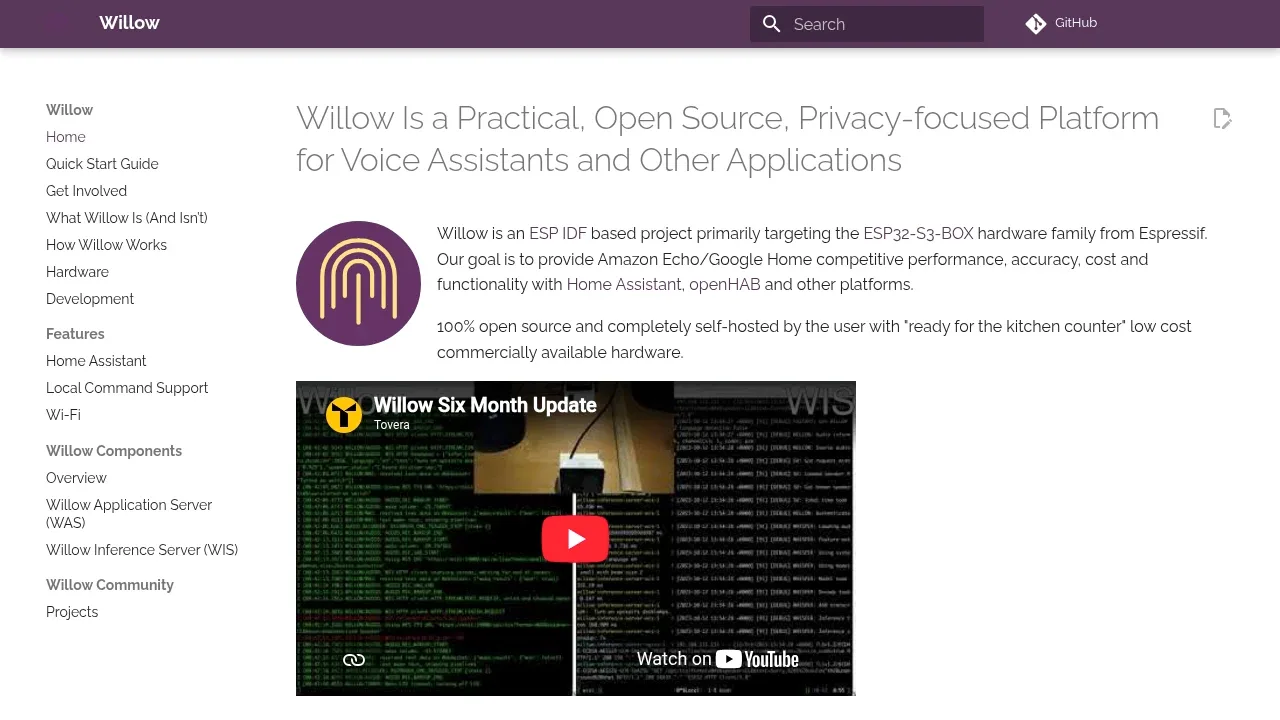
Willow is a self-hosted voice assistant platform for people who want home automation voice control on their own hardware. It runs on Espressif's ESP32-S3-BOX family and connects to Home Assistant, openHAB, or other services that accept speech results over HTTP. The project is open source under Apache 2.0.
You can choose where speech recognition happens. On-device recognition handles a configured set of commands and can work on a network without internet access. For speech beyond those commands, Willow Inference Server transcribes audio on a server you host. Tovera also provides a hosted inference service; that route sends audio off your hardware for processing.
Willow supports selectable wake words, including "Hi ESP" and "Alexa", and detects when you've finished speaking before taking action. Its far-field voice capture includes noise suppression and acoustic echo cancellation, useful for a device that sits across the room rather than beside your mouth. It also supports the ESP32-S3-BOX-3's color display and touchscreen.
The distinction from a cloud voice assistant is the choice between recognition entirely on the device and a separate speech server under your control. Generic REST API support lets it send recognized speech to applications beyond the named home automation systems. Willow Inference Server also supports text-to-speech and LLM tasks for Willow and other applications.
Claim this page with an email at heywillow.io. Willow gets the verified badge, and you can upgrade the listing to be featured on localhosted. Proud to be listed? Put our badge on your site.
Want more people to find Willow?Promote it
Something wrong or outdated on this page?
382Updated 3 years agoMIT
#Home Assistant integration#Multilingual#Voice activity detection
Rhasspy 3 is an early developer-preview local voice assistant toolkit for developers building their own assistants or adding voice control to Home Assistant. The project is archived and no longer maintained. It keeps data on your computer unless you choose to send it elsewhere, and its speech components support languages beyond English.
1.2KUpdated 8 months agoMIT
Linux · Docker#Code execution#Home Assistant integration#Voice activity detection
295Updated 2 days agoApache-2.0
Linux · Docker#OpenAI-compatible API#Wake word detection#Works offline
390Updated 1 day agoMIT
Docker#Home Assistant integration#Hugging Face integration#Multilingual
818Updated 4 years agoApache-2.0
macOS · Windows · Linux · Docker#Home Assistant integration#Works offline
5.7KUpdated 2 weeks agoMIT
macOS · Windows · Linux · Docker#Home Assistant integration#MCP#Multi-agent workflows
Wyoming Satellite connects a microphone and audio playback device to Home Assistant through the Wyoming protocol. It's for people building a self-hosted voice assistant with a separate device for speaking and listening. The project is archived and no longer maintained; its replacement is Linux Voice Assistant, which uses the ESPHome protocol.
OpenVoiceOS is a free, open-source voice AI platform for people building their own smart speakers or adding voice control to devices. Its core builds on a fork of MycroftAI/mycroft-core, and most classic Mycroft skills also work with it. The project uses the Apache 2.0 license, which permits personal and commercial use.
Wyoming Faster Whisper is a local speech-to-text server for Home Assistant and other clients that use the Wyoming protocol. It turns spoken audio into text on your own hardware, with support for names specific to your home. It's open source under the MIT license and runs as a Home Assistant add-on, a Docker container, or a local Python service.
DeepStack is a self-hosted computer vision API for developers adding image analysis to camera systems, home automation or other applications. It runs prebuilt and custom models on your own hardware and works fully offline. Image processing stays on the device or server where you host it, with no cloud service required.
GLaDOS is a local AI voice assistant modeled on the sarcastic character from Valve's Portal games. It's for people who want a conversational companion on their own hardware, with camera awareness and connections to home automation. The Python project is open source under the MIT license and runs on Linux and Windows. macOS support is experimental.