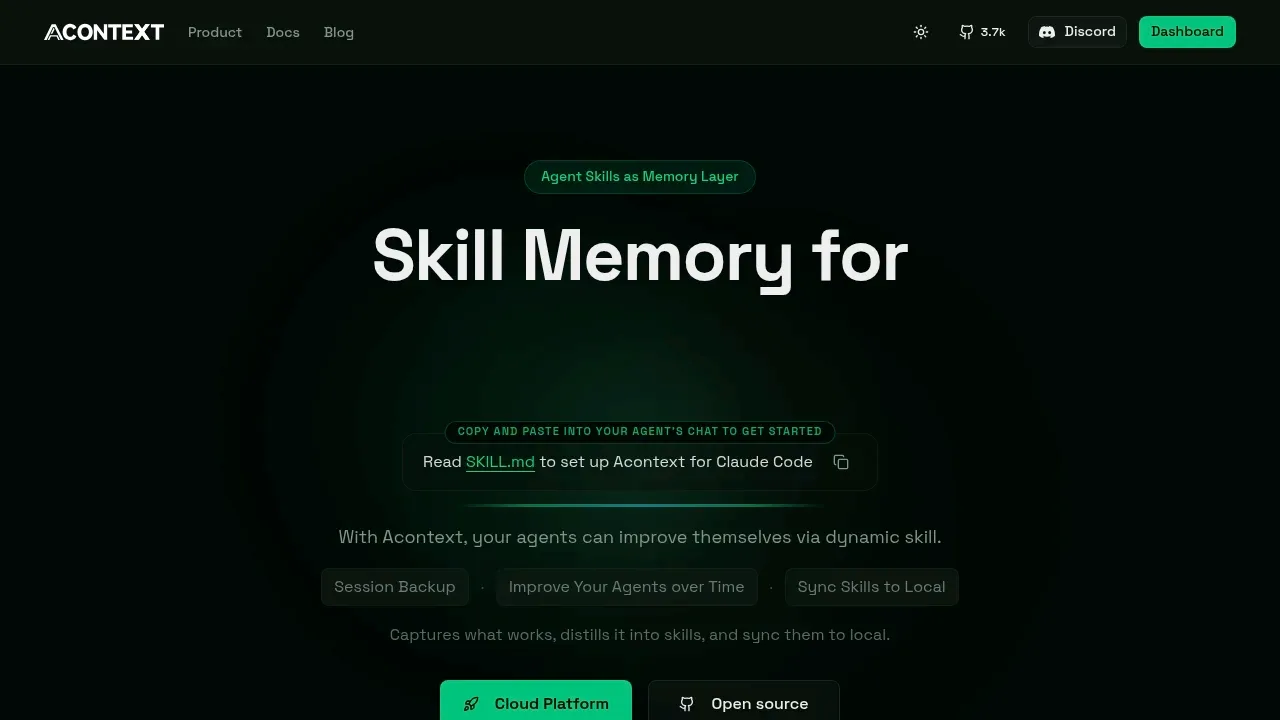
Acontext turns AI agent sessions into Markdown skill files that agents can reuse on later tasks. It's for developers who want agents to retain successful approaches, past mistakes, and user preferences in memory they can inspect and correct. The full stack can run on your own infrastructure, and a hosted cloud service is also available. It's open source under Apache 2.0.
The memory stays readable. Acontext draws lessons from conversations and execution traces when tasks succeed or fail, then creates or updates files in the SKILL.md format. You can define how those files are organized, such as keeping separate memory for each project or contact. Learning runs in the background.
Agents request the skill content they need rather than relying on embedding-based similarity search. The files remain editable and portable across agents, LLMs, and frameworks. You can export them as a ZIP or sync them locally for reuse; using the hosted service means sending session messages to that service, while self-hosting puts the Acontext stack on infrastructure you control.
Acontext works with Claude Code and OpenClaw, and provides Python and TypeScript SDKs. Its integrations include OpenAI, Anthropic, LangGraph, and Agno. Alongside skill memory, it offers context compression, a persistent virtual filesystem for agents, and isolated code execution with bash and Python. Agents can access files, sandboxes, and skills through function-calling tools.
Claim this page with an email at acontext.io. Acontext gets the verified badge, and you can upgrade the listing to be featured on localhosted. Proud to be listed? Put our badge on your site.
Want more people to find Acontext?Promote it
Something wrong or outdated on this page?
74.2KUpdated 2 hours agoApache-2.0
macOS · Windows · Linux#Context compression#MCP#Multi-agent workflows
Headroom compresses the material an AI agent reads before it reaches the model. It's for developers whose LLM apps or coding assistants spend context space on repetitive tool results, logs, files, and retrieved documents. Compression runs on your machine, and no prompt or file content goes to an external service for compression. Requests still go to your chosen LLM provider.
13.3KUpdated 1 day agoApache-2.0
Docker#Agent Skills#Hybrid search#MCP
31.4KUpdated 2 days agoApache-2.0
Docker#Hybrid search#Knowledge graphs#llama.cpp backend
4.5KUpdated 2 months agoApache-2.0
Docker · Web#Hybrid search#Knowledge graphs#MCP
901Updated 2 months agoApache-2.0
Docker · Web#Hybrid search#Knowledge graphs#MCP
3.2KUpdated 24 hours agoApache-2.0
Docker#Knowledge graphs#MCP#Ollama integration
EverOS is a self-hosted memory runtime and Python library for developers building AI agents that need to remember across sessions and applications. It stores conversations, files, and task histories as readable Markdown, with local SQLite and LanceDB indexes for retrieval. The code uses the Apache 2.0 license; a managed cloud service is also available.
Graphiti is a self-hosted Python framework for developers building AI agents that need to remember changing facts. It builds knowledge graphs from conversations, structured records and unstructured text, so an agent can query current information or recover what was true earlier. It's open source under Apache 2.0.
M Flow is a self-hosted memory engine for developers building AI agents and applications that need to recall earlier conversations, facts, and workflows. Its distinguishing feature is how it selects context: vector search finds possible matches, then a knowledge graph ranks them by the evidence connecting them to the query. It's open source under Apache 2.0 and runs as a Python library or a Docker service.
Memind is an open-source Java memory engine for developers building AI agents that need context across sessions. It turns conversations, documents, tool calls, and resolved tasks into connected memories, while retaining the original material so developers can trace a recalled fact to its source. It's licensed under Apache 2.0.
MemMachine is a self-hosted memory layer for developers building AI agents and LLM applications that need to remember users across conversations. Memory persists across sessions, restarts, agents, and model changes, so an application's user history isn't tied to one model provider. It's open source under Apache 2.0.