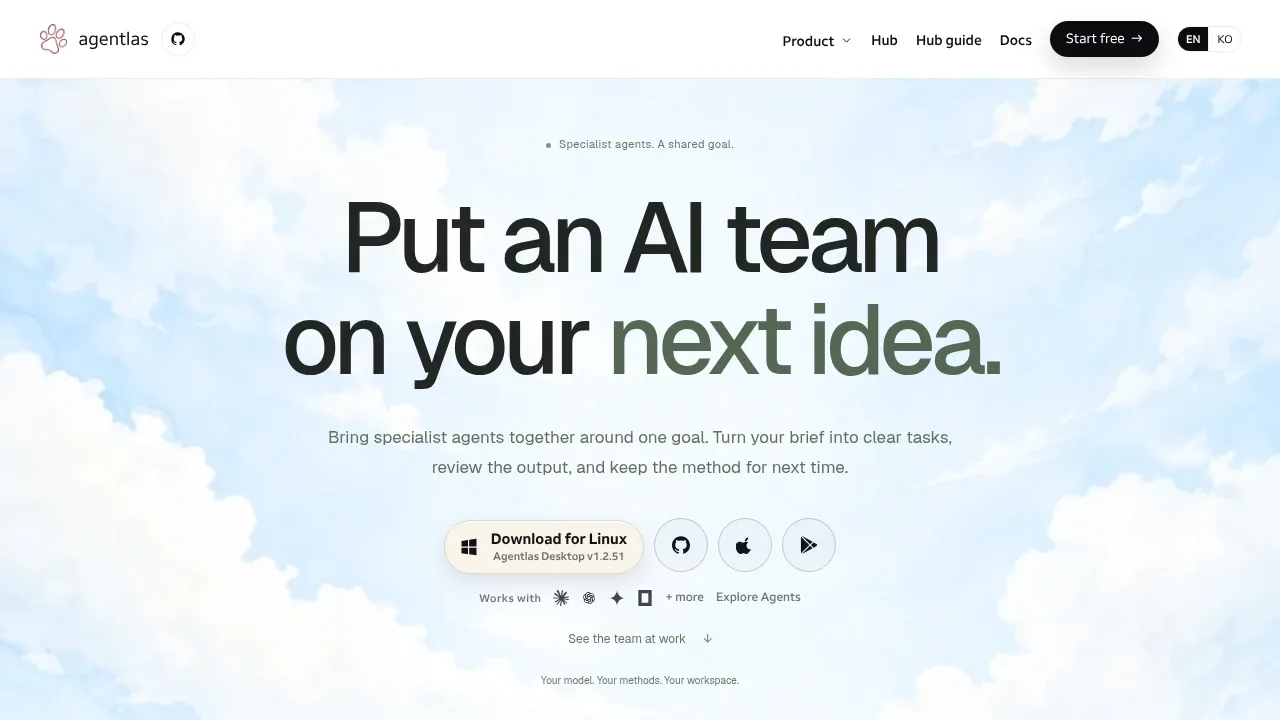
Agentlas OS is a local-first AI agent framework that assembles specialist teams around a task. It runs inside Claude Code, Codex, Cursor and Gemini and is open source under Apache 2.0. Its roles cover software development and work such as insurance analysis, M&A diligence and travel planning.
The framework splits a brief into tasks with defined roles, handoffs and expected outputs. It finds candidate agents on your machine, in your private Agent Cloud packages and in the public Agentlas Hub. Your chosen model selects the specialists and records its reasons. Project context and memory accompany each assignment, so agents receive information about the work they're taking on.
Verification is a separate stage. An independent verifier checks the work before the system marks it complete, with records of execution and handoffs. Agent releases are pinned to their exact contents, and external agents need signed identity verification as well as matching capabilities.
You supply the model access. Agent Cloud stores and retrieves agent packages; the selected model and current host runtime execute them. Credentials, local files and machine permissions don't travel with those packages. Project memory stays in a local database, while the chosen model provider determines where model requests go.
The related desktop app for macOS, Windows and Linux adds editable automation graphs and reusable Experience Chips for reviewed solutions. Tool-capable local models can browse pages, work with files and call connected tools; vision-capable models can control the screen within the access you allow.
Claim this page with an email at agentlas.cloud. Agentlas OS gets the verified badge, and you can upgrade the listing to be featured on localhosted. Proud to be listed? Put our badge on your site.
Want more people to find Agentlas OS?Promote it
Something wrong or outdated on this page?
18.2KUpdated 5 months agoApache-2.0
macOS · Windows · Linux · Docker · Web#Guardrails#Human approval#Knowledge graphs
OpenFang runs scheduled AI agents on your own machine, with built-in task packages called Hands that report results to a dashboard. It's for people who want recurring research, monitoring or business tasks to continue without prompting an agent each time. The open source platform runs on macOS, Windows and Linux under the Apache 2.0 license.
40.3KUpdated 23 hours agoGPL-3.0
macOS · Windows · Linux · Web#Human approval#LM Studio integration#MCP
137Updated 13 hours ago
macOS · Windows · Linux · Docker · Web#Agent Skills#Human approval#Knowledge graphs
32.9KUpdated 1 day agoApache-2.0
macOS · Windows · Linux · Docker · Web#Agent Client Protocol#Code execution#Guardrails
28.5KUpdated 5 hours ago
Web#Human approval#LLM tracing#MCP
1.2KUpdated 4 weeks agoMIT
#Agent Skills#Code execution#Git integration
OpenHuman is a free, open-source personal AI app for macOS, Windows and Linux that combines persistent local memory with agents that can act across your work apps. It's for people who want a desktop assistant that remembers context and handles tasks involving several tools. The project uses the GPL-3.0 license.
Project Orchestrator is a self-hosted coordination tool for developers working with multiple AI coding agents. It keeps code knowledge, development plans, and architectural decisions in a shared store so agents can reuse context across tasks and projects. It runs on macOS, Windows, and Linux, with desktop apps and Docker deployment available.
ZeroClaw is a self-hosted personal AI agent for people who want an assistant on their own computer or server, with control over its models and actions. It can answer messages, run shell commands, use a browser and carry out scheduled tasks. The agent runs locally.
Mastra is a TypeScript framework for developers building AI agents and applications on their own servers or inside existing web apps. Its server runs locally or as a standalone deployment; Mastra Cloud provides a hosted alternative. Model routing connects to providers such as OpenAI, Anthropic, and Gemini, so running the framework locally doesn't keep those model requests on your machine.
Pi Subagents adds specialized AI agents to pi for developers who want to split coding work across separate sessions. Each agent can have its own model, prompt and tool permissions. The extension runs within pi and is open source under the MIT license.