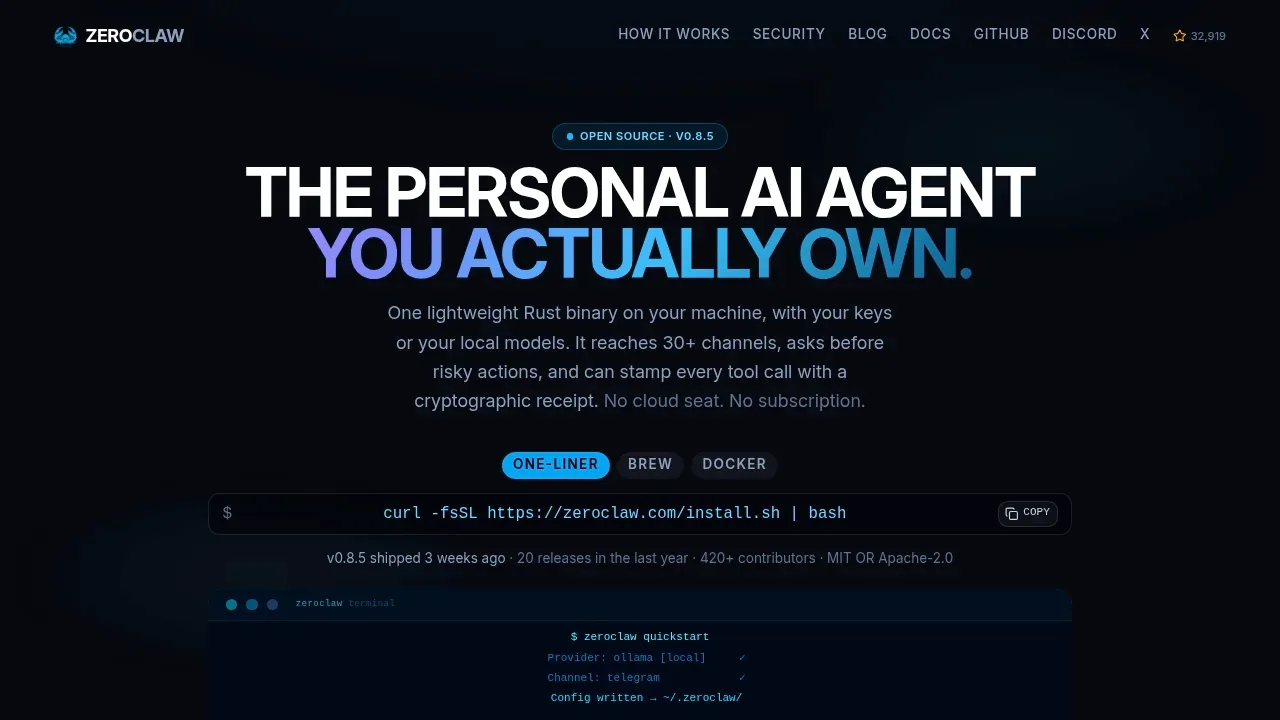
ZeroClaw is a self-hosted personal AI agent for people who want an assistant on their own computer or server, with control over its models and actions. It can answer messages, run shell commands, use a browser and carry out scheduled tasks. The agent runs locally.
It's a single Rust binary that runs on Linux, macOS and Windows, with Docker support. Its small runtime also suits Raspberry Pi hardware and homelab servers. ZeroClaw is open source under your choice of the MIT or Apache 2.0 license.
Local model backends include Ollama, LM Studio, llama.cpp and vLLM. With a local model, inference stays on your hardware; choosing Anthropic, OpenAI or another hosted provider sends prompts to that provider using your own key. There's no ZeroClaw cloud service between them. It also accepts OpenAI-compatible endpoints and can fall back between providers.
You can reach the agent through Telegram, Discord, Signal, Matrix, email and other channels. Schedules, webhooks and channel events can trigger tasks, while custom MCP servers extend the tools it can use. A web dashboard provides chat, memory browsing and task management. The runtime supports multiple named agents with separate isolation.
Supervised mode requires approval for medium-risk actions and blocks high-risk actions. Command allowlists, workspace boundaries and operating system sandboxes limit what the agent can access. Optional cryptographic receipts let you check that a reported tool call actually ran. Hardware tools can interact with Raspberry Pi GPIO and boards such as Arduino and ESP32.
Claim this page with an email at zeroclaw.com. ZeroClaw gets the verified badge, and you can upgrade the listing to be featured on localhosted. Proud to be listed? Put our badge on your site.
Want more people to find ZeroClaw?Promote it
Something wrong or outdated on this page?
18.2KUpdated 5 months agoApache-2.0
macOS · Windows · Linux · Docker · Web#Guardrails#Human approval#Knowledge graphs
OpenFang runs scheduled AI agents on your own machine, with built-in task packages called Hands that report results to a dashboard. It's for people who want recurring research, monitoring or business tasks to continue without prompting an agent each time. The open source platform runs on macOS, Windows and Linux under the Apache 2.0 license.
5.7KUpdated 2 days agoApache-2.0
macOS · Windows · Linux · Web#Code execution#MCP#Ollama integration
48.7KUpdated 9 hours agoMIT
macOS · Windows · Linux · Docker · Web#Agent Skills#Code execution#MCP
886Updated 2 weeks agoMIT
macOS · Windows · Linux · Docker · Web#Agent Skills#Code execution#Guardrails
41.2KUpdated 2 days agoAGPL-3.0
macOS · Docker · Web#Code execution#Hybrid search#LM Studio integration
326Updated 6 months agoMIT
macOS · Windows · Linux · Docker#Code execution#Guardrails#Hybrid search
OpenAgent is a self-hosted personal AI assistant that combines document search with agents that can act on your behalf. It's for people who want an assistant on their own computer or server, and teams building agents around their documents and workflows. It runs natively on Windows, macOS and Linux as a single executable. It's free and open source under Apache 2.0.
nanobot is a self-hosted personal AI agent for people who want an assistant that can work with files, carry tasks across conversations and handle recurring jobs. It runs on macOS, Windows or Linux, on your own server, or in Docker. Its Python core is open source under the MIT license and small enough for developers to inspect and extend.
PocketPaw is a self-hosted AI agent for people who want a personal assistant that can work with files, write code and use a browser on their own computer or server. It runs on macOS, Windows and Linux, with a web dashboard and access through messaging apps. It is open source under the MIT license.
AstrBot brings AI assistants into messaging apps such as Telegram, Discord, Slack, QQ and WeCom. It's an open source platform under AGPL-3.0 for people building personal companions, customer support bots or team automation. You can run it on your own computer or server, including through Docker, or use its desktop app for browser-style chat.
Clawlet is a self-hosted personal AI agent for people who want an assistant on their own machine or server, with searchable memory across conversations. Written in Go, it ships as a standalone binary with no separate runtime dependency. It supports macOS on Apple Silicon and Docker deployment, and it's open source under the MIT license.