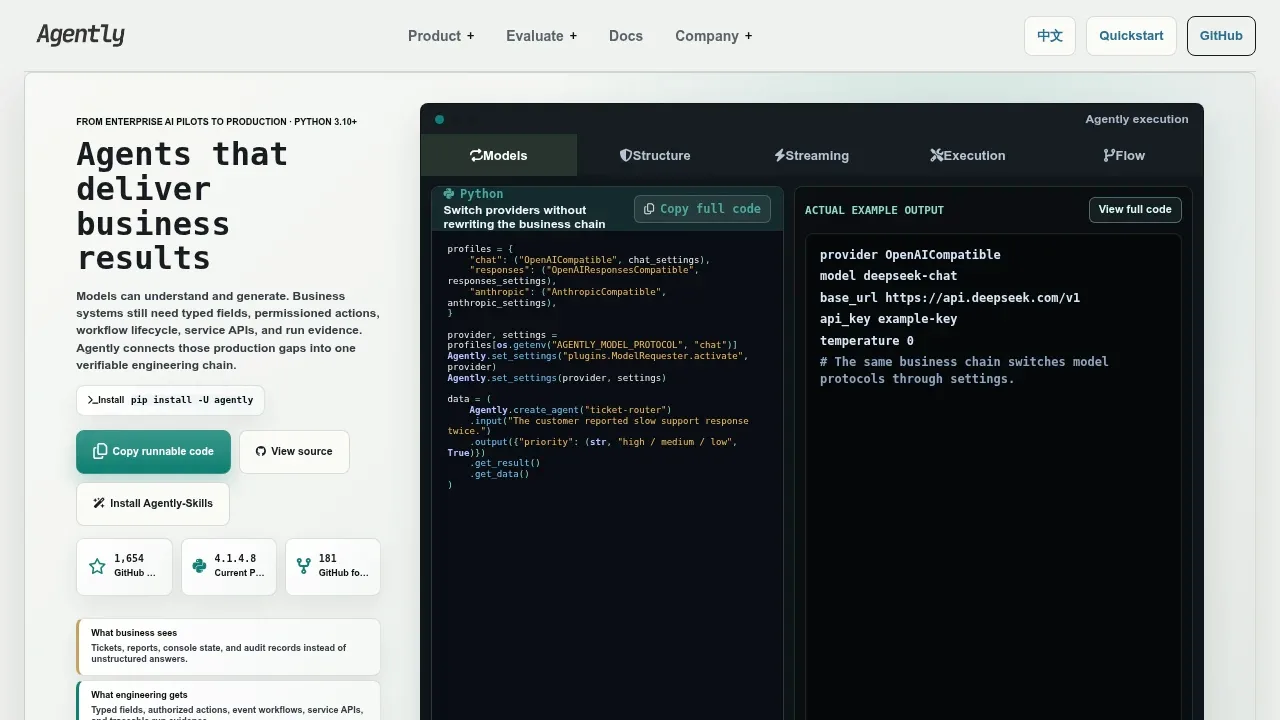
Agently is an open-source Python framework for engineering teams building AI service backends on their own infrastructure. It focuses on turning model responses into validated data and controlled actions that business applications can use. The framework runs in your application; requests go to the model provider you connect, including external services.
Its output schemas define typed fields and required values, with validation and retries to handle incomplete responses. Structured streaming lets an interface update individual fields before generation finishes. Those partial values remain provisional until final validation, a useful distinction for applications that act on model output.
Agents can call local functions, connect to MCP servers, and execute code in sandboxes. Permission boundaries control actions, while execution records capture results and references to generated artifacts. Reusable runtime Skills supply task guidance, with the host application retaining control over permitted actions.
TriggerFlow handles branching, parallel work, event-driven inputs, and pause or resume. Persistence and restart-safe execution support longer processes, including workflows with human review. Dynamic Task validates and runs task graphs supplied by applications or generated by models.
Agently supports OpenAI-compatible, OpenAI Responses-compatible, and Anthropic-compatible APIs without requiring a rewrite of business logic. FastAPI integration exposes agents as service endpoints with streaming responses. Agently-DevTools provides a local console for logs, evaluation, and run inspection. The framework uses the Apache 2.0 license.
Claim this page with an email at agently.tech. Agently gets the verified badge, and you can upgrade the listing to be featured on localhosted. Proud to be listed? Put our badge on your site.
Want more people to find Agently?Promote it
Something wrong or outdated on this page?
3.9KUpdated 1 day agoApache-2.0
#Agent Client Protocol#Agent Skills#Code execution
Fast Agent is a terminal coding assistant and Python toolkit for developers who want to build and evaluate AI agents with their choice of model. It supports local LLMs through a generic provider and automatically configures connections to llama.cpp servers. The toolkit runs on your machine; choosing Anthropic, Google, or a remote OpenAI-compatible endpoint sends model requests to that service.
4.7KUpdated 1 month agoMIT
macOS · Windows · Linux#Visual workflows
Rivet is a desktop visual programming environment for developers building AI agents and applications with complex LLM workflows. Its editor runs on macOS, Windows and Linux, and its TypeScript library executes the resulting graphs inside your own application. The project uses the MIT license.
94Updated 3 days agoApache-2.0
Docker · Web#Agent Client Protocol#Code execution#Distributed execution
24.8KUpdated 1 day ago
Docker · Web#Code execution#Human approval#MCP
2.3KUpdated 2 days agoApache-2.0
macOS · Windows · Linux · Docker · Web#Agent Skills#Guardrails#Human approval
1.4KUpdated 3 weeks agoMIT
Linux · Docker · Web#Agent Skills#Batch processing#Code execution
ACP Bridge lets teams share coding agents running on a development machine or self-hosted server through one HTTP API. It connects tools such as Claude Code, Codex, Kiro, Qwen and OpenCode using the Agent Client Protocol (ACP), so teammates and bots can call them without installing each agent locally. The project is open source under Apache 2.0 and supports Docker deployment.
Activepieces brings AI agents and workflow automation into one workspace for teams that need to connect their apps and internal data. It runs on your own servers with Docker or Kubernetes, or as a managed cloud service. An isolated deployment can keep platform data on its own infrastructure; connected apps and model providers may still require external access. Its core and app integration pieces are MIT-licensed.
Agency Orchestrator turns a task description into a team of specialist AI roles that divide the work and combine their results. It's for solo builders, developers and content creators who want repeatable workflows for product planning, research or code review. The open-source software uses the Apache 2.0 license and runs locally through a browser interface, a desktop app for macOS, Windows and Linux, or Docker on a server or NAS.
AgentFlow is an MIT-licensed Python framework for developers who want several coding agents to share a workflow. It connects Codex, Claude, Kimi, and Pi tasks in dependency graphs, so planning can feed implementation and parallel reviews can feed a combined result. Agents can run in local Docker containers or on remote machines through SSH, EC2, and ECS.