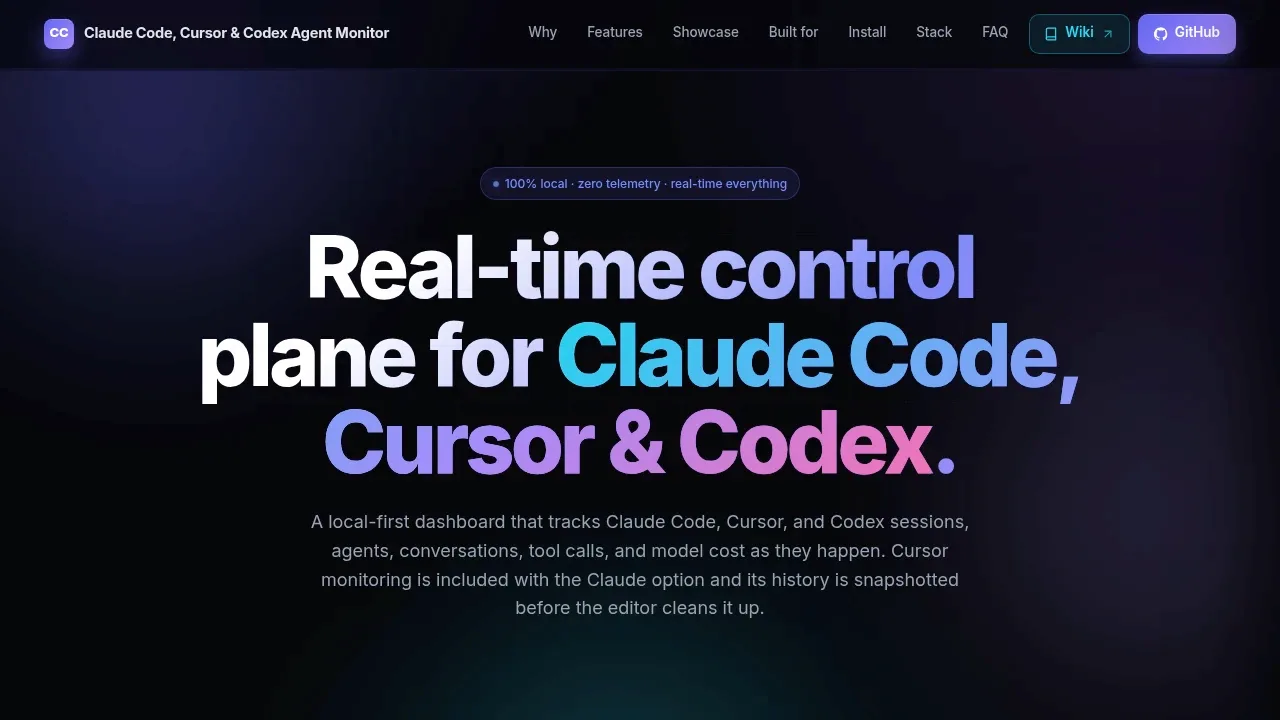
Claude Code Agent Monitor puts Claude Code, Cursor and Codex activity in one local dashboard for developers tracking coding sessions and teams monitoring agent work. It runs in a browser served by your own machine, with desktop apps for macOS and Windows and a VS Code sidebar. The dashboard works offline, requires no account and sends no telemetry. It's free and open source under the MIT license.
Live views show tool calls, agent status and conversations as work happens. A Kanban board separates work in progress from sessions waiting for input, completed tasks and errors. Searchable history and conversation replay help you inspect what an agent did, including its tool output and subagent activity. Cursor conversations remain available even after the editor removes its own history.
Token accounting handles context compression, while per-model and per-subagent cost estimates help you compare spending across sessions and projects. Workflow diagrams show delegation, tool transitions and collaboration between agents. Rules can flag stuck agents, error bursts or token thresholds and send alerts to webhook endpoints.
You can also start and resume Claude Code or Codex sessions in the browser, inspect their configuration and edit supported files with backups. Capture uses native hooks and local transcripts, so your CLI workflow can continue if the dashboard stops. It stores monitoring data locally in SQLite; optional SSH sources bring remote histories into the dashboard. A local MCP server, Prometheus metrics and Grafana dashboards support automation and team monitoring.
Claim this page and we'll verify you by hand. Claude Code Agent Monitor gets the verified badge, and you can upgrade the listing to be featured on localhosted. Proud to be listed? Put our badge on your site.
Want more people to find Claude Code Agent Monitor?Promote it
Something wrong or outdated on this page?
1.1KUpdated 16 hours agoAGPL-3.0
macOS · Web#Agent Client Protocol#Agent Skills#Git integration
AgentRQ is a self-hosted task manager for people supervising AI agents on their own computers. Agents can ask for decisions, report progress, and receive tasks while you follow their work and reply from a browser, phone, or desktop app. It also offers a hosted service; agents run on your machines, while the task dashboard runs on your own server or the hosted service.
42.5KUpdated 12 hours agoApache-2.0
Docker · Web#Guardrails#Human approval#LLM tracing
11.7KUpdated 19 hours ago
Docker · Web#LLM tracing#MCP#Ollama integration
3.3KUpdated 3 weeks agoApache-2.0
Docker · Web#LLM tracing#MCP
Laminar is an open-source platform for developers who need to see why an AI agent failed and check whether a fix worked. You can self-host it with Docker or on Kubernetes, including AWS and GCP, or use its managed cloud service. It uses the Apache 2.0 license.
4.7KUpdated 14 hours agoMIT
Docker · Web#Git integration#LLM tracing#MCP
201Updated 3 months agoMIT
macOS · Linux#Distributed execution#Guardrails#Human approval
Agno is a Python framework and runtime for developers building customer-facing or internal AI agents. You can run its agent platform locally with Docker, on your own servers or in your cloud. The open-source framework uses the Apache 2.0 license, and the platform keeps sessions, memory, knowledge and traces in your database.
Arize Phoenix is a self-hosted platform for developers who need to understand why an AI agent failed and test changes before shipping them. It runs on a laptop, in Docker, or on Kubernetes. Self-hosting keeps traces on your infrastructure; Phoenix Cloud provides a hosted alternative. Phoenix uses the Elastic License 2.0 (ELv2), a source-available license.
Latitude is a self-hosted AI agent monitoring platform for teams that need to find production failures and check that fixes work. It connects recurring problems to the sessions that caused them, then can dispatch Claude Code or Cursor with enough context to make a fix and open a pull request.
claudectl is a local dashboard and supervisor for developers running several Claude Code agents on macOS or Linux. It brings session activity, approvals and spending into one terminal view, with an optional local LLM that makes decisions based on your preferences. It's open source under the MIT license.