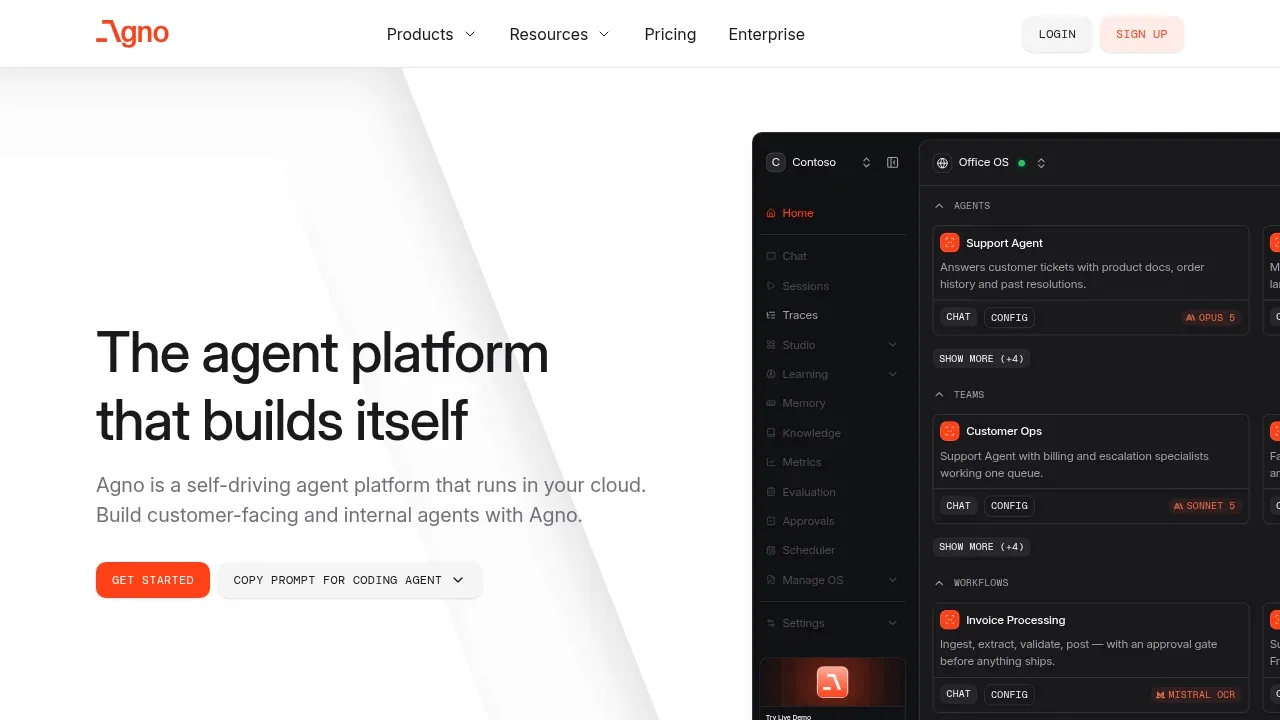
Agno is a Python framework and runtime for developers building customer-facing or internal AI agents. You can run its agent platform locally with Docker, on your own servers or in your cloud. The open-source framework uses the Apache 2.0 license, and the platform keeps sessions, memory, knowledge and traces in your database.
The SDK supports individual agents, cooperating teams and workflows, with tools, document knowledge, structured outputs and persistent memory. It suits product copilots, support agents and research workflows that need to take actions or retain context across conversations. Coding assistants such as Claude Code, Cursor and Codex can help build and improve the platform.
AgentOS turns agents into services accessible through REST APIs and MCP, so products, ChatGPT and Claude can call them. It also connects agents to Slack, Telegram, WhatsApp and Discord. The runtime supports scheduled jobs, background execution and runs that pause for human approval, while the web control plane shows sessions, traces, evaluations and usage metrics.
You're free to choose models, providers or gateways. AgentOS can also run agents built with LangGraph, DSPy, the Claude SDK or custom code. Role-based access, per-tool permissions and audit logs govern agent activity.
Local hosting doesn't make external services local: connected model providers and tools remain separate services. Agno also sends a telemetry event for each agent run, which you can disable; it doesn't send prompts, messages or outputs in those events.
Claim this page with an email at agno.com. Agno gets the verified badge, and you can upgrade the listing to be featured on localhosted. Proud to be listed? Put our badge on your site.
Want more people to find Agno?Promote it
Something wrong or outdated on this page?
9.5KUpdated 1 day agoApache-2.0
Docker · Web#Guardrails#MCP#Tool calling
Higress is a self-hosted AI gateway for developers and teams managing model APIs and the tools their AI agents call. It puts LLM traffic and MCP servers behind a shared entry point, with authentication, traffic controls and monitoring. The open-source edition uses the Apache 2.0 license and runs locally in Docker without registration. Alibaba Cloud also offers a fully managed gateway.
11.7KUpdated 23 hours ago
Docker · Web#LLM tracing#MCP#Ollama integration
3.3KUpdated 2 weeks agoApache-2.0
Docker · Web#LLM tracing#MCP
Laminar is an open-source platform for developers who need to see why an AI agent failed and check whether a fix worked. You can self-host it with Docker or on Kubernetes, including AWS and GCP, or use its managed cloud service. It uses the Apache 2.0 license.
4.7KUpdated 2 days agoMIT
Docker · Web#Git integration#LLM tracing#MCP
28.4KUpdated 21 hours ago
Web#Human approval#LLM tracing#MCP
7.1KUpdated 2 days agoApache-2.0
Docker#Guardrails#LLM tracing#Multi-agent workflows
Arize Phoenix is a self-hosted platform for developers who need to understand why an AI agent failed and test changes before shipping them. It runs on a laptop, in Docker, or on Kubernetes. Self-hosting keeps traces on your infrastructure; Phoenix Cloud provides a hosted alternative. Phoenix uses the Elastic License 2.0 (ELv2), a source-available license.
Latitude is a self-hosted AI agent monitoring platform for teams that need to find production failures and check that fixes work. It connects recurring problems to the sessions that caused them, then can dispatch Claude Code or Cursor with enough context to make a fix and open a pull request.
Mastra is a TypeScript framework for developers building AI agents and applications on their own servers or inside existing web apps. Its server runs locally or as a standalone deployment; Mastra Cloud provides a hosted alternative. Model routing connects to providers such as OpenAI, Anthropic, and Gemini, so running the framework locally doesn't keep those model requests on your machine.
Plano, formerly Arch Gateway, is a self-hosted AI gateway for developers building applications with multiple agents or model providers. It puts routing, guardrails and request tracing in a separate service, so each agent doesn't need its own implementation of that infrastructure. It's open source under Apache 2.0.