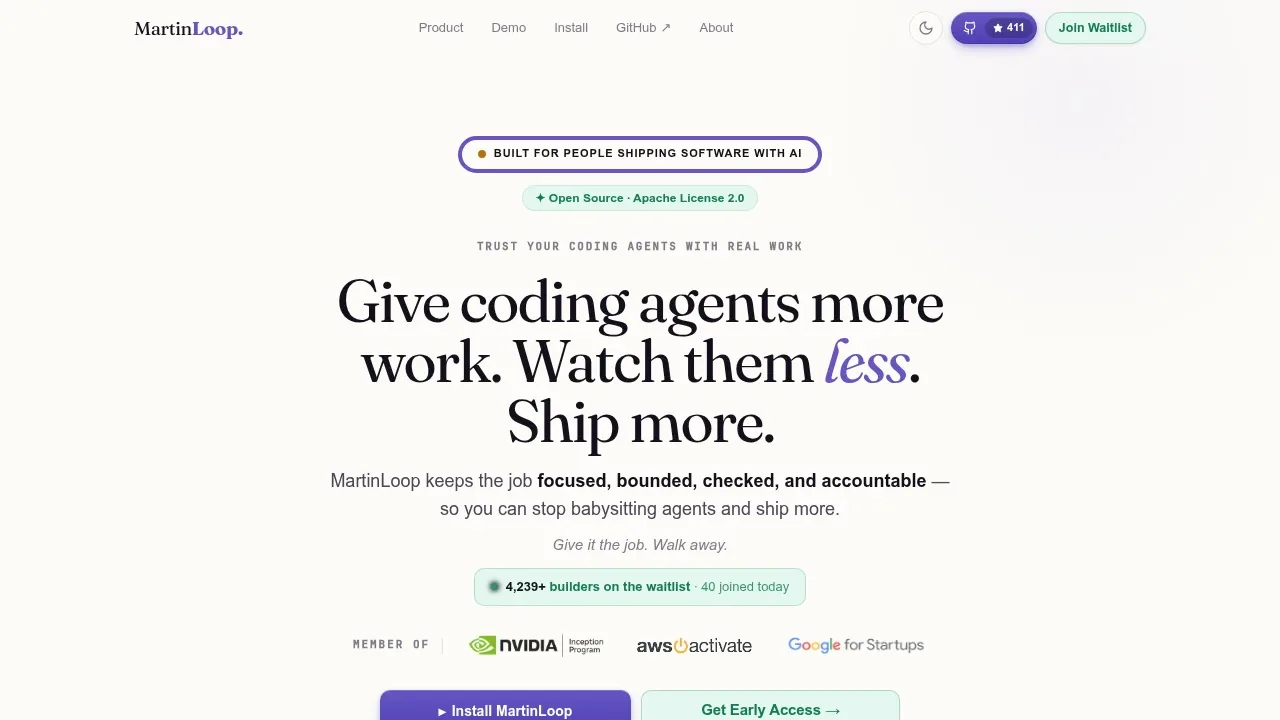
MartinLoop is a free, self-hosted runtime for developers and engineering teams delegating software work to AI coding agents. It wraps Claude Code, Codex CLI and Gemini CLI with limits and checks that sit outside the agent. The agent writes the code; MartinLoop decides when work can continue and when the result passes the configured checks.
Runs have spending, time and attempt limits, plus boundaries on which paths an agent can change. MartinLoop stops stalled work and requires verification evidence before accepting completion. Each run ends with a verified result, a stop reason or a request for review. Recovery and rollback records support another attempt or a handoff, while receipts bring together checks, failures and costs.
The job definition stays separate from the coding agent, so teams can switch workers while retaining the same limits and verification rules. MCP integration connects it to compatible hosts. OpenAI-compatible inference workflows can use hosted providers or local endpoints such as Ollama, LM Studio and llama.cpp; that path isn't presented as a finished autonomous coding worker.
The core uses the Apache 2.0 license and doesn't require an account to start. Run records stay local and carry signatures that make later edits detectable. Anonymous usage telemetry is enabled by default after disclosure and can be disabled. It excludes source code, prompts, repository contents, model output and receipt contents. A separate hosted dashboard is also offered.
Claim this page with an email at martinloop.com. MartinLoop gets the verified badge, and you can upgrade the listing to be featured on localhosted. Proud to be listed? Put our badge on your site.
Want more people to find MartinLoop?Promote it
Something wrong or outdated on this page?
42.5KUpdated 12 hours agoApache-2.0
Docker · Web#Guardrails#Human approval#LLM tracing
Agno is a Python framework and runtime for developers building customer-facing or internal AI agents. You can run its agent platform locally with Docker, on your own servers or in your cloud. The open-source framework uses the Apache 2.0 license, and the platform keeps sessions, memory, knowledge and traces in your database.
201Updated 3 months agoMIT
macOS · Linux#Distributed execution#Guardrails#Human approval
claudectl is a local dashboard and supervisor for developers running several Claude Code agents on macOS or Linux. It brings session activity, approvals and spending into one terminal view, with an optional local LLM that makes decisions based on your preferences. It's open source under the MIT license.
2.6KUpdated 2 days agoApache-2.0
#Distributed execution#Guardrails#Human approval
AgentField is a self-hosted, open source platform for developers building AI agents that need to work together under shared access rules. It runs in your own infrastructure and combines agent execution with identity, policy enforcement and audit records. The project uses the Apache 2.0 license.
587Updated 21 hours agoMIT
Web · VS Code · JetBrains#Agent Client Protocol#Code execution#Git integration
Claw Orchestrator is a self-hosted runtime for developers who want to coordinate coding agents on their own machine or server. It brings Claude Code, Codex, Antigravity, Grok Build and OpenCode into one interface, with support for custom coding CLIs. The runtime and browser dashboard run locally.
536Updated 6 months agoMIT
Web#Code execution#Git integration#Guardrails
ClawLess runs Claw AI agents in a browser sandbox, giving developers a place to execute and inspect agent tasks without a backend server. WebContainers provide a Node.js environment with a virtual filesystem that agents can read, write and execute files in, without access to the host system. The runtime runs locally. Model requests go to cloud services from Anthropic, OpenAI or Google using API keys, so this isn't fully offline AI.
3.9KUpdated 1 day agoApache-2.0
#Agent Client Protocol#Agent Skills#Code execution
Fast Agent is a terminal coding assistant and Python toolkit for developers who want to build and evaluate AI agents with their choice of model. It supports local LLMs through a generic provider and automatically configures connections to llama.cpp servers. The toolkit runs on your machine; choosing Anthropic, Google, or a remote OpenAI-compatible endpoint sends model requests to that service.