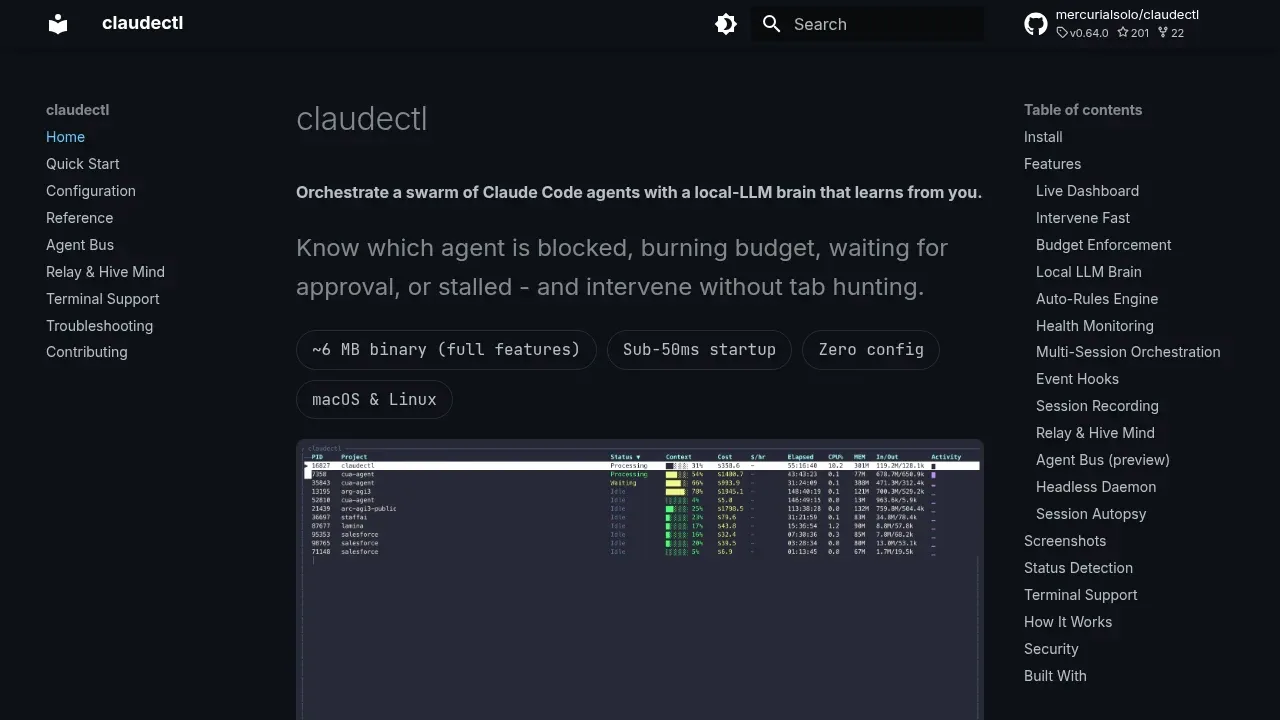
claudectl is a local dashboard and supervisor for developers running several Claude Code agents on macOS or Linux. It brings session activity, approvals and spending into one terminal view, with an optional local LLM that makes decisions based on your preferences. It's open source under the MIT license.
The dashboard shows which agents need input, are working or have stalled, alongside context usage, resource consumption and subagent activity. You can approve requests, send input or terminate sessions from the same view. Spending controls enforce session or daily limits, while health checks flag retry loops, cost spikes and overloaded context. Completed sessions have post-mortem reports showing where work stalled and costs accumulated.
The local supervisor can approve or deny tool calls, pass summarized context between agents and start sessions for parallel work. It learns from your corrections and manual decisions, with separate preferences for different projects. Decision reviews show the reasoning, confidence and past examples behind an action. It works with Ollama, llama.cpp, vLLM and LM Studio through OpenAI-compatible endpoints.
Dependency ordering and coordination help agents share context and avoid duplicate work. A headless mode keeps supervision active without the dashboard, and peer-to-peer connections let instances delegate tasks and share learned preferences across machines. claudectl itself needs no API key or account and keeps monitoring and learning data locally; configured webhooks can send data out.
Claim this page and we'll verify you by hand. claudectl gets the verified badge, and you can upgrade the listing to be featured on localhosted. Proud to be listed? Put our badge on your site.
Want more people to find claudectl?Promote it
Something wrong or outdated on this page?
42.5KUpdated 11 hours agoApache-2.0
Docker · Web#Guardrails#Human approval#LLM tracing
Agno is a Python framework and runtime for developers building customer-facing or internal AI agents. You can run its agent platform locally with Docker, on your own servers or in your cloud. The open-source framework uses the Apache 2.0 license, and the platform keeps sessions, memory, knowledge and traces in your database.
409Updated 1 day agoApache-2.0
#Code execution#Guardrails#Human approval
1.5KUpdated 3 weeks agoMIT
macOS · Windows · Linux · Web#Context compression#Human approval#MCP
1.2KUpdated 2 days agoApache-2.0
Linux · Docker#Code execution#Git integration#Guardrails
Coding Tools MCP gives AI chat apps and agents access to a codebase on your own machine through the Model Context Protocol (MCP). It's for developers who want their existing client to read files, edit code and run tests, with access confined to a chosen workspace. The Python server is open source under Apache 2.0 and can also run in Docker.
2.6KUpdated 2 days agoApache-2.0
#Distributed execution#Guardrails#Human approval
270.3KUpdated 2 days agoMIT
Windows#Guardrails#MCP#Multi-agent workflows
MartinLoop is a free, self-hosted runtime for developers and engineering teams delegating software work to AI coding agents. It wraps Claude Code, Codex CLI and Gemini CLI with limits and checks that sit outside the agent. The agent writes the code; MartinLoop decides when work can continue and when the result passes the configured checks.
agentchattr is a local chat server for developers who want multiple AI coding agents to work together in one conversation. Humans and agents can mention each other to prompt a response, so you don't have to carry messages between separate terminals. It runs on Windows, macOS and Linux, with a browser interface.
AgentField is a self-hosted, open source platform for developers building AI agents that need to work together under shared access rules. It runs in your own infrastructure and combines agent execution with identity, policy enforcement and audit records. The project uses the Apache 2.0 license.
ECC is a free, MIT-licensed open source toolkit that adds repeatable engineering workflows to coding assistants. It runs alongside your chosen agent and works with self-hosted models or cloud providers through that agent's supported endpoints. It's for developers who want planning, testing and review to follow a consistent process across coding sessions.