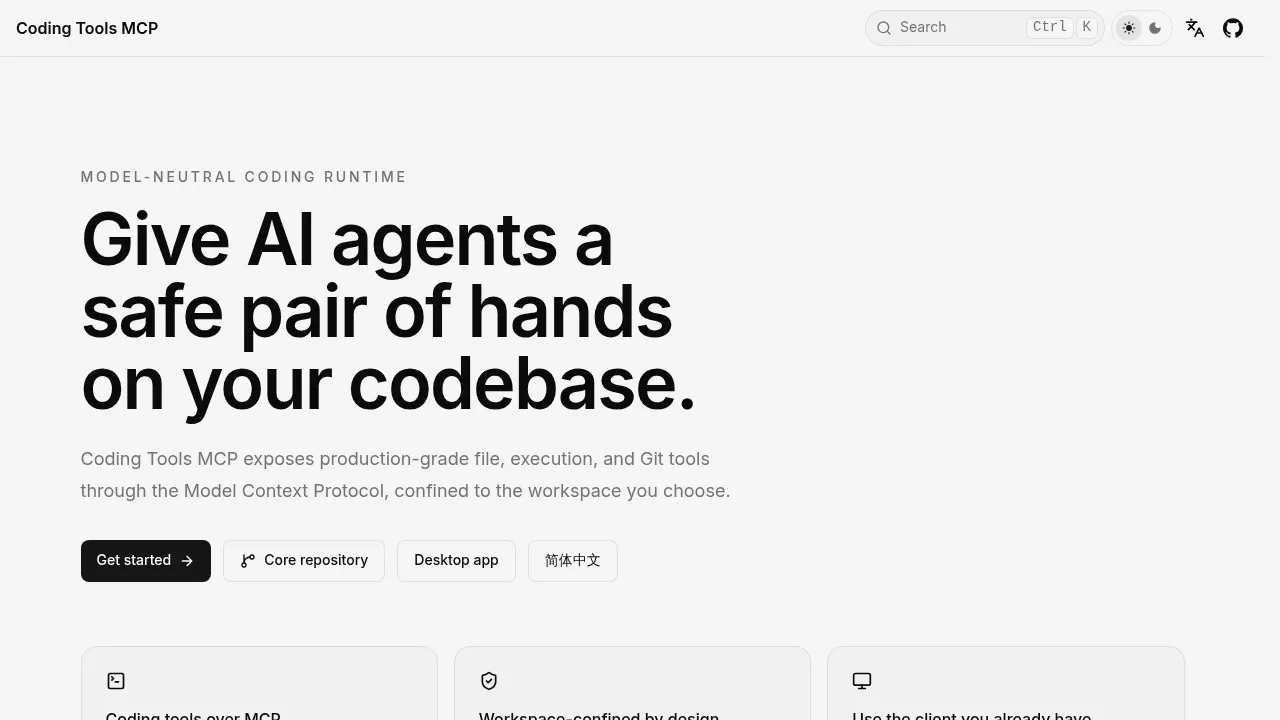
Coding Tools MCP gives AI chat apps and agents access to a codebase on your own machine through the Model Context Protocol (MCP). It's for developers who want their existing client to read files, edit code and run tests, with access confined to a chosen workspace. The Python server is open source under Apache 2.0 and can also run in Docker.
The runtime works across models and clients, including Claude Desktop, ChatGPT, Codex, Cursor, VS Code, Windsurf, Cline and Gemini CLI. It supplies the coding tools; the connected client supplies the AI model. Using a cloud client doesn't make that model local.
File search, image viewing and structured edits sit alongside command execution, interactive processes and Git inspection. Edits across multiple files check for conflicting changes and support rollback. Tool responses summarize and limit output to reduce how much of the agent's context window they consume.
Access controls are central to its design. Workspace boundaries reject paths and symlinks that escape the selected folder, while permission modes control network access, scripts and destructive commands. Secret filtering adds another safeguard. Linux can add kernel-level filesystem confinement through Landlock, though the runtime isn't a complete operating-system sandbox.
Remote access supports bearer tokens and OAuth, so a client can reach your workstation through an authenticated HTTPS tunnel. The server sends anonymous usage telemetry by default, which you can disable; those events exclude file contents, paths, commands and arguments.
Claim this page and we'll verify you by hand. Coding Tools MCP gets the verified badge, and you can upgrade the listing to be featured on localhosted. Proud to be listed? Put our badge on your site.
Want more people to find Coding Tools MCP?Promote it
Something wrong or outdated on this page?
201Updated 3 months agoMIT
macOS · Linux#Distributed execution#Guardrails#Human approval
claudectl is a local dashboard and supervisor for developers running several Claude Code agents on macOS or Linux. It brings session activity, approvals and spending into one terminal view, with an optional local LLM that makes decisions based on your preferences. It's open source under the MIT license.
270.3KUpdated 2 days agoMIT
Windows#Guardrails#MCP#Multi-agent workflows
1.8KUpdated 3 months agoApache-2.0
macOS · Windows · Linux · Docker#Agent Client Protocol#Code execution#Guardrails
1.5KUpdated 3 weeks agoMIT
macOS · Windows · Linux · Web#Context compression#Human approval#MCP
42.5KUpdated 10 hours agoApache-2.0
Docker · Web#Guardrails#Human approval#LLM tracing
45.6KUpdated 2 hours agoMIT
macOS · Windows · Linux · Web#Git integration#Knowledge graphs#MCP
Codebase Memory MCP gives AI coding agents a persistent map of a repository's structure, so they can answer questions about dependencies and call chains without repeatedly reading whole files. It's for developers using Claude Code, Codex CLI, Cursor or other MCP-compatible clients who want their agents to spend less context on code exploration.
ECC is a free, MIT-licensed open source toolkit that adds repeatable engineering workflows to coding assistants. It runs alongside your chosen agent and works with self-hosted models or cloud providers through that agent's supported endpoints. It's for developers who want planning, testing and review to follow a consistent process across coding sessions.
Stakpak is an open source AI agent for developers and DevOps teams who want to run production operations on their own machines or servers. It can work interactively in a terminal or run continuously in the background, investigating app health problems, taking corrective action and notifying a human when it needs help.
agentchattr is a local chat server for developers who want multiple AI coding agents to work together in one conversation. Humans and agents can mention each other to prompt a response, so you don't have to carry messages between separate terminals. It runs on Windows, macOS and Linux, with a browser interface.
Agno is a Python framework and runtime for developers building customer-facing or internal AI agents. You can run its agent platform locally with Docker, on your own servers or in your cloud. The open-source framework uses the Apache 2.0 license, and the platform keeps sessions, memory, knowledge and traces in your database.