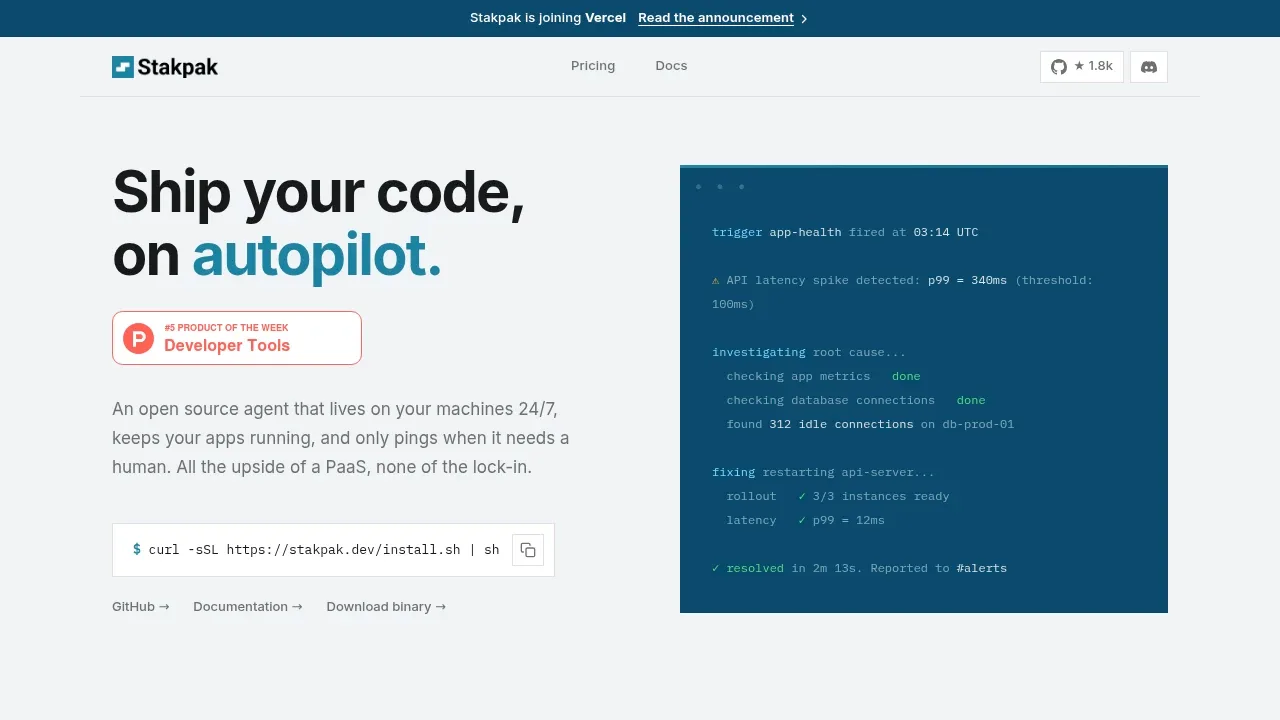
Stakpak is an open source AI agent for developers and DevOps teams who want to run production operations on their own machines or servers. It can work interactively in a terminal or run continuously in the background, investigating app health problems, taking corrective action and notifying a human when it needs help.
Its operations work includes deployment automation, Kubernetes debugging and infrastructure code generation. Scheduled tasks can check for unused cloud resources, produce cost reports and address expiring TLS certificates. It also indexes Terraform, Kubernetes, Dockerfile and GitHub Actions files locally for semantic search. Teams can supply their own playbooks and policies, and the agent retains knowledge of incidents and environment details.
The security controls address what an agent can access and change. Secret substitution replaces credentials with placeholders before model requests and restores real values during execution. Warden applies network policies through a proxy. Session logs record commands and file edits, while backups support recovery for changes made locally or over SSH.
Written in Rust and licensed under Apache 2.0, Stakpak runs on Linux, macOS and Windows, with a Docker image available. The agent runs locally; model requests can use Anthropic, OpenAI or Stakpak's API, or stay local through an OpenAI-compatible endpoint such as Ollama or LM Studio. You don't need a Stakpak account when using your own provider. Remote VM autopilot requires Docker, with at least 2 GB of RAM recommended for the agent and sandbox.
Claim this page with an email at stakpak.dev. Stakpak gets the verified badge, and you can upgrade the listing to be featured on localhosted. Proud to be listed? Put our badge on your site.
Want more people to find Stakpak?Promote it
Something wrong or outdated on this page?
409Updated 1 day agoApache-2.0
#Code execution#Guardrails#Human approval
MartinLoop is a free, self-hosted runtime for developers and engineering teams delegating software work to AI coding agents. It wraps Claude Code, Codex CLI and Gemini CLI with limits and checks that sit outside the agent. The agent writes the code; MartinLoop decides when work can continue and when the result passes the configured checks.
42Updated 2 days ago
macOS · Windows · Linux · Docker#Agent Skills#Code execution#Distributed execution
4.4KUpdated 1 day agoMIT
macOS · Windows · Linux · Web · JetBrains#Agent Client Protocol#Code execution#Git integration
1.3KUpdated 3 weeks agoMIT
macOS · Windows · Linux#Code execution#Guardrails#MCP
21.8KUpdated 2 hours ago
macOS · Windows · Linux#MCP#Multimodal input#Ollama integration
195Updated 7 months agoMIT
macOS · Windows · Linux · Web#Agent Skills#Code execution#Guardrails
Code Buddy is an AI coding assistant for developers who want a terminal agent running on their own machine, with a choice of local or cloud models. It reads repositories, edits code and runs commands on Linux, macOS and Windows. Ollama keeps model inference local without an API key or account; cloud providers send model requests off the machine. Routing includes automatic provider failover.
gptme is a self-hosted AI agent that works directly in your terminal, with access to your files and installed tools. It's for developers who want a coding assistant in their own environment, and people who want an agent for data analysis or other knowledge work. The software is free under the MIT license and doesn't require a gptme account.
Reverify is a local verification toolkit for developers and reverse engineers who use AI to analyze binaries or rewrite code. It checks a model's claims against the actual file or executed behavior, then returns a verdict with evidence. The Python project is open source under the MIT license and runs on Linux, Windows and macOS as a CLI or MCP server.
Screenpipe records screen activity and audio as searchable local history that AI agents can use as context. It's for people who want to recall past work and teams that want agents to draft follow-ups or update work records using what actually happened. Raw history stays on your device by default.
VibeHQ Hub coordinates separate Claude Code, Codex and Gemini CLI agents on your own computer. It's for developers assigning parts of a project to multiple coding assistants who need agreement on interfaces, dependencies and deliverables. The hub runs locally. It's open source under the MIT license, with tested Windows and macOS support; some Linux components remain untested.