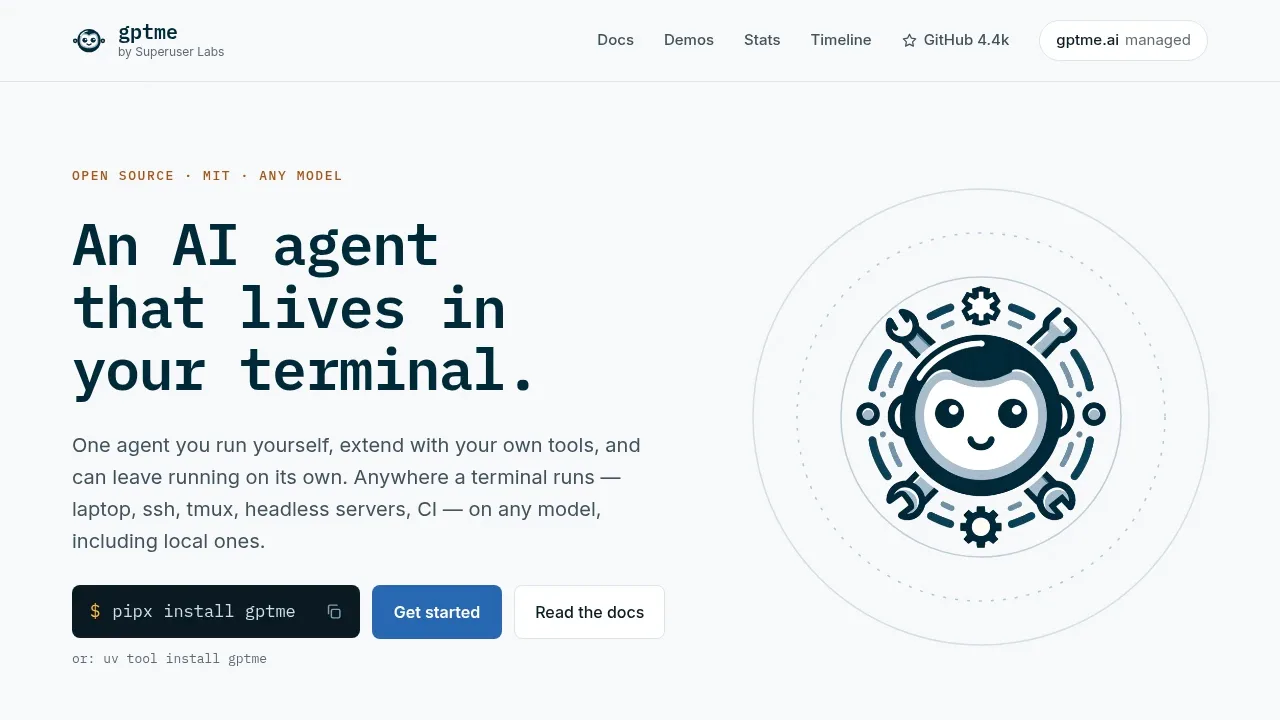
gptme is a self-hosted AI agent that works directly in your terminal, with access to your files and installed tools. It's for developers who want a coding assistant in their own environment, and people who want an agent for data analysis or other knowledge work. The software is free under the MIT license and doesn't require a gptme account.
You can run models locally through Ollama, LM Studio, vLLM or llama.cpp, or connect an OpenAI-compatible server. With a local model, inference runs on your hardware; browser tasks and other network tools can still contact external services. Cloud choices include Claude, GPT, Gemini, Grok and DeepSeek; those send model requests to the chosen provider. gptme runs on laptops, remote servers and in CI, with a desktop app for Linux, macOS and Windows.
Its tools can execute shell commands and Python, make targeted file edits, run tests and work with GitHub. A Chromium browser handles web tasks and PDFs, while vision reads images and screenshots. Desktop control works with macOS and X11 apps. Shell and Python sessions retain state between steps, and child agents can work on separate tasks in parallel.
For ongoing work, persistent agents have a task queue, scheduled or event-driven runs, and a Git-tracked journal and memory. Plugins add tools; Markdown skills and lessons capture workflows. A local memory store can also be shared with Claude Code and Codex.
A web UI connects to your own server. ACP connects the agent to Zed and JetBrains, while MCP lets it use external tools or expose its own shell, Python and file tools to clients such as Cursor and Claude Desktop.
Claim this page with an email at gptme.org. gptme gets the verified badge, and you can upgrade the listing to be featured on localhosted. Proud to be listed? Put our badge on your site.
Want more people to find gptme?Promote it
Something wrong or outdated on this page?
42Updated 12 hours ago
macOS · Windows · Linux · Docker#Agent Skills#Code execution#Distributed execution
Code Buddy is an AI coding assistant for developers who want a terminal agent running on their own machine, with a choice of local or cloud models. It reads repositories, edits code and runs commands on Linux, macOS and Windows. Ollama keeps model inference local without an API key or account; cloud providers send model requests off the machine. Routing includes automatic provider failover.
69.6KUpdated 2 hours agoApache-2.0
macOS · Windows · VS Code · JetBrains#Code execution#Git integration#Human approval
127.2KUpdated 24 hours agoApache-2.0
macOS · Windows · Linux#Code execution#Git integration#Human approval
54.8KUpdated 3 hours agoApache-2.0
macOS · Windows · Linux#MCP#Multi-agent workflows#Ollama integration
68.5KUpdated 3 days agoApache-2.0
macOS · Windows · Linux#Agent Client Protocol#Code execution#Human approval
37.7KUpdated 2 days agoApache-2.0
macOS · Windows · Linux · Docker#Code execution#LM Studio integration#MCP
Cline is an AI coding agent for developers who want help understanding a codebase and changing it. Its shared agent core is open source under Apache 2.0. You can use it in VS Code, JetBrains IDEs, or a terminal. A native desktop app runs on macOS and Windows. No editor is required for desktop sessions. The JetBrains plugin itself is not open source.
Codex CLI is an open source coding assistant that runs on your computer and works with local repositories. It's for developers who want to explore code, make changes, and use their existing development tools from the terminal. It runs on macOS, Windows, and Linux under the Apache 2.0 license.
Goose is a general-purpose AI agent that runs on your computer. It suits people who want an agent for coding, research, writing, automation, or data analysis, without committing to one model provider. The desktop app runs on macOS, Windows, and Linux; there's also a CLI for terminal work and an API for use in other software.
Open Interpreter is a terminal coding assistant built around open-weight models, with model-specific behavior for Kimi, Qwen and DeepSeek. It's a fork of OpenAI's Codex for developers who want to choose their model provider while keeping a familiar agent interface. The project uses the Apache 2.0 license.
Playwright MCP lets AI agents control a browser by reading structured page information rather than interpreting screenshots. It's for developers building browser automation, exploratory tests or agent workflows that need to keep a browser session open across repeated actions. The server runs locally on macOS, Windows and Linux, or as a self-hosted service.