
Forge Orchestrator
AI coding orchestrator that coordinates Claude Code, Codex CLI, and Gemini CLI with local shared state, file locking, and drift detection.
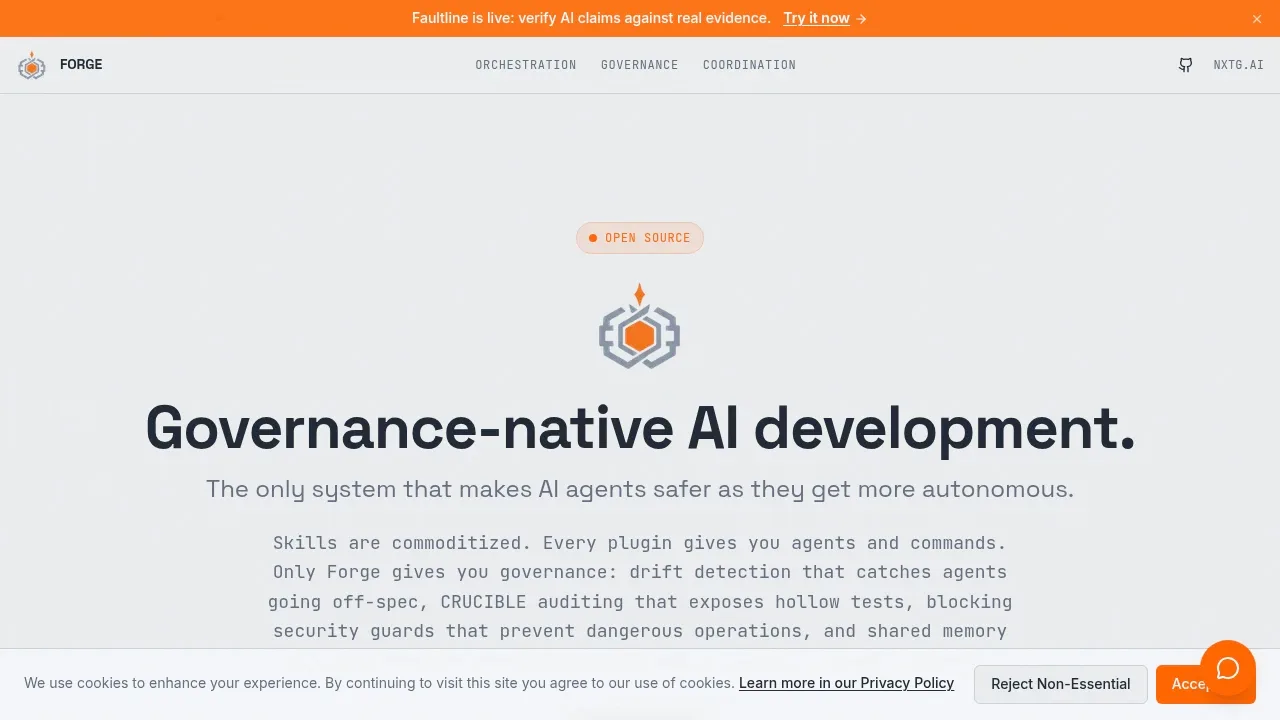
Forge Orchestrator coordinates Claude Code, Codex CLI, and Gemini CLI when they work on the same repository. It's for developers who use multiple AI coding assistants and need them to share decisions, respect file ownership, and follow the same specification.
Exclusive file locks prevent tools from editing a file simultaneously. Locks have timeouts and deadlock detection, so a crashed tool doesn't keep a file locked indefinitely. Shared knowledge captures decisions and coding patterns across sessions, with automatic categorization and search. Context recorded by Claude Code remains available to Codex CLI in a later session.
The orchestrator turns specifications into tasks with dependencies, assigns tools, and tracks progress. Drift detection compares work in progress with the specification and flags departures. A terminal dashboard shows live agent panes, task status, lock state, and health scores; headless execution supports autonomous work in CI/CD pipelines.
Written in Rust, it runs as a single binary without runtime dependencies. Coordination state stays in plain files under the repository's .forge/ directory, without a daemon or database. An MCP server exposes that state to connected AI clients. This local state storage doesn't establish that the connected coding assistants process requests offline.
The orchestrator is source-available under FSL-1.1-Apache-2.0, which converts to Apache 2.0 after two years. The separate Forge plugin uses the MIT license, while the optional Forge UI provides a browser dashboard.


