
GameStringer
A desktop AI game translator for Windows, Linux and macOS that uses local Ollama models or cloud providers and applies patches with backups.
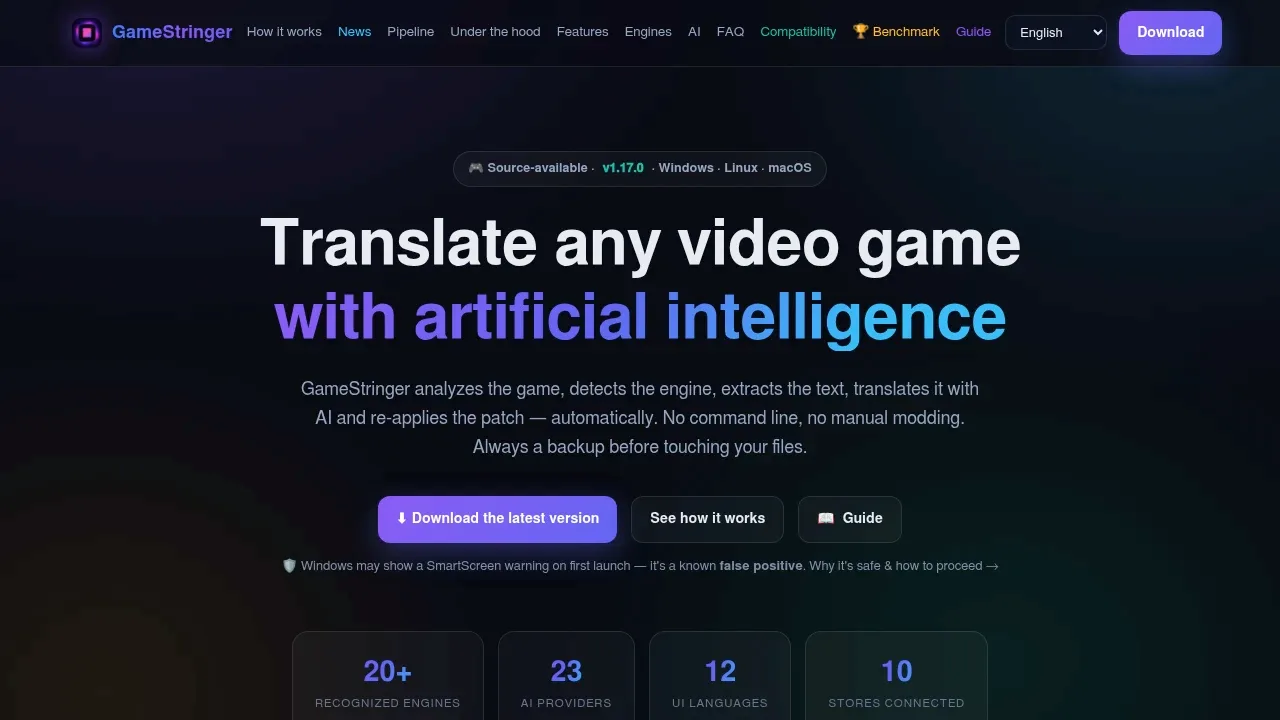
GameStringer translates games for players and fan translators who want a language the game doesn't include. It detects the engine, extracts text and applies translated text to the game, with compatibility depending on the engine and title.
- Game translation: Translate through file patches, Windows runtime injection or an on-screen OCR overlay, depending on how the game stores and displays text.
- Context and consistency: Optional screen context helps interpret ambiguous words, while a local translation memory and glossary retain corrections and terminology across a game.
- Quality review: Per-line quality scores flag text for human review, and an optional second pass checks translations against tone, glossary terms and consistency.
- Library analysis and backups: Detect installed Steam, Epic and GOG games, assess translation difficulty, and back up files before patching; Steam update alerts flag patches that need reapplying.
- Shared translations: Publish and download translation packs through the online Patch Hub, which uses a hosted Supabase backend.
Translation can run locally with Ollama and models such as Llama 3, Gemma and Qwen 3, including the optional context and review features. Choosing OpenAI, Claude, Gemini or DeepL sends translation requests to that provider. Translation memory stays in a local database.
GameStringer is source-available and runs on Windows, Linux and macOS. It requires 4 GB RAM, with 8 GB or more listed for local AI. Supported engines include Unity, Godot, Ren'Py, RPG Maker, Bethesda and CRI. Unreal support is partial; GameMaker translations longer than the original text are truncated and reported. Runtime injection is intended for single-player or offline games, and an anti-cheat gate blocks injection for protected online games.


