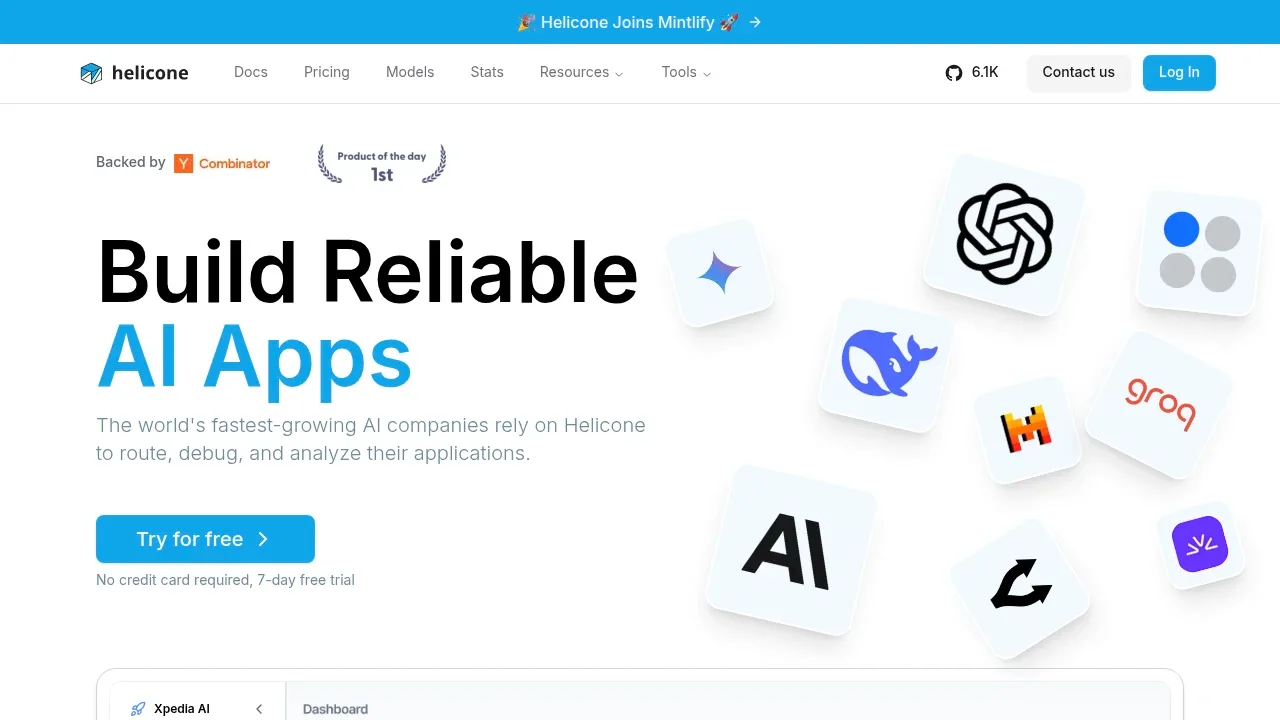
Helicone combines an AI gateway with LLM observability for engineers building agents, chatbots, and document processing apps. You can self-host the open source observability platform under Apache 2.0 or use the hosted service. It also integrates with Ollama for apps that run models locally. Its hosted gateway routes requests to external AI providers, so those requests leave your machine.
The gateway gives applications an OpenAI-compatible API for accessing models across providers, with routing and automatic fallbacks when a request needs another provider. Integrations include OpenAI, Anthropic, Azure OpenAI, AWS Bedrock, and Gemini. Helicone records requests and lets you inspect agent traces and sessions, helping you investigate failures across a sequence of calls rather than looking at each response alone.
Cost, latency, and quality tracking help teams compare application behavior and spending. A playground lets you test prompts against sessions and traces, while prompt management supports versioning with production data and deployment through the gateway without code changes. You retain access to your prompts.
For teams with an existing AI stack, Helicone connects with LangChain, LlamaIndex, LangGraph, and the Vercel AI SDK. It can export analytics to PostHog for custom dashboards and supports evaluation through RAGAS. Fine-tuning integrations connect to OpenPipe and Autonomi.
Claim this page with an email at helicone.ai. Helicone gets the verified badge, and you can upgrade the listing to be featured on localhosted. Proud to be listed? Put our badge on your site.
Want more people to find Helicone?Promote it
Something wrong or outdated on this page?
11.7KUpdated 23 hours ago
Docker · Web#LLM tracing#MCP#Ollama integration
Arize Phoenix is a self-hosted platform for developers who need to understand why an AI agent failed and test changes before shipping them. It runs on a laptop, in Docker, or on Kubernetes. Self-hosting keeps traces on your infrastructure; Phoenix Cloud provides a hosted alternative. Phoenix uses the Elastic License 2.0 (ELv2), a source-available license.
28.2KUpdated 1 day agoApache-2.0
Docker · Web#Batch processing#LLM tracing#MCP
2.8KUpdated 1 day agoApache-2.0
Windows · Linux · Docker · Web#LLM tracing#Ollama integration#Prompt versioning
lunary.aiLLM Evaluation and Testing
Docker · Web#LLM tracing#Multi-user access#Prompt versioning
22.3KUpdated 1 day agoApache-2.0
Web#Guardrails#LLM tracing#Prompt versioning
11.7KUpdated 4 months agoApache-2.0
Docker · Web#Batch processing#LLM tracing#Multimodal input
MLflow brings agent tracing, LLM evaluation, and model experiment tracking into a platform you can run locally or on your own servers. It's for developers and teams who need to understand failures, compare changes, and monitor AI applications in production. It's open source under Apache 2.0.
OpenLIT is a self-hosted platform for developers who need to understand how their LLM applications and AI agents behave. It connects model calls with tool activity, retrieval and agent steps, so teams can investigate errors and compare cost, latency and output quality across a workflow.
Lunary is a self-hosted LLM observability and prompt management platform for teams building chatbots and AI agents. It brings production traces, user conversations and prompt versions into one place so developers can investigate errors and teams can assess response quality. You can host it in your own infrastructure or use its cloud service.
Opik is an open-source LLM observability and evaluation platform for developers building AI agents and RAG applications. Its Apache 2.0 licensed platform can be self-hosted on your own hardware or servers; Comet also offers a hosted service. Self-hosting lets teams keep their observability deployment in their own environment.
TensorZero is a self-hosted platform for developers building LLM applications. The project is archived and no longer maintained. It combines a model gateway with tools for inspecting responses, evaluating workflows, and improving prompts using production data and human feedback.