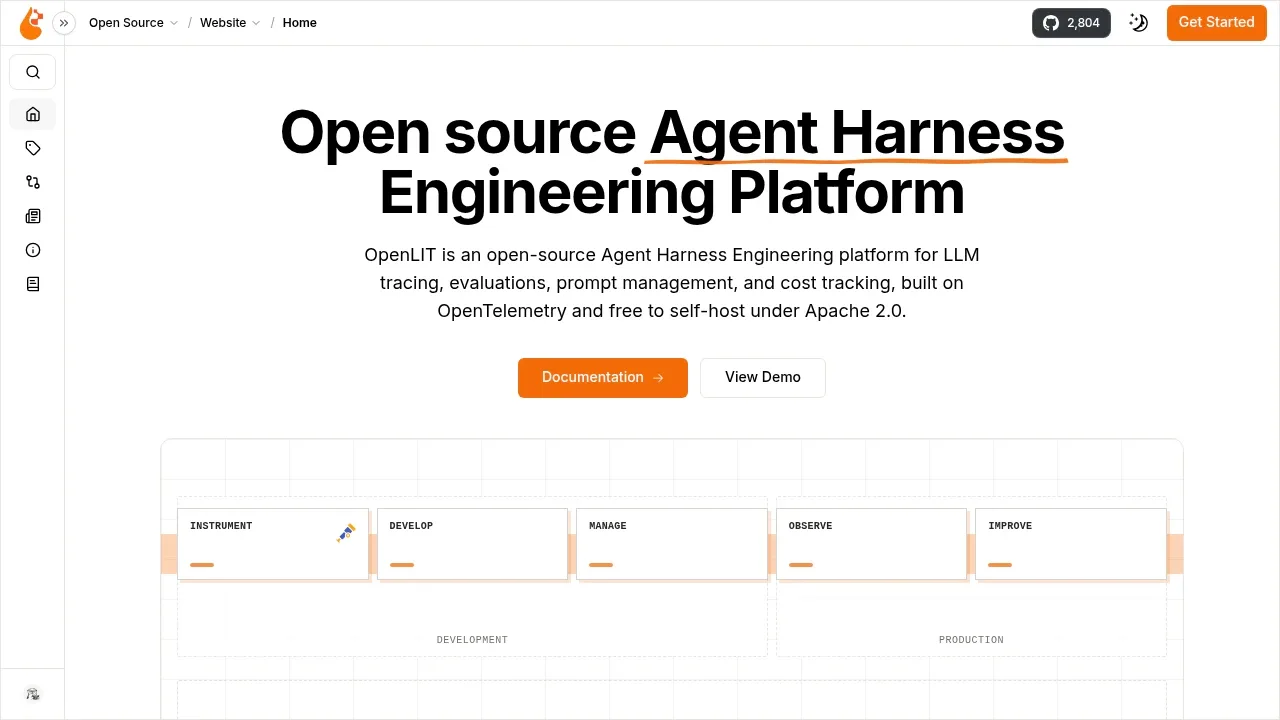
OpenLIT is a self-hosted platform for developers who need to understand how their LLM applications and AI agents behave. It connects model calls with tool activity, retrieval and agent steps, so teams can investigate errors and compare cost, latency and output quality across a workflow.
The core platform is open source under Apache 2.0 and can be self-hosted with Docker Compose or Kubernetes. Its UI and ClickHouse storage run in your infrastructure, keeping collected prompts, traces and secrets in your environment. Integrations include local LLM backends such as Ollama, GPT4All and vLLM, alongside cloud providers including OpenAI and Anthropic. Model requests still go to whichever backend your application uses.
Tracing uses OpenTelemetry, so you can retain existing instrumentation and export telemetry to Grafana, Datadog or other compatible backends. OpenLIT doesn't require a proxy for every model call. It also monitors Claude Code, Cursor and Codex sessions, with views of tool use, costs and outcomes.
Evaluations support LLM judges, heuristics and human review on experiments or production traffic. Prompt Hub versions prompts and lets teams deploy or roll them back independently of application code. OpenGround compares model responses side by side on the same inputs, while Vault stores and rotates API secrets outside app code.
For teams running inference on their own hardware, the GPU collector tracks utilization, memory, temperature and power on NVIDIA, AMD and Intel GPUs.
Claim this page with an email at openlit.io. OpenLIT gets the verified badge, and you can upgrade the listing to be featured on localhosted. Proud to be listed? Put our badge on your site.
Want more people to find OpenLIT?Promote it
Something wrong or outdated on this page?
11.7KUpdated 23 hours ago
Docker · Web#LLM tracing#MCP#Ollama integration
Arize Phoenix is a self-hosted platform for developers who need to understand why an AI agent failed and test changes before shipping them. It runs on a laptop, in Docker, or on Kubernetes. Self-hosting keeps traces on your infrastructure; Phoenix Cloud provides a hosted alternative. Phoenix uses the Elastic License 2.0 (ELv2), a source-available license.
28.2KUpdated 1 day agoApache-2.0
Docker · Web#Batch processing#LLM tracing#MCP
lunary.aiLLM Evaluation and Testing
Docker · Web#LLM tracing#Multi-user access#Prompt versioning
11.7KUpdated 4 months agoApache-2.0
Docker · Web#Batch processing#LLM tracing#Multimodal input
35.2KUpdated 2 hours ago
Docker#Agent Skills#LLM tracing#MCP
22.3KUpdated 1 day agoApache-2.0
Web#Guardrails#LLM tracing#Prompt versioning
MLflow brings agent tracing, LLM evaluation, and model experiment tracking into a platform you can run locally or on your own servers. It's for developers and teams who need to understand failures, compare changes, and monitor AI applications in production. It's open source under Apache 2.0.
Lunary is a self-hosted LLM observability and prompt management platform for teams building chatbots and AI agents. It brings production traces, user conversations and prompt versions into one place so developers can investigate errors and teams can assess response quality. You can host it in your own infrastructure or use its cloud service.
TensorZero is a self-hosted platform for developers building LLM applications. The project is archived and no longer maintained. It combines a model gateway with tools for inspecting responses, evaluating workflows, and improving prompts using production data and human feedback.
Langfuse is an open source observability and evaluation platform for teams building LLM applications and AI agents. It shows the steps behind a response so developers can investigate failures, slow requests, and cost. Teams can run its MIT-licensed core on their own servers with Docker Compose or Kubernetes, or use Langfuse Cloud as a hosted service.
Opik is an open-source LLM observability and evaluation platform for developers building AI agents and RAG applications. Its Apache 2.0 licensed platform can be self-hosted on your own hardware or servers; Comet also offers a hosted service. Self-hosting lets teams keep their observability deployment in their own environment.