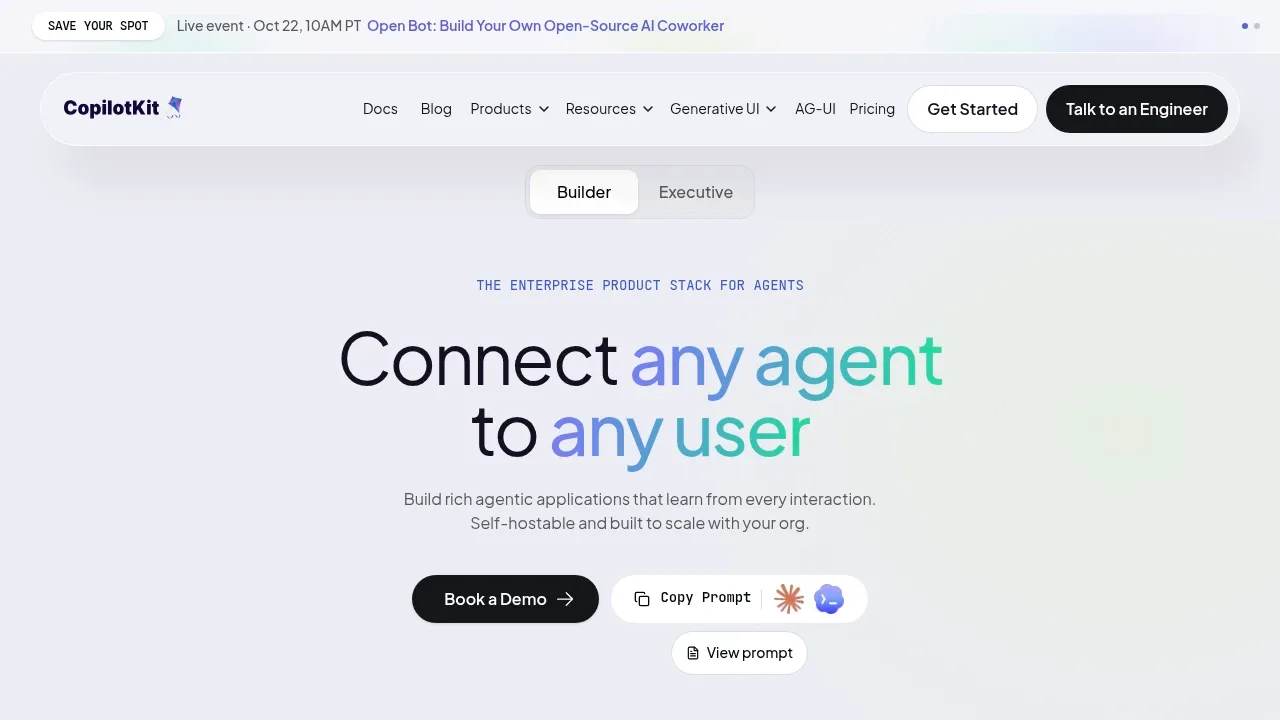
CopilotKit is a self-hostable SDK for developers building AI agents into web and mobile apps, Slack, or Microsoft Teams. Agents can display interactive charts and forms using an app's own components, read shared app state, and take actions through frontend tools, APIs, or MCP tools.
Its AG-UI protocol connects the interface to the agent backend, so teams can choose each independently. Supported agent stacks include OpenAI Agents SDK, Claude Agent SDK, LangChain, Google ADK, AWS Strands, and Mastra. Frontend support includes React, Next.js, Angular, Vue, and React Native, with iOS and Android among its supported surfaces.
The chat interface supports streaming responses and tool calls. Developers can adapt ready-made components to their design system or build a custom interface with headless APIs. Human approval and input can sit within an agent workflow, while shared state keeps the agent and app working with the same information.
The open-source SDK uses the MIT license. CopilotKit also offers an enterprise runtime that teams can self-host on their own infrastructure, plus a managed Copilot Cloud service. Self-hosted deployments can keep platform data within the organization's infrastructure and use its existing database.
CopilotKit Intelligence adds persistent conversations that retain interactive UI across sessions and devices, along with user memories. It also provides action records and product analytics. Completed threads become insights and reusable skills that developers review and publish; this learning workflow does not require a fine-tuning pipeline.
Claim this page with an email at copilotkit.ai. CopilotKit gets the verified badge, and you can upgrade the listing to be featured on localhosted. Proud to be listed? Put our badge on your site.
Want more people to find CopilotKit?Promote it
Something wrong or outdated on this page?
31.3KUpdated 1 day agoApache-2.0
Docker#Hybrid search#Knowledge graphs#llama.cpp backend
Graphiti is a self-hosted Python framework for developers building AI agents that need to remember changing facts. It builds knowledge graphs from conversations, structured records and unstructured text, so an agent can query current information or recover what was true earlier. It's open source under Apache 2.0.
42.5KUpdated 2 hours agoMIT
#Human approval#Multi-agent workflows#Persistent memory
66.3KUpdated 5 days agoApache-2.0
Browser Extension#Persistent memory#Semantic search
27.1KUpdated 1 hour ago
#Agent Skills#Streaming inference#Structured output
3.5KUpdated 19 hours agoApache-2.0
macOS · Windows · Linux · iOS · Android · Web#Agent Skills#Hugging Face integration#Multimodal input
9.4KUpdated 1 day agoApache-2.0
macOS · Windows · Linux · iOS · Android · Web#Batch processing#LLM tracing#Structured output
LangGraph is a free, MIT-licensed Python framework for developers building AI agents that need to keep state and handle complex tasks. It gives teams control over how an agent moves between steps, where people can intervene, and what happens when a long-running task is interrupted.
Mem0 is a memory layer for developers building AI agents and assistants that need to recall earlier interactions. It retains user, session, and agent context across conversations, so an assistant can remember preferences or a support bot can refer to past tickets. The self-hosted code is open source under Apache 2.0; Mem0 also has a managed service.
Vercel AI SDK is a TypeScript library for developers building chatbots, generative interfaces, and AI agents. It gives an application one way to work with models from providers such as OpenAI, Anthropic, and Google, so teams can change providers without rebuilding the parts of their app that handle responses. It suits developers who want control over the application they build while choosing how it connects to model services.
LiteRT is Google's open-source framework for developers building AI into apps that run on users' own devices. It succeeds TensorFlow Lite and covers model conversion, optimization and local inference. It's licensed under Apache 2.0.
BAML is a programming language for developers building AI agents, with typed model calls and local tracing built into the language. It runs standalone on macOS, Linux and Windows, or alongside an existing application. The language is open source under Apache 2.0, and works offline.