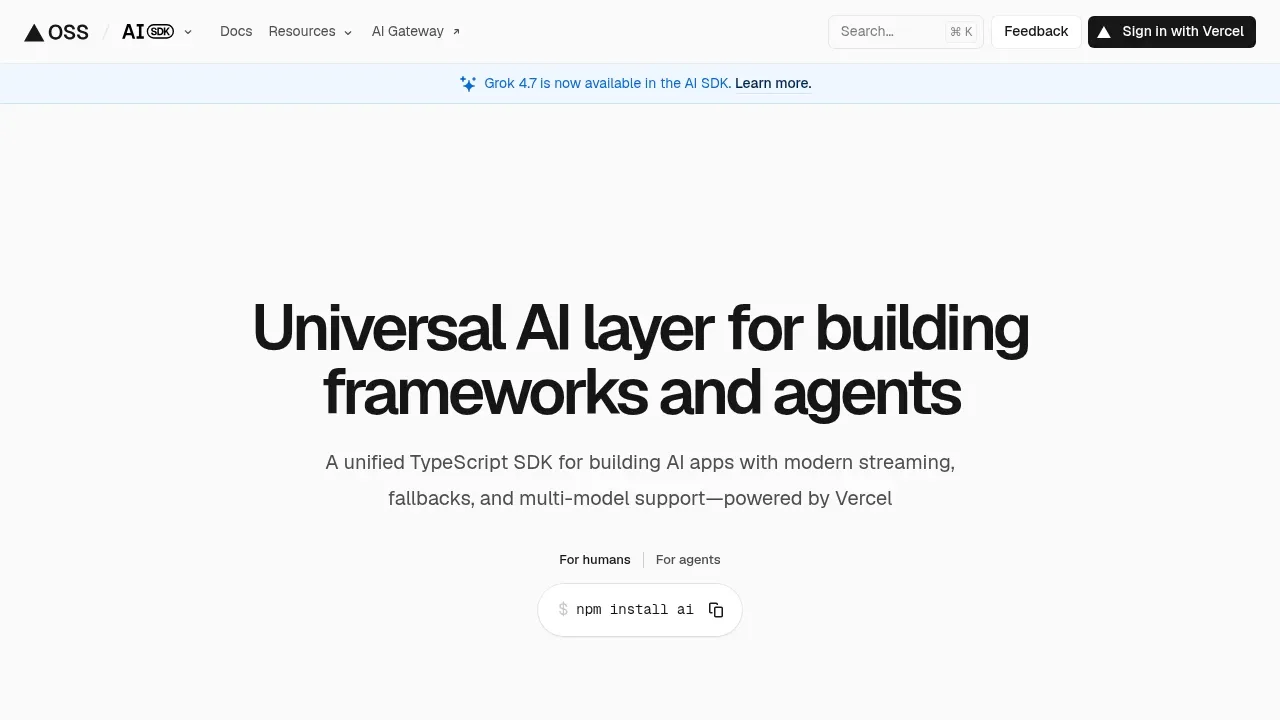
Vercel AI SDK is a TypeScript library for developers building chatbots, generative interfaces, and AI agents. It gives an application one way to work with models from providers such as OpenAI, Anthropic, and Google, so teams can change providers without rebuilding the parts of their app that handle responses. It suits developers who want control over the application they build while choosing how it connects to model services.
The core library handles text generation, structured output, tool calls, and agent workflows. Streaming is built in. It also supports image and video generation, speech, and transcription, with fallbacks and error handling for applications that depend on model responses. A separate UI library provides hooks for chat and generative interfaces in React, Next.js, Svelte, and Vue; the toolkit also works with Node.js.
Model requests use Vercel AI Gateway by default. Developers can connect directly to providers instead, including OpenAI, Anthropic, and Google. That choice matters if an application already uses particular model providers or needs to change them later. The SDK is free and runs as part of the developer's application; the selected gateway or provider handles its model requests.
Claim this page with an email at ai-sdk.dev. Vercel AI SDK gets the verified badge, and you can upgrade the listing to be featured on localhosted. Proud to be listed? Put our badge on your site.
Want more people to find Vercel AI SDK?Promote it
Something wrong or outdated on this page?
42.5KUpdated 2 hours agoMIT
#Human approval#Multi-agent workflows#Persistent memory
LangGraph is a free, MIT-licensed Python framework for developers building AI agents that need to keep state and handle complex tasks. It gives teams control over how an agent moves between steps, where people can intervene, and what happens when a long-running task is interrupted.
147.3KUpdated 1 day agoMIT
#Human approval#RAG#Streaming inference
20.3KUpdated 1 hour agoMIT
#Human approval#LLM tracing#MCP
38.4KUpdated 4 days agoMIT
#Code execution#MCP#Multimodal input
26.6KUpdated 1 day agoApache-2.0
Docker#Guardrails#Hugging Face integration#Hybrid search
4.4KUpdated 1 day agoMIT
#Human approval#Multi-agent workflows#Multimodal input
LangChain is an MIT-licensed open-source framework for developers building AI agents and applications powered by LLMs. It provides a shared interface for models, tools and data connections, so developers can change providers or test workflows without rebuilding the whole application.
Pydantic AI is a Python SDK for developers building AI agents into their own applications. Its main draw is Pydantic validation across agent tools and results, so an agent can return structured data that application code can check and use. The SDK is MIT licensed.
DSPy is a Python framework for developers building AI applications whose tasks need clear inputs, predictable output types, and measurable results. You define what a language model should produce, then compose those tasks into a larger program. It's open source under the MIT license.
Haystack is a Python framework for developers building self-hosted AI agents, document search, and apps that answer questions using their own data. Its modular pipelines let teams control which information reaches a model and inspect how retrieval, memory, tools, and generation contribute to an answer. It's open source under Apache 2.0.
RubyLLM is an MIT-licensed AI framework for developers building Ruby and Rails applications with local or hosted models. Its shared API lets an application switch between Ollama, cloud providers such as Anthropic and OpenAI, and OpenAI-compatible endpoints without rewriting its model integration. The framework runs in your application; model processing happens at the local or hosted backend you choose.