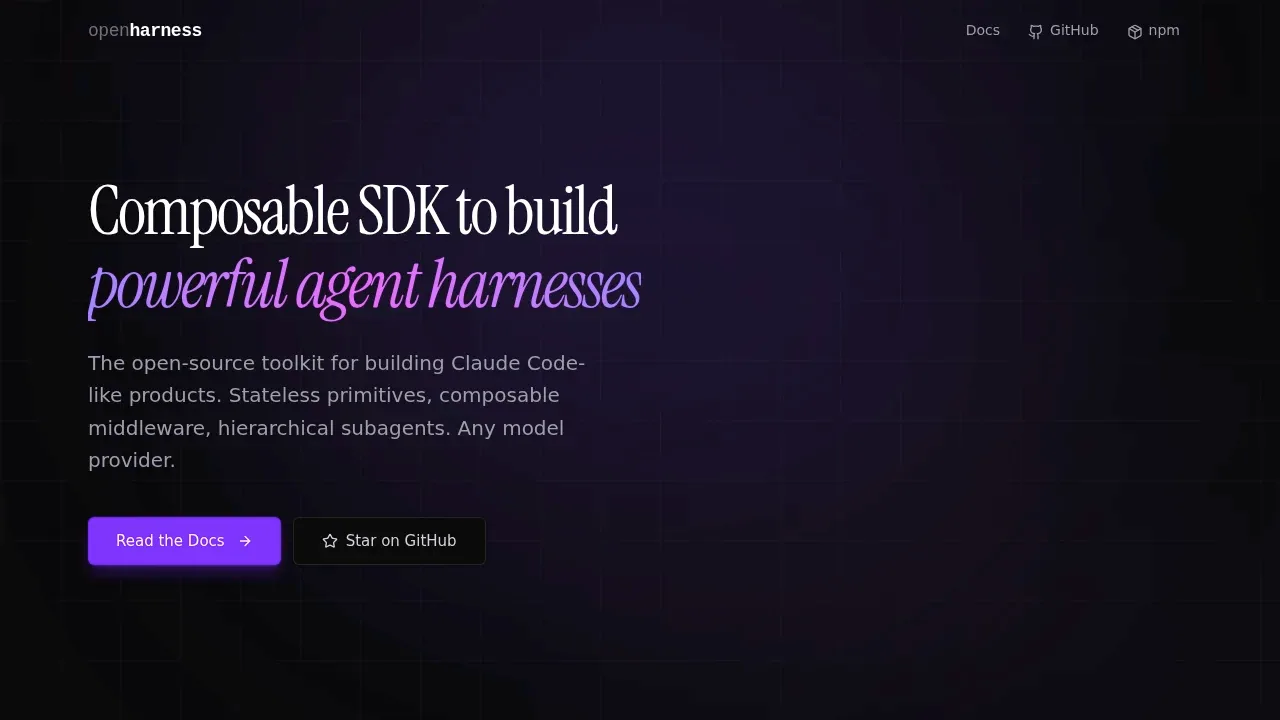
OpenHarness SDK is a TypeScript toolkit for developers building their own AI agents or coding assistants in the style of Claude Code. It runs in Node.js or edge runtimes and is open source under the MIT license. You control the application code; model calls use your chosen provider through Vercel AI SDK, including OpenAI, Anthropic, and Google.
Its agents keep conversation history outside the agent itself, so your application can inspect, edit, or share messages between agents. Optional middleware handles retries, persistence, and context compaction. Compaction first removes older tool results, then uses an LLM to summarize context when needed.
Agents can work with files, execute shell commands, and call custom tools. Approval callbacks let an application ask permission before a tool runs, through a terminal prompt, web dialog, or external service. MCP support connects agents to tool servers over stdio, HTTP, or SSE.
For tasks that need several agents, it supports nested delegation, background execution, and resumable subagent sessions. Dynamic subagent catalogs let an application choose the available specialists at runtime.
React hooks and Vue composables support streaming chat interfaces, while the same core can power a CLI. The SDK also loads SKILL.md instructions on demand and brings AGENTS.md or CLAUDE.md project context into agent conversations. A separate virtual filesystem provider supports sandboxed, in-memory, or SQLite-backed file access.
Claim this page with an email at open-harness.dev. OpenHarness SDK gets the verified badge, and you can upgrade the listing to be featured on localhosted. Proud to be listed? Put our badge on your site.
Want more people to find OpenHarness SDK?Promote it
Something wrong or outdated on this page?
1.7KUpdated 3 weeks agoApache-2.0
#Agent Skills#Code execution#Guardrails
Agently is an open-source Python framework for engineering teams building AI service backends on their own infrastructure. It focuses on turning model responses into validated data and controlled actions that business applications can use. The framework runs in your application; requests go to the model provider you connect, including external services.
38.5KUpdated 23 hours agoMIT
#Code execution#MCP#Multimodal input
3.9KUpdated 1 day agoApache-2.0
#Agent Client Protocol#Agent Skills#Code execution
3.2KUpdated 16 hours agoApache-2.0
macOS · Linux · Web#Agent Client Protocol#Agent Skills#MCP
711Updated 1 month agoMIT
Web#Agent Skills#Code execution#Git integration
26.6KUpdated 10 hours agoApache-2.0
Docker#Guardrails#Hugging Face integration#Hybrid search
DSPy is a Python framework for developers building AI applications whose tasks need clear inputs, predictable output types, and measurable results. You define what a language model should produce, then compose those tasks into a larger program. It's open source under the MIT license.
Fast Agent is a terminal coding assistant and Python toolkit for developers who want to build and evaluate AI agents with their choice of model. It supports local LLMs through a generic provider and automatically configures connections to llama.cpp servers. The toolkit runs on your machine; choosing Anthropic, Google, or a remote OpenAI-compatible endpoint sends model requests to that service.
fx is an open source coding assistant that runs as a small native program in your terminal and connects to local or cloud models. It's aimed at developers who prefer a shell-style interface, and researchers building agents into larger systems. Written in Zig and licensed under Apache 2.0, it runs without a background service.
GitAgent is an MIT-licensed, open-source AI agent framework for developers who want to keep an agent's behavior and memory under version control. It runs locally, with its configuration, personality, rules and saved memory stored as files in a Git repository. That makes changes reviewable through diffs and history, and lets teams fork an agent or maintain different behaviors on separate branches.
Haystack is a Python framework for developers building self-hosted AI agents, document search, and apps that answer questions using their own data. Its modular pipelines let teams control which information reaches a model and inspect how retrieval, memory, tools, and generation contribute to an answer. It's open source under Apache 2.0.