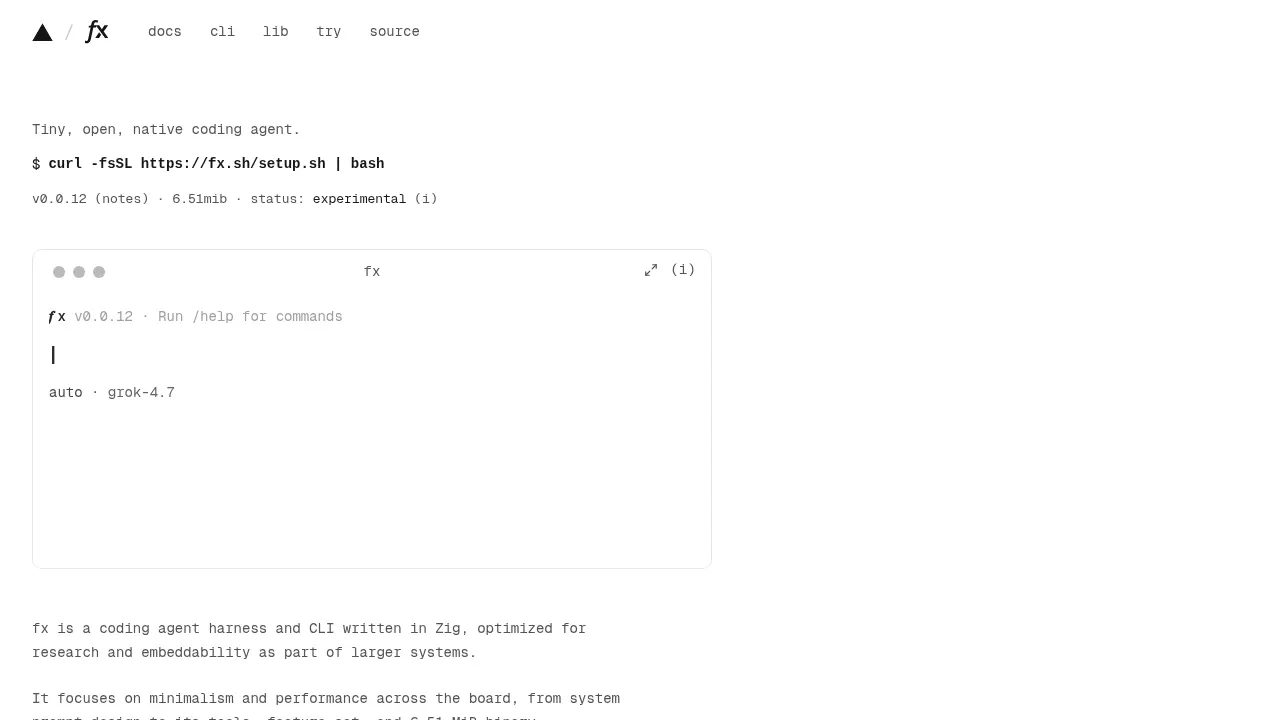
fx is an open source coding assistant that runs as a small native program in your terminal and connects to local or cloud models. It's aimed at developers who prefer a shell-style interface, and researchers building agents into larger systems. Written in Zig and licensed under Apache 2.0, it runs without a background service.
You can connect it to Ollama through an OpenAI-compatible endpoint, use OpenRouter or Vercel AI Gateway, or access models through ChatGPT and Grok subscriptions. The agent runs on your machine; inference runs at the endpoint you choose. A local model connection keeps inference local, while a cloud connection sends model requests to that service.
The terminal interface preserves scrollback and shows tool activity alongside the conversation, with a full transcript available for closer inspection. fx supports interactive work and individual requests for scripts or CI. Its concise tool definitions keep context use small, and it loads skill instructions and MCP tool definitions when they're needed. Skills, MCP servers, custom tools and subagents extend what it can do.
For developers embedding an agent, libfx exposes the core and interactive terminal, while Agent Client Protocol support connects the native agent to compatible editors. fx also runs as WebAssembly in the browser. Applications that embed it control storage, permissions, tools and network access; the website's browser demo uses a browser workspace, while the native CLI works with your own files.
Claim this page with an email at fx.sh. fx gets the verified badge, and you can upgrade the listing to be featured on localhosted. Proud to be listed? Put our badge on your site.
Want more people to find fx?Promote it
Something wrong or outdated on this page?
711Updated 1 month agoMIT
Web#Agent Skills#Code execution#Git integration
GitAgent is an MIT-licensed, open-source AI agent framework for developers who want to keep an agent's behavior and memory under version control. It runs locally, with its configuration, personality, rules and saved memory stored as files in a Git repository. That makes changes reviewable through diffs and history, and lets teams fork an agent or maintain different behaviors on separate branches.
3.9KUpdated 1 day agoApache-2.0
#Agent Client Protocol#Agent Skills#Code execution
3.2KUpdated 13 hours agoApache-2.0
macOS · Linux · Web#Agent Skills#MCP#Multi-agent workflows
195Updated 7 months agoMIT
macOS · Windows · Linux · Web#Agent Skills#Code execution#Guardrails
294Updated 4 hours ago
macOS · Windows · Linux · Web#Agent Skills#Batch processing#Code execution
Ringer runs parallel AI coding agents on your machine and checks their output by executing tests or other validation commands. It's for developers who want to delegate implementation while keeping planning and review with a stronger model. The aim is to reduce model spending on routine coding work without relying on workers' claims that they're finished.
2Updated 4 weeks agoMIT
macOS · Windows · Linux · Web#Code execution#Git integration#Human approval
Fast Agent is a terminal coding assistant and Python toolkit for developers who want to build and evaluate AI agents with their choice of model. It supports local LLMs through a generic provider and automatically configures connections to llama.cpp servers. The toolkit runs on your machine; choosing Anthropic, Google, or a remote OpenAI-compatible endpoint sends model requests to that service.
OpenRig is a self-hosted coordinator for coding agent teams that keep their responsibilities and context across projects lasting weeks or months. It's for developers who want Claude Code, Codex and Pi to work together, with a lead agent handling requests and feedback while specialists carry out assigned work.
VibeHQ Hub coordinates separate Claude Code, Codex and Gemini CLI agents on your own computer. It's for developers assigning parts of a project to multiple coding assistants who need agreement on interfaces, dependencies and deliverables. The hub runs locally. It's open source under the MIT license, with tested Windows and macOS support; some Linux components remain untested.
Swarm Fleet runs multiple terminal agents on your own machine and lets you supervise them together. It's for developers coordinating coding, review or ticket work across Claude, Codex and other command-line tools. Written in Go and licensed under MIT, it runs on Linux, macOS and Windows. Swarm serves its browser interface itself.