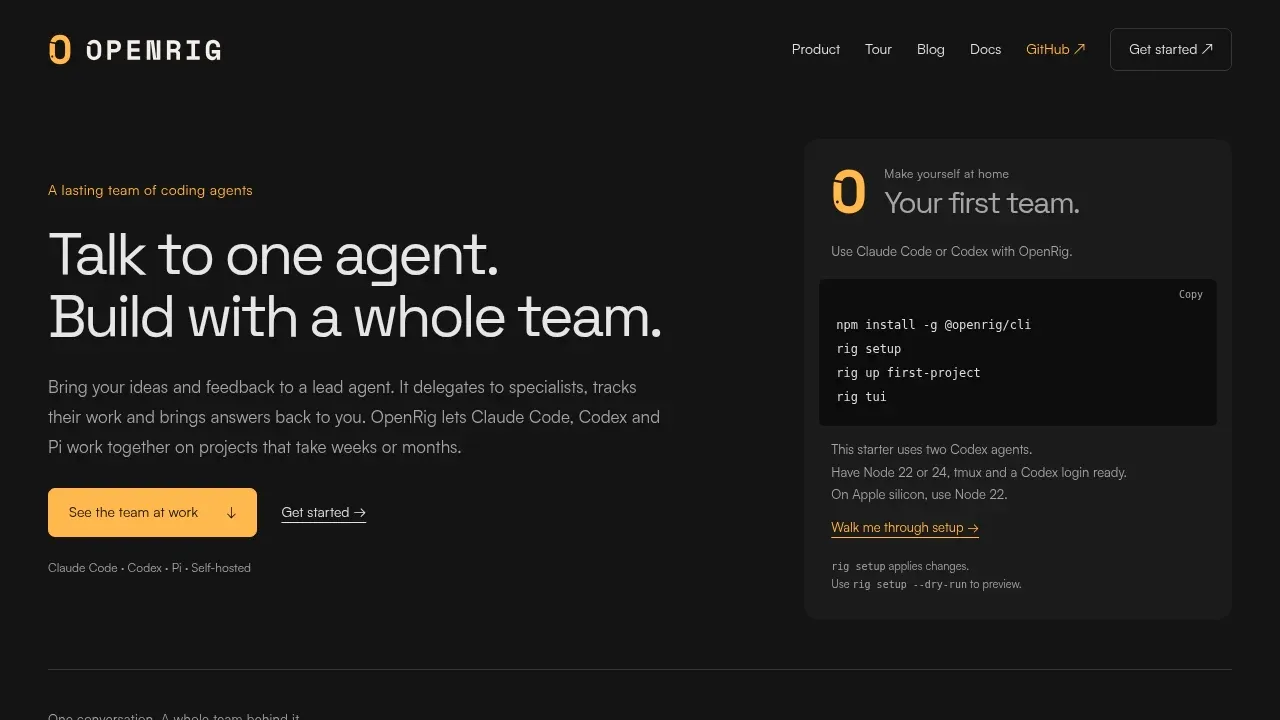
OpenRig is a self-hosted coordinator for coding agent teams that keep their responsibilities and context across projects lasting weeks or months. It's for developers who want Claude Code, Codex and Pi to work together, with a lead agent handling requests and feedback while specialists carry out assigned work.
The lead can delegate work, follow progress and bring back results or decisions that need your attention. Specialists can ask teammates about earlier decisions without turning every question into a task. Tracked assignments retain a named owner and progress for later follow-up, and agents can use temporary subagents for smaller jobs.
A terminal interface shows the team's organization, current work and requests for attention in one place. Each agent also has its own terminal session that you can inspect or work in directly. OpenRig can adopt existing Claude Code and Codex sessions, save and restore team arrangements, and add or remove agents while a team is running.
The coordination system runs on your own macOS or Linux machine or infrastructure. It's open source under Apache 2.0 and uses a local daemon, CLI, terminal UI and MCP server built around tmux. Its MCP tools let agents communicate and manage the team themselves. Native Windows isn't supported.
Self-hosting covers the coordination layer; the selected providers still handle model usage, and their usage costs apply. The Codex starter requires a Codex login.
Claim this page with an email at openrig.dev. OpenRig gets the verified badge, and you can upgrade the listing to be featured on localhosted. Proud to be listed? Put our badge on your site.
Want more people to find OpenRig?Promote it
Something wrong or outdated on this page?
195Updated 7 months agoMIT
macOS · Windows · Linux · Web#Agent Skills#Code execution#Guardrails
VibeHQ Hub coordinates separate Claude Code, Codex and Gemini CLI agents on your own computer. It's for developers assigning parts of a project to multiple coding assistants who need agreement on interfaces, dependencies and deliverables. The hub runs locally. It's open source under the MIT license, with tested Windows and macOS support; some Linux components remain untested.
587Updated 20 hours agoMIT
Web · VS Code · JetBrains#Agent Client Protocol#Code execution#Git integration
3.9KUpdated 1 day agoApache-2.0
#Agent Client Protocol#Agent Skills#Code execution
162Updated 2 months ago
#Code execution#MCP#Multi-agent workflows
Forge Orchestrator coordinates Claude Code, Codex CLI, and Gemini CLI when they work on the same repository. It's for developers who use multiple AI coding assistants and need them to share decisions, respect file ownership, and follow the same specification.
409Updated 1 day agoApache-2.0
#Code execution#Guardrails#Human approval
127.4KUpdated 15 hours agoApache-2.0
macOS · Windows · Linux#Code execution#Git integration#Human approval
Claw Orchestrator is a self-hosted runtime for developers who want to coordinate coding agents on their own machine or server. It brings Claude Code, Codex, Antigravity, Grok Build and OpenCode into one interface, with support for custom coding CLIs. The runtime and browser dashboard run locally.
Fast Agent is a terminal coding assistant and Python toolkit for developers who want to build and evaluate AI agents with their choice of model. It supports local LLMs through a generic provider and automatically configures connections to llama.cpp servers. The toolkit runs on your machine; choosing Anthropic, Google, or a remote OpenAI-compatible endpoint sends model requests to that service.
MartinLoop is a free, self-hosted runtime for developers and engineering teams delegating software work to AI coding agents. It wraps Claude Code, Codex CLI and Gemini CLI with limits and checks that sit outside the agent. The agent writes the code; MartinLoop decides when work can continue and when the result passes the configured checks.
Codex CLI is an open source coding assistant that runs on your computer and works with local repositories. It's for developers who want to explore code, make changes, and use their existing development tools from the terminal. It runs on macOS, Windows, and Linux under the Apache 2.0 license.