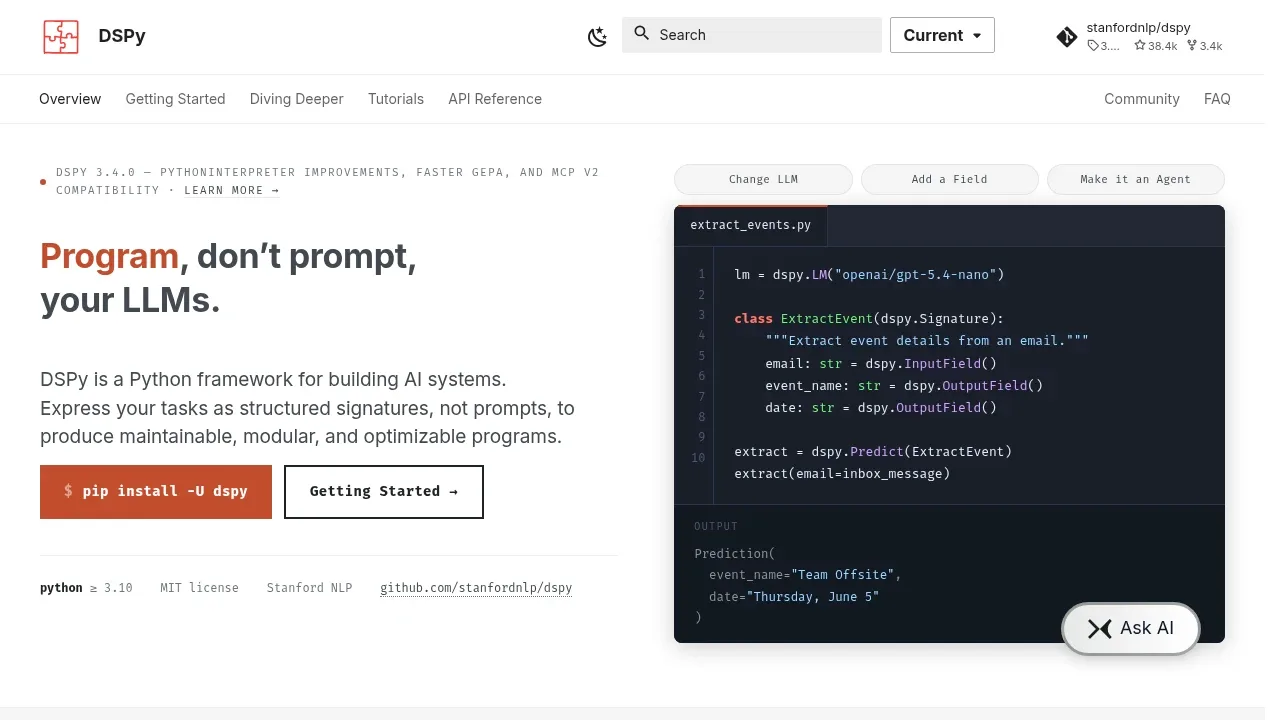
DSPy is a Python framework for developers building AI applications whose tasks need clear inputs, predictable output types, and measurable results. You define what a language model should produce, then compose those tasks into a larger program. It's open source under the MIT license.
Its central abstraction is a signature: a task description with typed inputs and outputs. That can describe extracting contact details from an email, assigning a support ticket to a team, or identifying claims in an article. Separate modules determine how the model handles the task, so the same definition can work with direct generation, step-by-step reasoning, or an agent that calls tools.
DSPy's optimizers use examples and a scoring function to improve prompts automatically. The framework also includes algorithms for optimizing model weights. This makes it relevant to developers comparing approaches against a defined metric, including classification, retrieval-augmented generation, and agent workflows. Optimized programs can be saved for reuse.
Programs use ordinary Python control flow to connect multiple model calls. Agents can call Python functions for knowledge-base searches or calculations, and image inputs support tasks such as chart analysis. DSPy works with OpenAI models, whose inference runs through a cloud service; the Python framework is the application layer. Its reusable task definitions let developers change execution strategies without rewriting the task itself.
Claim this page with an email at dspy.ai. DSPy gets the verified badge, and you can upgrade the listing to be featured on localhosted. Proud to be listed? Put our badge on your site.
Want more people to find DSPy?Promote it
Something wrong or outdated on this page?
20.1KUpdated 2 days agoMIT
macOS · Linux · Docker · Web#Code execution#llama.cpp backend#OpenAI-compatible API
DB-GPT is a self-hosted AI data assistant for teams analyzing business data and developers building data applications. It turns plain-language requests into SQL queries and Python analysis, then produces charts, dashboards, or HTML reports. You can run it on macOS or Linux, with Docker deployment also supported.
26.6KUpdated 1 day agoApache-2.0
Docker#Guardrails#Hugging Face integration#Hybrid search
5.1KUpdated 21 hours ago
macOS · Windows · Linux#Git integration#MCP#Multi-agent workflows
Kiln is a desktop workbench for teams building AI applications on macOS, Windows and Linux. It keeps a task and its dataset together across evaluation, prompt optimization, RAG and fine-tuning, so teams can compare changes against the same examples. Engineers, data scientists, QA staff and subject matter experts can contribute through the app.
147.3KUpdated 1 day agoMIT
#Human approval#RAG#Streaming inference
13.2KUpdated 1 day agoApache-2.0
#MCP#Ollama integration#RAG
4.4KUpdated 1 day agoMIT
#Human approval#Multi-agent workflows#Multimodal input
Haystack is a Python framework for developers building self-hosted AI agents, document search, and apps that answer questions using their own data. Its modular pipelines let teams control which information reaches a model and inspect how retrieval, memory, tools, and generation contribute to an answer. It's open source under Apache 2.0.
LangChain is an MIT-licensed open-source framework for developers building AI agents and applications powered by LLMs. It provides a shared interface for models, tools and data connections, so developers can change providers or test workflows without rebuilding the whole application.
LangChain4j is an Apache 2.0 open-source Java library for developers building chatbots, assistants and AI agents in JVM applications. It connects application code to local LLM backends such as Ollama as well as cloud providers such as OpenAI and Google Vertex AI. Where model requests go depends on the backend you choose.
RubyLLM is an MIT-licensed AI framework for developers building Ruby and Rails applications with local or hosted models. Its shared API lets an application switch between Ollama, cloud providers such as Anthropic and OpenAI, and OpenAI-compatible endpoints without rewriting its model integration. The framework runs in your application; model processing happens at the local or hosted backend you choose.