
Hollama is an open-source LLM chat app whose interface runs entirely in your browser. It's for people who want to chat with local AI through Ollama or connect to OpenAI servers, with support for multiple server connections. The interface stores data locally in the browser; the connected server handles model requests, so where inference runs depends on the server you choose.
It supports text, vision and reasoning models. Large prompt fields give you room for longer inputs, while editable messages and retries let you revise a conversation without starting over. Custom system prompts and advanced Ollama parameters let you adjust model behavior. You can also download Ollama models through the interface.
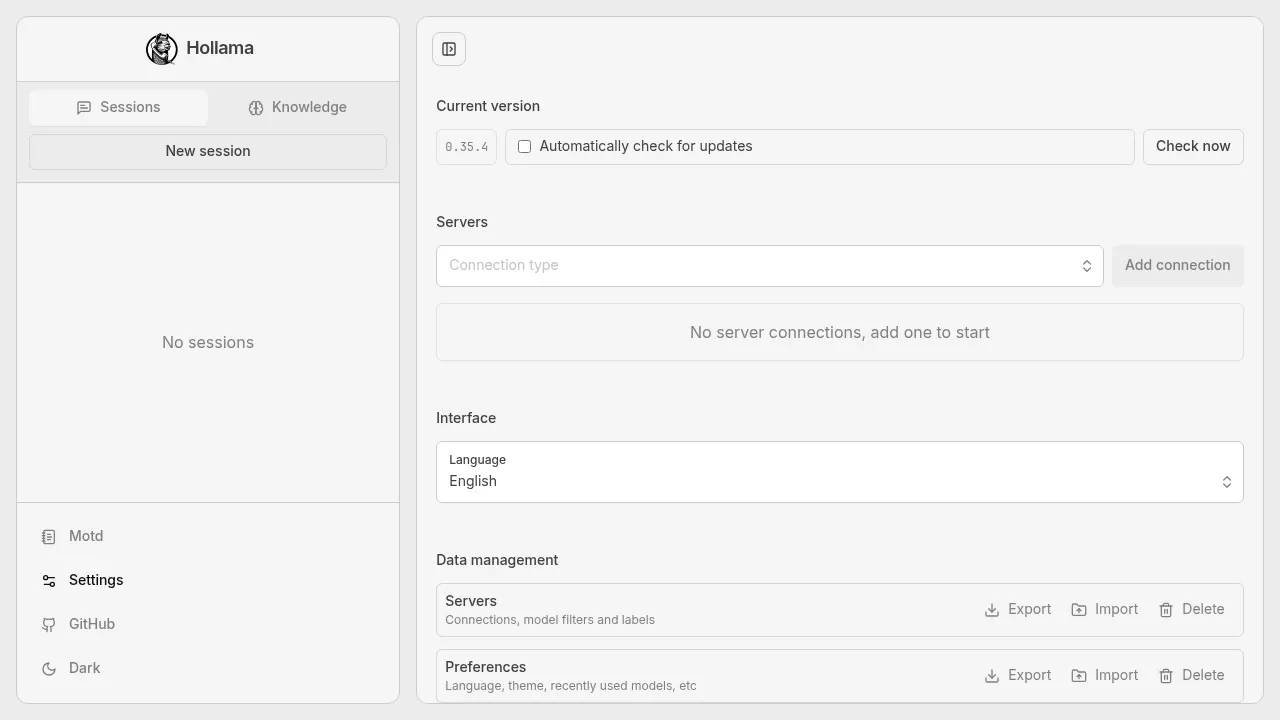
For conversations that include code or technical material, Hollama renders Markdown with syntax highlighting and KaTeX math notation. It includes code editor features, and you can copy a code snippet, a single message or an entire session. Import and export cover stored data, including session history, attachments, custom model settings and the knowledge base. Server connections, model filters and labels are part of its data management settings too.
The live demo requires no sign-up. Hollama also offers downloads for macOS, Windows and Linux, plus Docker self-hosting. Its responsive layout supports different screen sizes, and the interface has multiple languages and light and dark themes. The project uses the MIT license.
Claim this page with an email at hollama.fernando.is. Hollama gets the verified badge, and you can upgrade the listing to be featured on localhosted. Proud to be listed? Put our badge on your site.
Want more people to find Hollama?Promote it
Something wrong or outdated on this page?
1.6KUpdated 1 year agoMIT
Windows · Docker · Web#llama.cpp backend#LM Studio integration#Multimodal input
Amica is a locally runnable interface for talking with customizable 3D AI characters. It's for people who want an animated, voiced character as the face of their AI assistant, with a choice of local LLM backends or cloud services. The project builds on Pixiv's ChatVRM.
41.2KUpdated 1 day agoAGPL-3.0
macOS · Docker · Web#Code execution#Hybrid search#LM Studio integration
14KUpdated 5 months ago
macOS · Windows · Linux · Web#GGUF#LM Studio integration#MCP
Open-LLM-VTuber is a local AI companion for people who want a character they can talk to, with a Live2D avatar that responds through speech and expressions. It runs on Windows, macOS and Linux through web and desktop clients. With local models for speech and language processing, it works fully offline and keeps conversations on your device. Cloud APIs are optional alternatives that send the corresponding processing to external services.
88.8KUpdated 2 months agoMIT
macOS · Windows · Linux · Docker · Web#MCP#Multimodal input#OpenAI-compatible API
47.7KUpdated 1 month agoAGPL-3.0
macOS · Windows · Linux · Docker · Web#GGUF#llama.cpp backend#LoRA
49.8KUpdated 23 hours agoMIT
macOS · Windows · Web#Ollama integration
AstrBot brings AI assistants into messaging apps such as Telegram, Discord, Slack, QQ and WeCom. It's an open source platform under AGPL-3.0 for people building personal companions, customer support bots or team automation. You can run it on your own computer or server, including through Docker, or use its desktop app for browser-style chat.
NextChat is a self-hosted AI chat interface for people who want one place to use their own LLM server and cloud models. The web and desktop project is open source under the MIT license. You can host it with Docker or on Vercel, and desktop clients run on macOS, Windows and Linux.
text-generation-webui, also called TextGen, runs language models on your own hardware through a desktop app or a self-hosted browser interface. It's for people who want private chat and writing tools, and developers who need a local model API. It works offline without telemetry; web search and page fetching use the internet.
AIRI is a self-hosted AI companion for people who want a virtual character they can talk to and play games with. Inspired by Neuro-sama, it combines real-time voice conversation with game integrations for Minecraft and Factorio. The project is in early development; Factorio support is a work in progress with a proof of concept. It's open source under the MIT license.