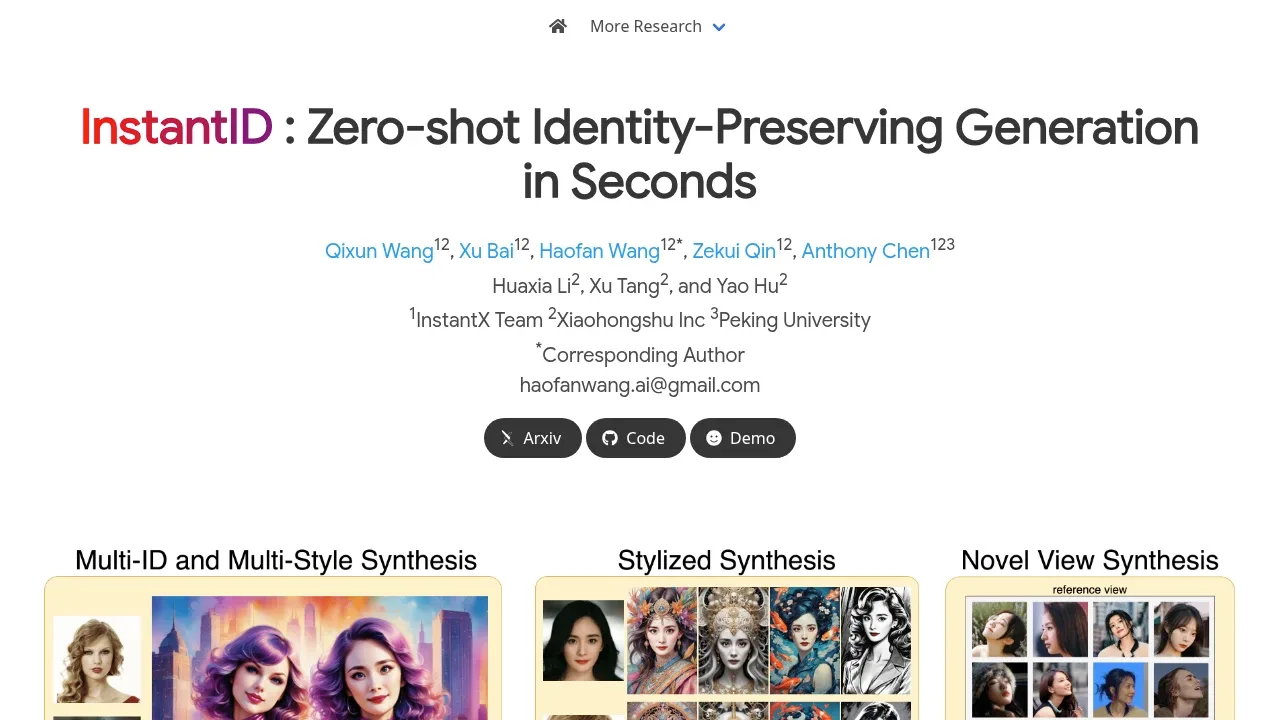
InstantID generates images that retain a person's facial identity from a single reference photo, with text prompts controlling the style and scene. It's for creators and developers who want personalized avatars or portraits without collecting a photo set or training a model for each person. The Python code runs locally and includes a Gradio demo.
Its main distinction is the combination of face resemblance and prompt control. You can ask for realistic or stylized images, change poses, and blend the face into the generated scene. InstantID uses facial information and landmarks to guide a diffusion model while leaving the underlying model's image generation abilities intact.
The released local examples use SDXL through Hugging Face Diffusers. It also works with existing ControlNets, including canny and depth controls, for users who need more control over composition. Multiple reference photos can contribute to the identity representation, though a single image is sufficient. LCM-LoRA and OneDiff provide options for faster generation, and InstantStyle is compatible for style transfer.
The code is open source under Apache 2.0, which permits academic and commercial use. The InsightFace face models it relies on have a separate restriction: they're licensed for non-commercial research only.
Claim this page and we'll verify you by hand. InstantID gets the verified badge, and you can upgrade the listing to be featured on localhosted. Proud to be listed? Put our badge on your site.
Want more people to find InstantID?Promote it
Something wrong or outdated on this page?
6.7KUpdated 2 years agoApache-2.0
#ControlNet#Hugging Face integration#Image-to-image
IP-Adapter lets you guide Stable Diffusion with a reference image while still using text to describe the result you want. It's for artists and developers who want image references in their local AI workflows. The main code and standard adapter weights use Apache 2.0; the separate FaceID variants are restricted to research use.
10.1KUpdated 2 years ago
macOS · Web#Image-to-image#LoRA#Multimodal input
2.7KUpdated 1 year agoApache-2.0
#ControlNet#Hugging Face integration#Image-to-image
InfiniteYou generates images from a reference photo and a text prompt while preserving the person's facial identity. It's a local AI framework for researchers and creators exploring personalized portraits with FLUX, with an official ComfyUI integration for visual workflows.
34.1KUpdated 3 years agoApache-2.0
Web#ControlNet#Hugging Face integration#Image-to-image
53.3KUpdated 1 year agoGPL-3.0
macOS · Windows · Linux · Docker · Web#ControlNet#Image-to-image#Inpainting
4.3KUpdated 10 months ago
Linux · Web#ControlNet#Hugging Face integration#Image-to-image
HunyuanDiT is a text-to-image diffusion transformer for people who want to generate images on their own hardware using Chinese or English prompts. Its focus on Chinese language and cultural references makes it relevant for scenes drawn from poetry, idioms, food and architecture. It also handles long descriptions with details about subjects, clothing, lighting and artistic style.
PhotoMaker generates realistic portraits and stylized images of a person from reference pictures and text prompts. You can run it locally through a Gradio interface, including on macOS, with community implementations for Windows. It's aimed at people creating personalized photos, artwork or avatars who want to retain a person's recognizable features across different scenes.
ControlNet lets you guide Stable Diffusion with visual references, so a generated image can follow a sketch, a person's pose or the geometry of an existing scene. It's for artists and developers who need more control over image structure than a text prompt alone provides. The Python implementation runs on your own hardware and includes Gradio interfaces for its pretrained models.
Fooocus is a free, open-source AI image generator for people who want to create images on their own computer without spending much time tuning settings. It uses Stable Diffusion XL and automatically expands prompts with a local GPT-2 engine. Generation works offline once the required models are downloaded, so prompts and images can stay on your machine.