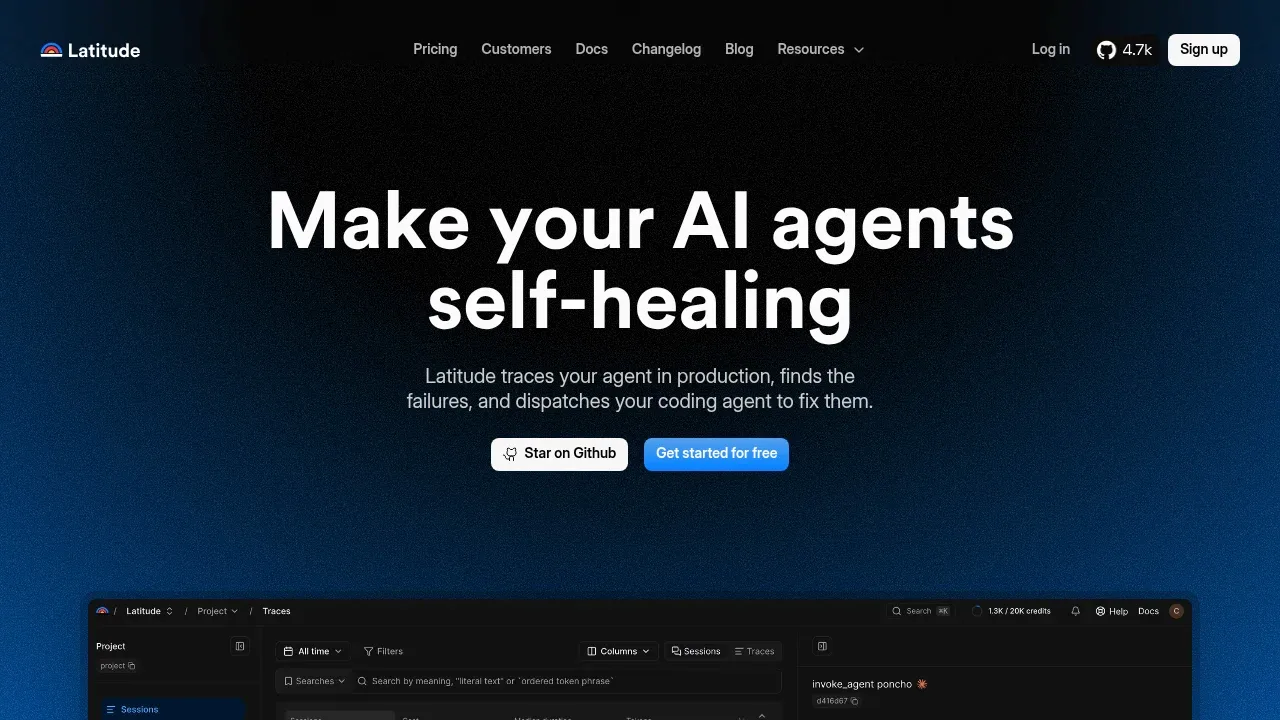
Latitude is a self-hosted AI agent monitoring platform for teams that need to find production failures and check that fixes work. It connects recurring problems to the sessions that caused them, then can dispatch Claude Code or Cursor with enough context to make a fix and open a pull request.
You can run the MIT-licensed software on your own server with Docker Compose or Kubernetes. A hosted service is also available; it stores and processes hosted data in Europe. Self-hosting lets you keep the monitoring infrastructure under your control, while your application's model provider remains a separate choice.
Latitude captures multi-turn conversations, tool calls, errors, costs, and execution paths. It accepts OpenTelemetry traces and works with OpenAI, Anthropic, Bedrock, Vercel AI SDK, and LangChain. Its conversation analysis identifies events such as abandoned sessions, retries, escalations, and tool failures.
Similar failures become tracked issues with examples and trends, so teams can investigate recurring behavior rather than read individual logs. Custom signals track specific failure modes, policies, or quality checks. Alerts reach Slack, email, or webhooks when an issue appears or escalates.
Semantic search and metadata filters help narrow down affected sessions. Teams can annotate traces and outputs, then use validated production traces to build versioned datasets for evaluations and regression tests. Latitude replays fixes against failing traces, and its MCP server and CLI give coding agents access to the workspace's monitoring and project controls.
Claim this page with an email at latitude.so. Latitude gets the verified badge, and you can upgrade the listing to be featured on localhosted. Proud to be listed? Put our badge on your site.
Want more people to find Latitude?Promote it
Something wrong or outdated on this page?
42.4KUpdated 1 day agoApache-2.0
Docker · Web#Guardrails#Human approval#LLM tracing
Agno is a Python framework and runtime for developers building customer-facing or internal AI agents. You can run its agent platform locally with Docker, on your own servers or in your cloud. The open-source framework uses the Apache 2.0 license, and the platform keeps sessions, memory, knowledge and traces in your database.
11.7KUpdated 23 hours ago
Docker · Web#LLM tracing#MCP#Ollama integration
3.3KUpdated 2 weeks agoApache-2.0
Docker · Web#LLM tracing#MCP
Laminar is an open-source platform for developers who need to see why an AI agent failed and check whether a fix worked. You can self-host it with Docker or on Kubernetes, including AWS and GCP, or use its managed cloud service. It uses the Apache 2.0 license.
lunary.aiLLM Evaluation and Testing
Docker · Web#LLM tracing#Multi-user access#Prompt versioning
28.2KUpdated 1 day agoApache-2.0
Docker · Web#Batch processing#LLM tracing#MCP
9.5KUpdated 1 day agoApache-2.0
Docker · Web#Guardrails#MCP#Tool calling
Arize Phoenix is a self-hosted platform for developers who need to understand why an AI agent failed and test changes before shipping them. It runs on a laptop, in Docker, or on Kubernetes. Self-hosting keeps traces on your infrastructure; Phoenix Cloud provides a hosted alternative. Phoenix uses the Elastic License 2.0 (ELv2), a source-available license.
Lunary is a self-hosted LLM observability and prompt management platform for teams building chatbots and AI agents. It brings production traces, user conversations and prompt versions into one place so developers can investigate errors and teams can assess response quality. You can host it in your own infrastructure or use its cloud service.
MLflow brings agent tracing, LLM evaluation, and model experiment tracking into a platform you can run locally or on your own servers. It's for developers and teams who need to understand failures, compare changes, and monitor AI applications in production. It's open source under Apache 2.0.
Higress is a self-hosted AI gateway for developers and teams managing model APIs and the tools their AI agents call. It puts LLM traffic and MCP servers behind a shared entry point, with authentication, traffic controls and monitoring. The open-source edition uses the Apache 2.0 license and runs locally in Docker without registration. Alibaba Cloud also offers a fully managed gateway.