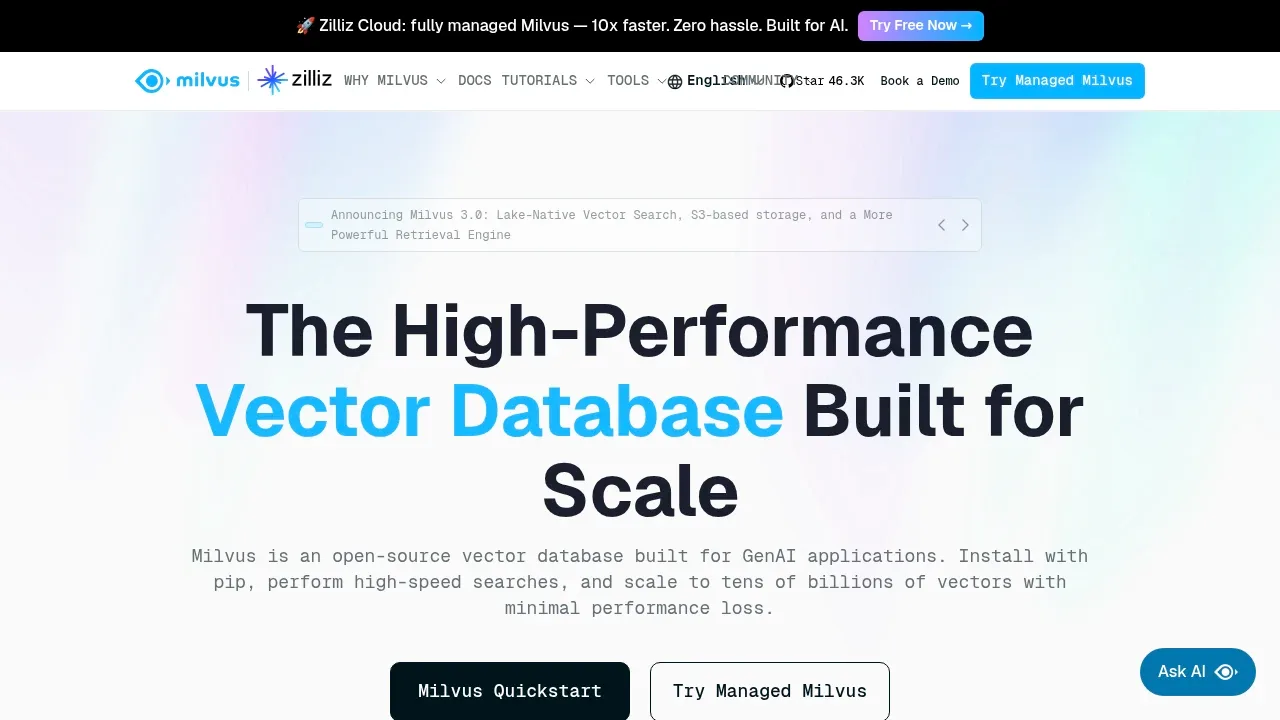
Milvus is an open-source vector database for developers building RAG applications, image search and recommendation systems. It stores embeddings alongside metadata so applications can retrieve related text, images or multimodal data. You can run it on your own hardware, from a laptop prototype to a distributed production cluster.
Milvus Lite runs as a Python library in notebooks and on laptops, with data persisted in a local file. Standalone provides a complete database on one machine. Distributed deployments use Kubernetes and separate compute from storage, so teams can expand read and write capacity independently as workloads grow.
Search combines semantic matching with native BM25 full-text retrieval. Milvus also supports sparse embeddings such as SPLADE and BGE-M3, metadata filters and multi-vector search. These capabilities let developers combine keyword relevance with embedding similarity and restrict results using fields stored alongside the vectors.
For larger workloads, Milvus supports CPU and GPU acceleration, including NVIDIA CAGRA indexing. Its index choices include HNSW and DiskANN. Streaming updates keep searchable data fresh, while replicas support fault tolerance. Teams sharing a cluster can isolate tenants, and hot/cold storage places frequently accessed data in memory or on SSDs.
Milvus uses the Apache 2.0 license. Zilliz Cloud offers a separate managed service, with hosted deployments and an option to run in your own cloud account.
Claim this page with an email at milvus.io. Milvus gets the verified badge, and you can upgrade the listing to be featured on localhosted. Proud to be listed? Put our badge on your site.
Want more people to find Milvus?Promote it
Something wrong or outdated on this page?
23.2KUpdated 1 day ago
macOS · Windows · Linux · Docker#Semantic search
pgvector adds vector storage and similarity search to Postgres, so developers can keep embeddings alongside application records in a self-hosted database. It suits applications that need to find similar items while retaining SQL queries, joins and transactional guarantees. It runs on Linux, macOS and Windows, with Docker also supported.
4.7KUpdated 1 week agoApache-2.0
macOS · Windows · Linux · Docker#Hybrid search#Reranking#Semantic search
26.6KUpdated 6 days agoGPL-3.0
macOS · Linux · Docker#Hybrid search#Multimodal input#RAG
3.1KUpdated 3 weeks agoPostgreSQL
macOS · Linux · Docker#Semantic search
pgvectorscale adds an index for large embedding datasets to PostgreSQL databases that use pgvector. It's for application developers and database administrators who want to keep AI similarity search in their existing database, with more control over search speed and storage use.
8.2KUpdated 4 months agoApache-2.0
macOS · Windows · Linux · Web#Semantic search
sqlite-vec adds vector storage and similarity search to SQLite, so developers can keep embeddings alongside application data in a local database. It's for applications that need to find related items by vector distance without running a separate vector database server. The extension is small, written in C and has no dependencies.
7.1KUpdated 1 day agoApache-2.0
Linux#Hybrid search#RAG#Semantic search
Infinity is a self-hosted database for developers building search and retrieval-augmented generation (RAG) into LLM applications. It combines embedding search with full-text search and structured filters, so an application can retrieve relevant records through both meaning and exact terms.
Typesense combines typo-tolerant site search with vector and semantic search in a self-hosted engine. It's for developers building searchable apps, product catalogs or AI search over their own data. The C++ engine uses an in-memory architecture for low-latency results as users type.
Vespa is a self-hosted AI search platform for developers building search, RAG, and recommendation systems over large, changing datasets. It combines retrieval with machine-learned ranking, so an application can find candidate results and evaluate their relevance in the same platform. The code is open source under Apache 2.0. You can run it on your own servers or use the managed Vespa Cloud service, where applications run in the cloud.