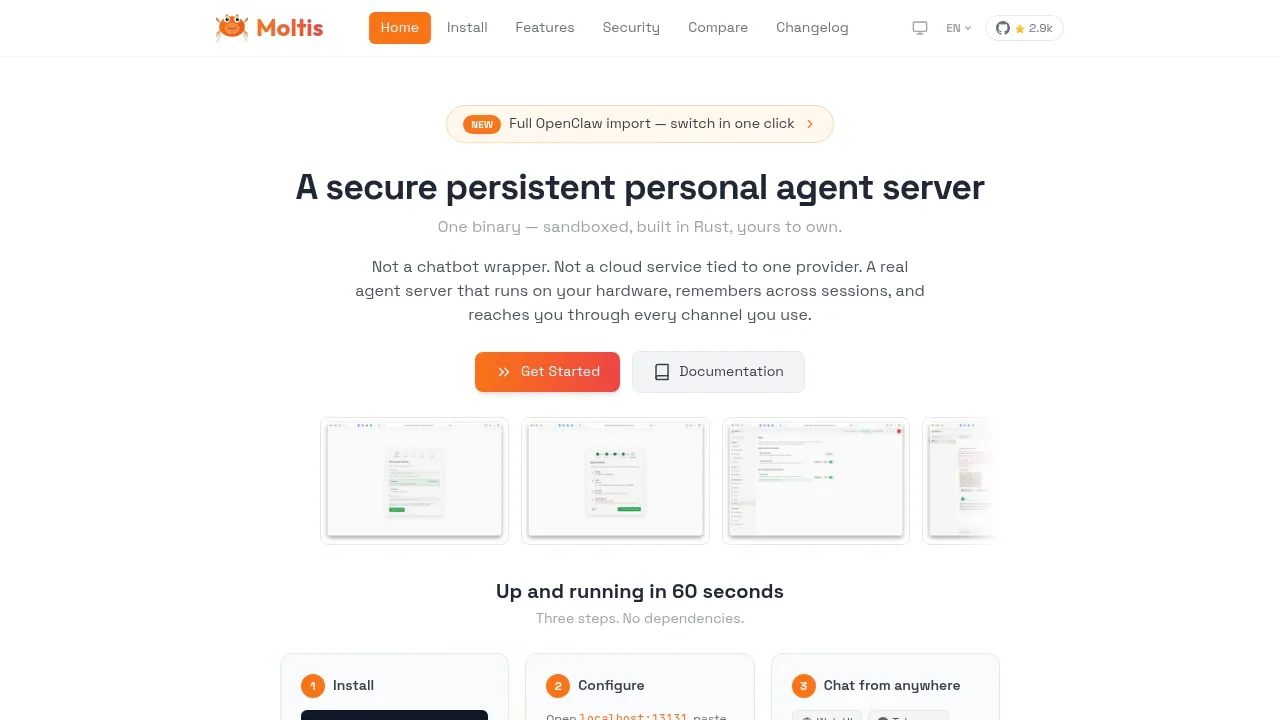
Moltis is a self-hosted personal AI agent server for people who want an assistant that remembers past conversations and can act on their behalf. It runs on your own hardware as a single Rust binary, with a browser interface and access through messaging apps. It's open source under the MIT license.
You can use Ollama, LM Studio or local GGUF models, including CPU and GPU execution and MLX on Apple Silicon. It also connects to Anthropic, OpenAI, Google Gemini and OpenAI-compatible services. The server and persistent memory run on your host; choosing a cloud model or cloud voice provider sends requests to that service. Moltis runs on macOS, Linux and Windows, supports Docker deployment, and can also run on a cloud host you control.
Its tools cover recurring tasks described in natural language, browser automation, and CalDAV calendar events and reminders. Memory combines semantic and full-text search for recall across sessions. Voice input and spoken replies work with local or cloud providers, while Telegram, WhatsApp, Discord, Slack, Matrix, Nostr and Microsoft Teams give you other ways to reach the agent.
Tool execution uses sandbox isolation by default, with permission controls for actions and filesystem access. Passwords, passkeys and scoped API keys protect access, and an encrypted vault stores credentials. MCP support connects additional tools; skills and hooks let you extend behavior. An OpenClaw import brings over conversations, skills and settings without modifying the original workspace.
Claim this page with an email at moltis.org. Moltis gets the verified badge, and you can upgrade the listing to be featured on localhosted. Proud to be listed? Put our badge on your site.
Want more people to find Moltis?Promote it
Something wrong or outdated on this page?
2.5KUpdated 23 hours agoMIT
Windows · Linux · Docker · Web#Agent Skills#Code execution#Guardrails
Bitterbot is a local-first personal AI agent for people who want an assistant that remembers ongoing projects and preferences across conversations. It runs on your own device or server, with a browser dashboard for chatting, reviewing memory activity and managing skills. It's open source under the MIT license.
203Updated 4 days ago
Linux · Docker · Web#Code execution#Guardrails#Human approval
Frona is a self-hosted AI assistant for people who want agents to carry out tasks with controlled access to their servers, files, and accounts. Its agents can browse websites, run code, build applications, and delegate work to other agents. You interact through chat, while sandboxes restrict what each agent can access.
6.7KUpdated 1 month agoApache-2.0
macOS · Windows · Linux · Web#Agent Skills#Code execution#Multi-agent workflows
18.2KUpdated 5 months agoApache-2.0
macOS · Windows · Linux · Docker · Web#Guardrails#Human approval#Knowledge graphs
886Updated 2 weeks agoMIT
macOS · Windows · Linux · Docker · Web#Agent Skills#Code execution#Guardrails
6.1KUpdated 1 week agoMIT
macOS · Windows · Linux#Agent Skills#Batch processing#Code execution
HanaAgent is an open source personal AI agent for everyday computer work, with a graphical interface, persistent memory and customizable personalities. It runs on macOS (Apple Silicon and Intel), Windows and Linux, and suits people who want help with office tasks as well as coding.
OpenFang runs scheduled AI agents on your own machine, with built-in task packages called Hands that report results to a dashboard. It's for people who want recurring research, monitoring or business tasks to continue without prompting an agent each time. The open source platform runs on macOS, Windows and Linux under the Apache 2.0 license.
PocketPaw is a self-hosted AI agent for people who want a personal assistant that can work with files, write code and use a browser on their own computer or server. It runs on macOS, Windows and Linux, with a web dashboard and access through messaging apps. It is open source under the MIT license.
LobsterAI is an open-source desktop AI agent from NetEase Youdao, built on OpenClaw. It runs on macOS, including Apple Silicon and Intel Macs, and Windows. It's for people who want an assistant to work directly with their files, browser and local projects, with remote control through familiar chat apps.