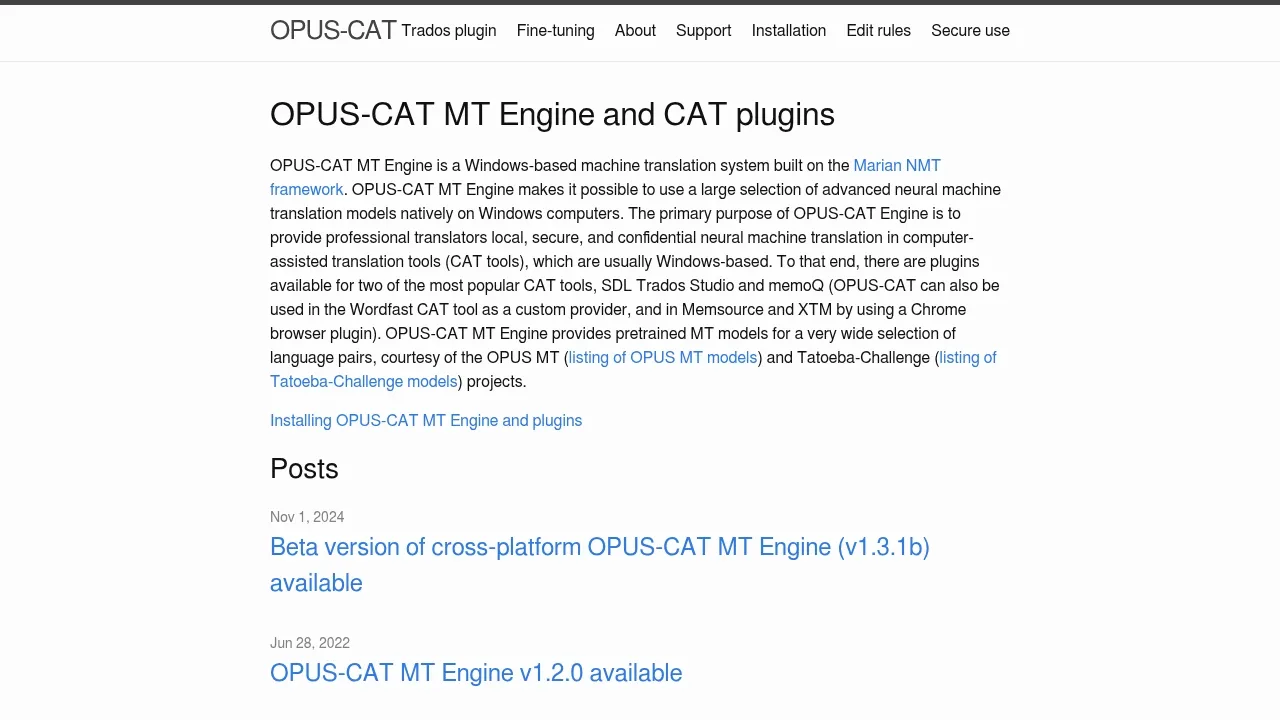
OPUS-CAT runs neural machine translation locally on Windows for professional translators who work in computer-assisted translation (CAT) tools. Its offline engine keeps translation processing on the user's computer, so translators can use machine translation for confidential text without sending it to a cloud translation service.
The engine connects to existing translation software. Dedicated plugins support SDL Trados Studio and memoQ, while Wordfast can use it as a custom translation provider. A Chrome browser plugin connects the local engine to Memsource and XTM. Those browser integrations provide access from web-based CAT tools; the translation engine itself runs locally.
Built on Marian NMT, OPUS-CAT uses pretrained models supplied by the OPUS-MT and Tatoeba-Challenge projects. These cover a wide range of language pairs, giving translators a choice of models for their working languages. The focus is machine translation within a professional translation workflow, with model output available through the CAT software where translators already work.
You can also test a downloaded model in the engine's own text translation window before connecting a CAT tool. OPUS-CAT is open source under the MIT license. Its established workflow is on Windows; a cross-platform beta also runs on macOS and Linux, with the same translation functions and a different interface.
Claim this page and we'll verify you by hand. OPUS-CAT gets the verified badge, and you can upgrade the listing to be featured on localhosted. Proud to be listed? Put our badge on your site.
Want more people to find OPUS-CAT?Promote it
Something wrong or outdated on this page?
21.8KUpdated 1 week agoMIT
macOS · Windows · Linux#Hugging Face integration#Multilingual#Speaker diarization
Buzz transcribes and translates speech on your own computer using OpenAI's Whisper. It's for people who need transcripts or subtitles from recordings, plus live captions from a microphone. Local transcription works offline; the optional OpenAI Whisper API sends audio to a cloud service.
796Updated 2 weeks agoMIT
macOS · Windows · Linux#llama.cpp backend#LM Studio integration#Multilingual
19.2KUpdated 2 days agoGPL-3.0
macOS · Windows · Linux · Docker · Web#Batch processing#Human approval#Multilingual
14.4KUpdated 1 day agoMIT
macOS · Windows · Linux#Batch processing#LM Studio integration#Multilingual
7.7KUpdated 4 weeks agoMIT
macOS · Windows · Linux#Batch processing#Multilingual#Ollama integration
20.3KUpdated 4 days agoApache-2.0
macOS · Windows · Linux · Docker · Web#Batch processing#Multilingual#Voice cloning
Interpreter reads Japanese text from game windows and displays English translations over your screen. It's built for people playing Japanese retro games, with MeikiOCR tuned for game text and pixel fonts. The default OCR and Sugoi V4 translation models run locally, so text stays on your computer and no internet connection is needed after setup. It's open source under the MIT license, with support for Windows, macOS and Linux.
pyVideoTrans translates spoken audio into another language and produces a video with translated subtitles and AI dubbing. It's for people adapting videos for audiences in other languages who want control over which parts run locally. It recognizes speech directly, so the original video doesn't need subtitles.
Subtitle Edit is an MIT-licensed subtitle editor for Windows, macOS and Linux. It's for people creating captions, translating dialogue or fixing subtitles that don't match the video. Its core editing, conversion and video playback work offline on your device, with optional AI tools for transcription and translation.
Vibe is an open source desktop app for people who need transcripts or subtitles without uploading their recordings to a transcription service. It runs on macOS, Windows and Linux under the MIT license. Audio transcription works fully offline, with processing on your own computer.
ebook2audiobook turns non-DRM ebooks into narrated audio with chapters and metadata, for readers who want audio editions of their own books. It runs locally on Windows, macOS and Linux, with Docker support and a browser interface built with Gradio. It's open source under Apache 2.0.