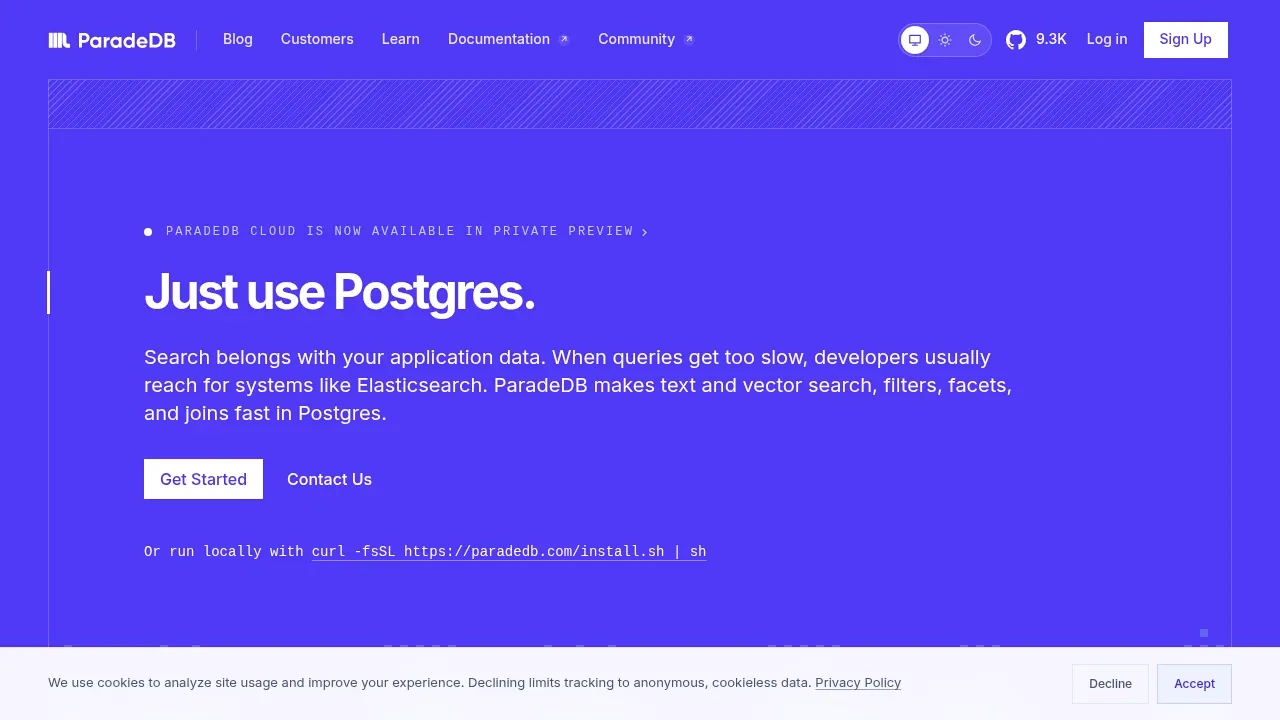
ParadeDB adds full-text, vector and hybrid search to the Postgres database that holds your application data. It's for developers who need search and analytics without maintaining a separate Elasticsearch cluster or synchronizing a second copy of their data. It runs as the pg_search extension in self-managed Postgres, including local Docker deployments.
Search uses standard SQL, so you can combine ranked results with joins, filters and existing database logic. Full-text capabilities include tunable BM25 scoring, typo tolerance, highlighting, phrase matching, fuzzy search, proximity queries and regex queries. Vector retrieval and hybrid search support searches that combine lexical and semantic relevance. Facets and aggregations let applications group results and calculate metrics alongside retrieval.
The index combines inverted, vector and columnar structures within Postgres. Rust libraries Tantivy and Apache DataFusion provide search and analytical processing. Application data stays in your database, with ACID transactions and read-after-write guarantees; search doesn't require a sidecar process, an external cluster or schema changes.
ParadeDB is open source under AGPL-3.0, with community and enterprise self-managed offerings. It works with Drizzle, Django, SQLAlchemy, Rails and EF Core. For AI development workflows, it also provides agent skills, an MCP integration and a Cursor plugin.
Claim this page with an email at paradedb.com. ParadeDB gets the verified badge, and you can upgrade the listing to be featured on localhosted. Proud to be listed? Put our badge on your site.
Want more people to find ParadeDB?Promote it
Something wrong or outdated on this page?
13KUpdated 21 hours agoApache-2.0
Docker#Agent Skills#Hugging Face integration#Knowledge graphs
txtai is a Python framework for developers building search applications, chat with their data, and AI agents on their own hardware or servers. Its embeddings database combines sparse and dense vector search with graphs and relational data, so the same system can find related content and supply context to language models. It's open source under Apache 2.0.
4.7KUpdated 1 week agoApache-2.0
macOS · Windows · Linux · Docker#Hybrid search#Reranking#Semantic search
Infinity is a self-hosted database for developers building search and retrieval-augmented generation (RAG) into LLM applications. It combines embedding search with full-text search and structured filters, so an application can retrieve relevant records through both meaning and exact terms.
5KUpdated 6 months agoApache-2.0
Docker#Hugging Face integration#Multimodal input#RAG
Marqo Open Source is a self-hosted search engine for developers building semantic document search, image search, or retrieval for AI applications. It handles embedding generation alongside storage and retrieval, so applications can submit documents without maintaining a separate embedding service. The open-source project is deprecated and no longer receives updates.
23.2KUpdated 1 day ago
macOS · Windows · Linux · Docker#Semantic search
pgvector adds vector storage and similarity search to Postgres, so developers can keep embeddings alongside application records in a self-hosted database. It suits applications that need to find similar items while retaining SQL queries, joins and transactional guarantees. It runs on Linux, macOS and Windows, with Docker also supported.
3.1KUpdated 3 weeks agoPostgreSQL
macOS · Linux · Docker#Semantic search
pgvectorscale adds an index for large embedding datasets to PostgreSQL databases that use pgvector. It's for application developers and database administrators who want to keep AI similarity search in their existing database, with more control over search speed and storage use.
34.9KUpdated 4 weeks agoApache-2.0
Docker · Web#Agent Skills#Hybrid search#RAG
Qdrant is a self-hosted vector database for developers building semantic search, retrieval-augmented generation (RAG), recommendations and AI agent memory. It stores embeddings alongside JSON metadata, so applications can find similar content while restricting results by attributes such as location, text or numeric ranges. The Rust engine is open source under Apache 2.0 and runs locally in Docker or on your own servers.