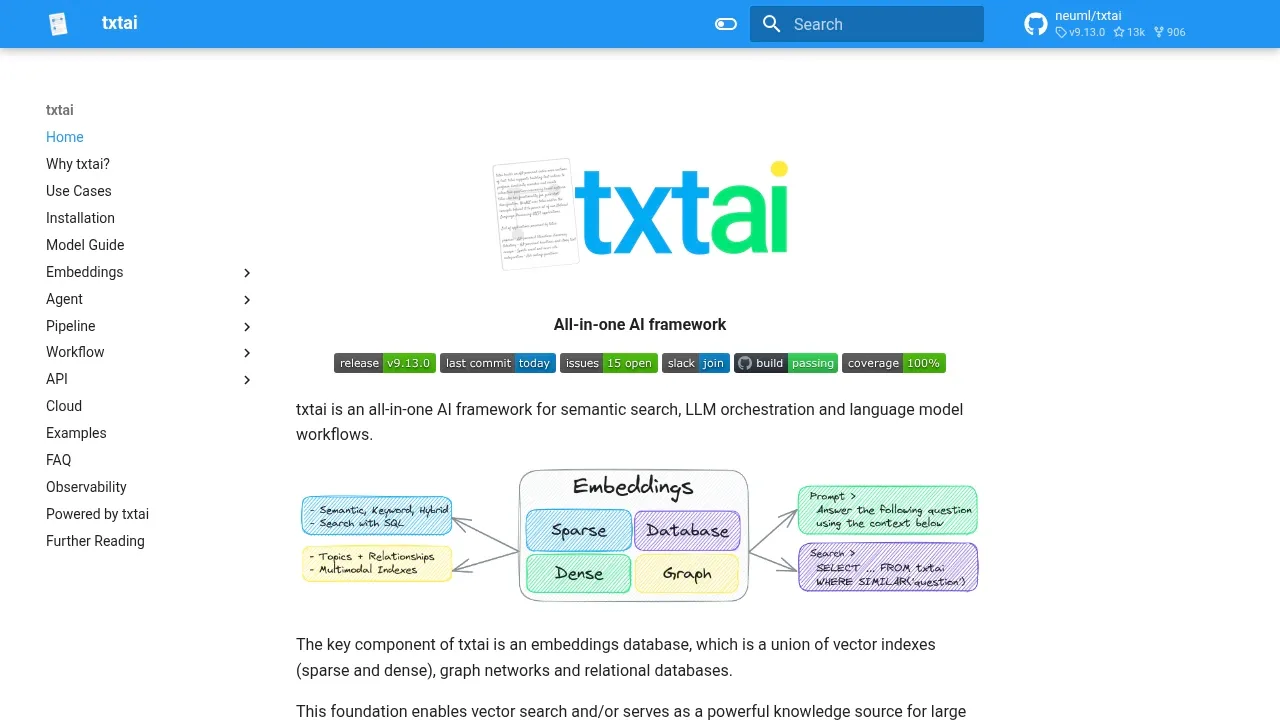
txtai is a Python framework for developers building search applications, chat with their data, and AI agents on their own hardware or servers. Its embeddings database combines sparse and dense vector search with graphs and relational data, so the same system can find related content and supply context to language models. It's open source under Apache 2.0.
Semantic search finds results by meaning rather than requiring matching keywords. txtai supports SQL queries, object storage, topic modeling and graph analysis, and can index text, documents, audio, images and video. It can also place images and text in a shared search space.
Model pipelines handle question answering, summarization, transcription, translation and text-to-speech. Workflows connect these tasks and combine specialized smaller models with LLMs. Agents built on smolagents can use the database, pipelines, workflows and other agents to carry out tasks.
You can run models locally with Hugging Face or llama.cpp and keep data within your deployment instead of sending it to remote services. Models can load from local directories or the Hugging Face Hub. LiteLLM also connects to cloud services such as OpenAI, Claude and AWS Bedrock; those calls use remote providers.
txtai runs locally or in Docker and can scale through container orchestration. Its web and Model Context Protocol (MCP) APIs expose applications to other software, with language bindings for JavaScript, Java, Rust and Go.
Claim this page and we'll verify you by hand. txtai gets the verified badge, and you can upgrade the listing to be featured on localhosted. Proud to be listed? Put our badge on your site.
Want more people to find txtai?Promote it
Something wrong or outdated on this page?
26.6KUpdated 1 day agoApache-2.0
Docker#Guardrails#Hugging Face integration#Hybrid search
Haystack is a Python framework for developers building self-hosted AI agents, document search, and apps that answer questions using their own data. Its modular pipelines let teams control which information reaches a model and inspect how retrieval, memory, tools, and generation contribute to an answer. It's open source under Apache 2.0.
155.4KUpdated 1 day agoMIT
macOS · Windows · Docker · Web#LLM tracing#MCP#Multi-agent workflows
38.4KUpdated 4 days agoMIT
#Code execution#MCP#Multimodal input
13.2KUpdated 1 day agoApache-2.0
#MCP#Ollama integration#RAG
9.7KUpdated 9 months agoMIT
#Ollama integration#RAG#Semantic search
4.4KUpdated 1 day agoMIT
#Human approval#Multi-agent workflows#Multimodal input
Langflow is a visual builder for developers creating AI agents and retrieval-augmented generation (RAG) applications. You can run it locally or on your own server, with Docker support and desktop apps for Windows and macOS. The open-source software uses the MIT license. A hosted cloud offering provides a separate deployment option.
DSPy is a Python framework for developers building AI applications whose tasks need clear inputs, predictable output types, and measurable results. You define what a language model should produce, then compose those tasks into a larger program. It's open source under the MIT license.
LangChain4j is an Apache 2.0 open-source Java library for developers building chatbots, assistants and AI agents in JVM applications. It connects application code to local LLM backends such as Ollama as well as cloud providers such as OpenAI and Google Vertex AI. Where model requests go depends on the backend you choose.
LangChainGo is a Go implementation of LangChain for developers building LLM applications in their own software. It connects Go programs to model backends, including Ollama for local LLM use and cloud services such as OpenAI and Gemini. It's a library, so its audience is developers who want to build an application rather than use a ready-made chat interface.
RubyLLM is an MIT-licensed AI framework for developers building Ruby and Rails applications with local or hosted models. Its shared API lets an application switch between Ollama, cloud providers such as Anthropic and OpenAI, and OpenAI-compatible endpoints without rewriting its model integration. The framework runs in your application; model processing happens at the local or hosted backend you choose.