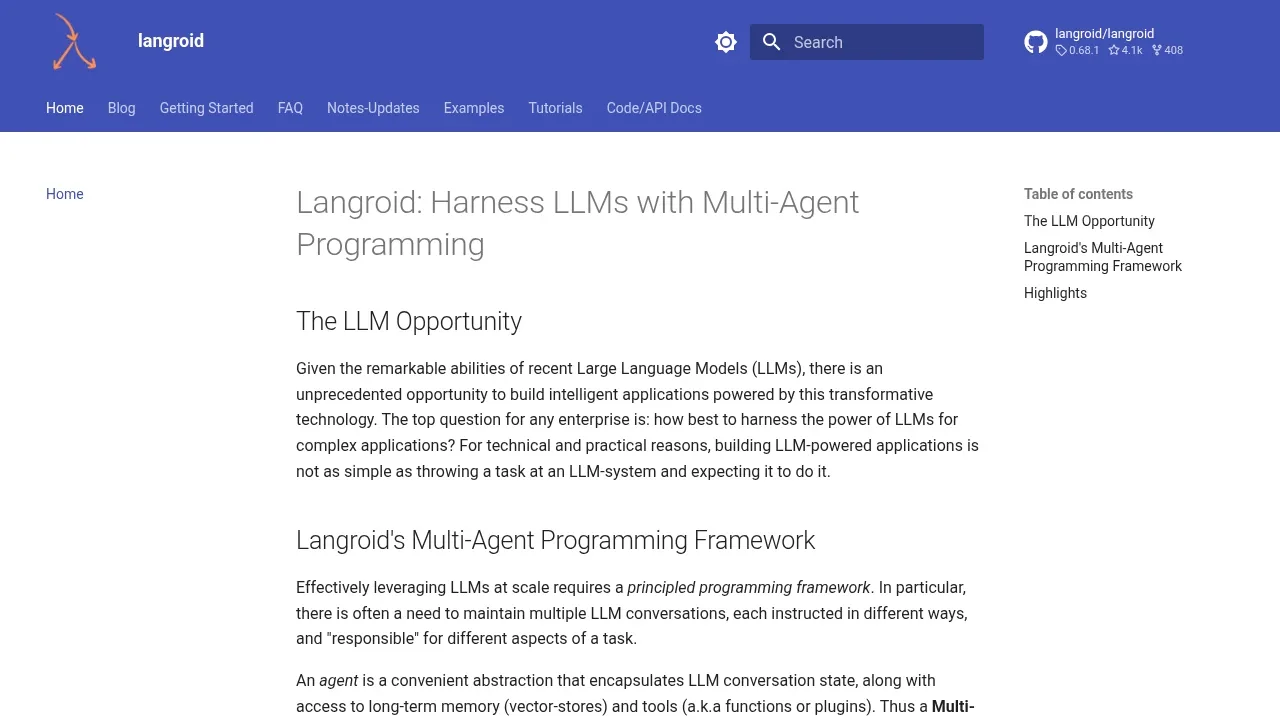
Langroid is a Python framework for developers building applications where several AI agents share a task. Each agent can keep its own conversation, use tools, and retrieve documents, while delegating work to other agents. It's open source under the MIT license.
You can run its agents with a local LLM through Ollama or oobabooga, or connect them to OpenAI and other remote providers through LiteLLM. Local model servers handle inference on your hardware; remote APIs send model requests to the chosen provider. A documented Mistral example extracts structured information from documents using only a local model.
Its main distinction is the way it organizes work around reusable agents and tasks. Developers can give agents separate responsibilities and combine them into larger workflows. The architecture draws on the Actor Framework and doesn't depend on LangChain or another LLM framework.
Document question answering includes retrieval and citations to supporting excerpts. Supported vector stores include Qdrant, Chroma, LanceDB, and Milvus. Dedicated agents cover document chat and SQL, alongside structured information extraction.
Agents can call OpenAI functions, use Langroid's own tool interface with other models, or access MCP server tools. Pydantic validates tool inputs and lets the model correct malformed responses. Langroid also caches prompts and responses with Redis and records agent interactions with message provenance, so developers can trace where an answer came from.
Claim this page and we'll verify you by hand. Langroid gets the verified badge, and you can upgrade the listing to be featured on localhosted. Proud to be listed? Put our badge on your site.
Want more people to find Langroid?Promote it
Something wrong or outdated on this page?
26.6KUpdated 10 hours agoApache-2.0
Docker#Guardrails#Hugging Face integration#Hybrid search
Haystack is a Python framework for developers building self-hosted AI agents, document search, and apps that answer questions using their own data. Its modular pipelines let teams control which information reaches a model and inspect how retrieval, memory, tools, and generation contribute to an answer. It's open source under Apache 2.0.
3.9KUpdated 1 week agoApache-2.0
Docker · Web#Distributed execution#LoRA#MCP
13KUpdated 1 day agoApache-2.0
Docker#Agent Skills#Hugging Face integration#Knowledge graphs
38.5KUpdated 22 hours agoMIT
#Code execution#MCP#Multimodal input
6.5KUpdated 17 hours agoApache-2.0
Web#LLM tracing#Multimodal input#Ollama integration
147.4KUpdated 12 hours agoMIT
#Human approval#RAG#Streaming inference
LazyLLM is a Python framework for developers building multi-agent applications with locally deployed models or cloud services. It combines application assembly with data preparation, evaluation and model fine-tuning, so developers can test a prototype and improve the parts that perform poorly. It's open source under Apache 2.0.
txtai is a Python framework for developers building search applications, chat with their data, and AI agents on their own hardware or servers. Its embeddings database combines sparse and dense vector search with graphs and relational data, so the same system can find related content and supply context to language models. It's open source under Apache 2.0.
DSPy is a Python framework for developers building AI applications whose tasks need clear inputs, predictable output types, and measurable results. You define what a language model should produce, then compose those tasks into a larger program. It's open source under the MIT license.
Genkit is Google's open-source framework for developers building AI applications and agents with local or cloud models. Its shared API connects to Ollama as well as hosted providers such as Gemini, OpenAI and Anthropic. You can host the application logic yourself. The framework uses the Apache 2.0 license.
LangChain is an MIT-licensed open-source framework for developers building AI agents and applications powered by LLMs. It provides a shared interface for models, tools and data connections, so developers can change providers or test workflows without rebuilding the whole application.