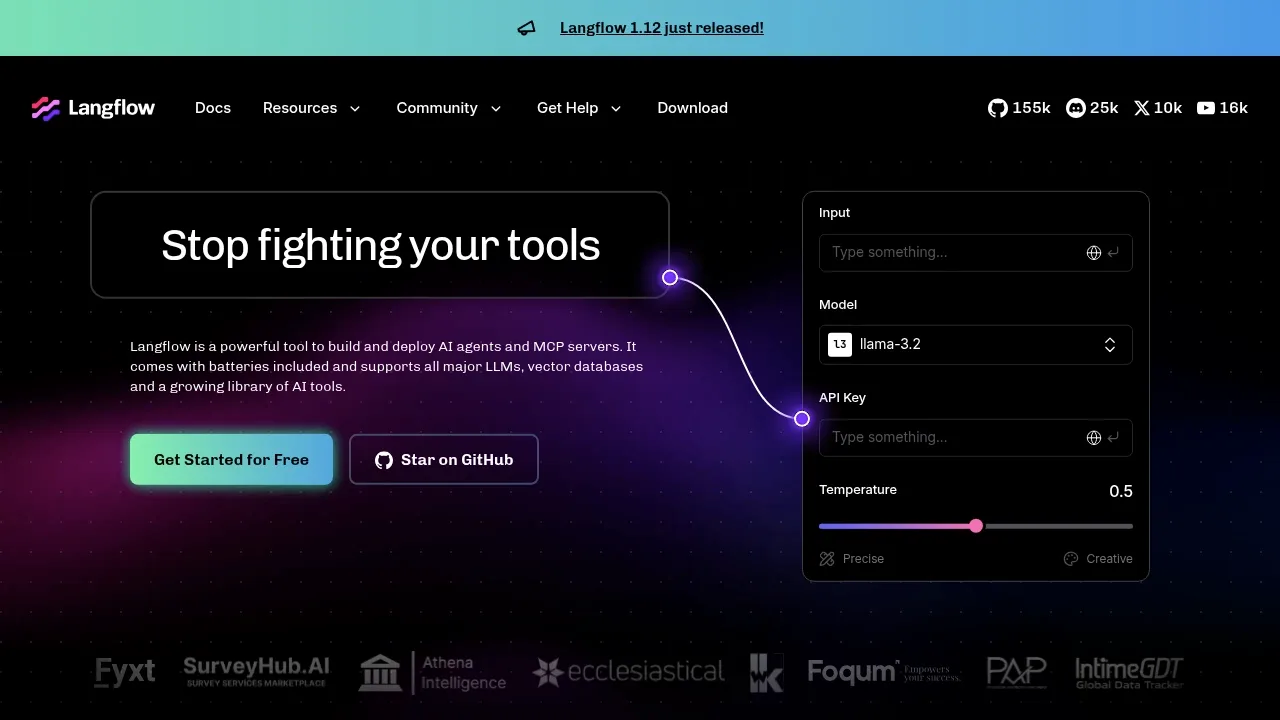
Langflow is a visual builder for developers creating AI agents and retrieval-augmented generation (RAG) applications. You can run it locally or on your own server, with Docker support and desktop apps for Windows and macOS. The open-source software uses the MIT license. A hosted cloud offering provides a separate deployment option.
Its drag-and-drop editor connects models, data sources and tools into workflows. Prebuilt components and reusable flows give you a starting point, while Python customization lets you change components when the visual editor doesn't cover your needs. An interactive playground lets you test flows and inspect their behavior step by step.
Model choice stays flexible. Langflow connects to Ollama for local LLM use and to cloud providers including OpenAI, Anthropic and Amazon Bedrock. Retrieval workflows can use vector stores such as Qdrant, Milvus and Weaviate, alongside data integrations including Google Drive and Confluence. Running the builder locally is separate from choosing a local or cloud model backend.
You can build a single agent or coordinate multiple agents with conversation management and retrieval. Agents can use workflow components as tools. Built-in API and MCP servers expose flows to other applications and MCP clients, so the same visual workflow can become part of an existing app. Flows also export as JSON for Python applications, and LangSmith and LangFuse integrations support observability.
Claim this page with an email at langflow.org. Langflow gets the verified badge, and you can upgrade the listing to be featured on localhosted. Proud to be listed? Put our badge on your site.
Want more people to find Langflow?Promote it
Something wrong or outdated on this page?
55.5KUpdated 2 months ago
Docker · Web#Human approval#LLM tracing#Multi-agent workflows
Flowise is a visual builder for AI agents and chatbots that can run locally or on your own server, including through Docker. It's for developers and teams building LLM applications with connected workflow blocks. The project is archived and no longer maintained.
12KUpdated 1 week agoApache-2.0
Docker · Web#Batch processing#Human approval#Multi-agent workflows
157.6KUpdated 3 hours ago
Docker · Web#Code execution#MCP#OpenAI-compatible API
18.3KUpdated 24 hours agoMIT
macOS · Windows · Linux · Docker · Web#Human approval#Hybrid search#llama.cpp backend
91.5KUpdated 7 hours agoApache-2.0
macOS · Windows · Linux · Docker#Hybrid search#MCP#Multi-agent workflows
20.1KUpdated 2 days agoMIT
macOS · Linux · Docker · Web#Code execution#llama.cpp backend#OpenAI-compatible API
Bisheng is an open source, self-hosted platform for teams building AI applications around business documents and processes. Its visual workflow editor combines automated tasks with human feedback, including intervention during multi-turn conversations. It's suited to document review, support ticket assistance and report generation that need more control than a single chatbot exchange.
Dify is a source-available platform for teams building AI agents and apps on a visual canvas. Its Community Edition runs on your own server with Docker. Dify also offers a hosted cloud service, while Enterprise deployments can run in a VPC or on a self-hosted server. The Community Edition uses a custom Apache 2.0 derivative license.
DocsGPT is an MIT-licensed, open-source platform for teams that want AI search, assistants and agents over their own documents. It can run on your servers with local models, including fully air-gapped deployments where documents and questions stay inside your network. Answers include the source title and page number so readers can check the evidence.
RAGFlow is an Apache 2.0 licensed RAG engine for teams building AI agents that need to answer questions from their own documents. It can run on a self-hosted server through Docker on Windows, macOS or Linux. A separate hosted cloud service is available.
DB-GPT is a self-hosted AI data assistant for teams analyzing business data and developers building data applications. It turns plain-language requests into SQL queries and Python analysis, then produces charts, dashboards, or HTML reports. You can run it on macOS or Linux, with Docker deployment also supported.